Some links on this page are affiliate links: if you book through them, we may earn a commission at no extra cost to you. How this works
São Bento station is two things at once, and visitors tend to notice only one. It is a working railway terminus in the middle of Porto, where the trains for the Douro Valley, Braga, Guimarães and Aveiro start. It is also a hall lined with about twenty thousand painted tiles, the work of Jorge Colaço, that set the history of Portugal and the history of transport across its walls.
The station was inaugurated on 5 October 1916 on the site of a convent, to a design by the Porto architect José Marques da Silva. Its hall is rated 4.7 out of 5 from 1,119 reviews, and the tiles are what reviewers mention most. It stands on Praça de Almeida Garrett, 310 m from the cathedral and 340 m from the Clérigos Tower, so it falls on almost any walk through the centre.
Two guided walks through the historic centre, three hours each.
 Most reviewed
Porto: 3-Hour Guided City Highlights Walking Tour
The highlights of the centre with a guide
 Historic centre
What the walls show
The mistake is to take one photograph of the whole wall and move on. The São Bento station tiles are arranged in bands, one above the other, and each band has its own subject. The large panels are painted in blue and white and show scenes from the history of Portugal, set among landscapes and scenes of country life. Above them runs a frieze in colour that sets out a chronology of the ways people have travelled.
Jorge Colaço (1864-1942) painted them. He trained in Paris and was already admired as a painter when he turned to large compositions in tile, and the hall was not treated as a place for repeated factory patterns: every panel is a picture composed for its wall.
The state heritage register counts about twenty thousand tiles. The railway company that owns the building puts the number at 22,000. Either way the walls of the hall are covered entirely, and visitors notice: the tiles come up in their reviews more than anything else, and the history of Portugal is the next most common subject.
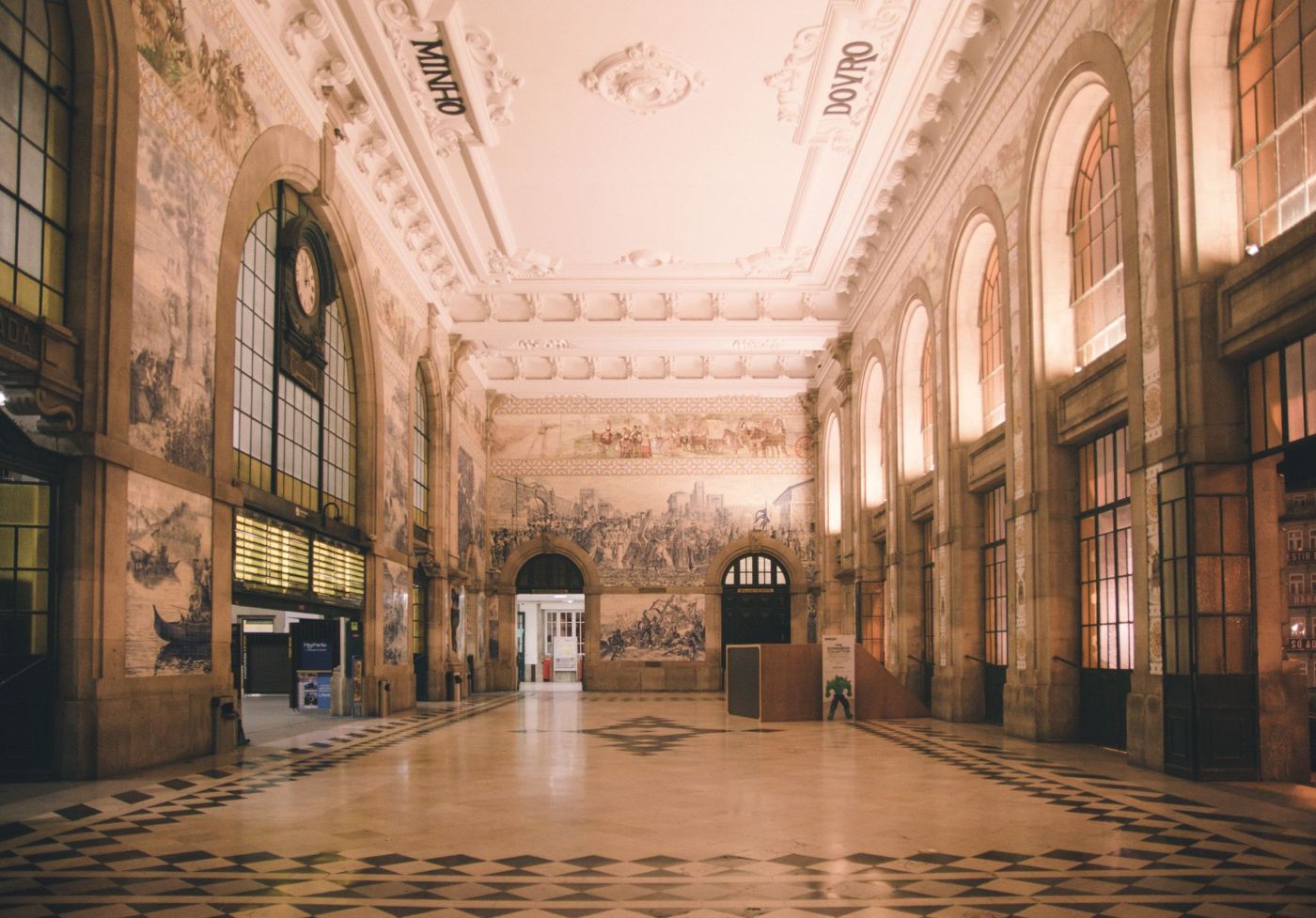 About twenty thousand tiles, painted by Jorge Colaço.
A convent, then a station
The mistake is to think the building is as old as the scenes on its walls. The São Bento azulejos are 20th-century work in a 20th-century station. Before it, the site held the convent of the Benedictine nuns of São Bento de Ave Maria, founded in the 16th century. The convent burned in 1783 and was rebuilt at the start of the following century. By 1900 it was in such poor repair that it was pulled down.
King Carlos I laid the first stone of the station in 1900. Marques da Silva (1869-1947) gave it a late neoclassical exterior. Behind the hall, an iron and glass shed covers eight terminal tracks and five platforms, and the trains reach them through a tunnel.
The state listed the station as a Property of Public Interest on 31 December 1997, and the listing names the iron train shed, the tile panels and the mouth of the tunnel. The station lies inside the World Heritage area of the historic centre, described on the UNESCO page for Porto.
São Bento station in figures
- Inaugurated
- 5 October 1916
- Architect
- José Marques da Silva
- Tiles
- About 20,000, by Jorge Colaço
- Tracks and platforms
- 8 terminal tracks, 5 platforms
- Listed
- Property of Public Interest, 1997
- Visitor rating
- 4.7 out of 5 from 1,119 reviews
Where the hall sits in a walk
The mistake is to treat the hall as a detour. The Porto train station tiles lie between the upper town and the river: the cathedral is 310 m away, about five minutes on foot, the Clérigos Tower is 340 m in the other direction, and the Fontainhas viewpoint is 843 m to the east.
Stand in the middle of the hall and read the walls from the top down, the coloured frieze first and then the blue and white panels beneath it. The panels are large, so step back to the opposite wall for each one.
Guided walks of the centre use the station as a landmark, and one themed walk meets on platforms 3 and 4. The address is Praça de Almeida Garrett, and the entrance to the hall is on the square.

Porto: Tile Painting Workshop with Port Wine
★ 4.9 · 1,814 reviewsA two-hour workshop painting a tile of your own, with Port wine.
The trains that leave from here
The mistake is to admire the hall and forget that it is also a way out of town. São Bento is where the classic day by rail begins. The Douro line follows the river: Régua is 1 h 55 min away for 11.10 euros, Pinhão 2 h 20 min for 12.45 euros, and Pocinho, at the end of the line, 3 h 20 min for 15.10 euros.
The urban trains run north and south. Braga takes 54 to 71 minutes and Guimarães 1 h 10 to 1 h 20, each for 3.60 euros. Aveiro is about 1 h 15 away for 3.95 euros. Urban tickets load onto a Siga card, which costs 0.50 euros, and are valid on any departure, so there is nothing to reserve.
Fares are set per service by Comboios de Portugal, the national railway, and they change; check them on the CP site before you travel.
Trains from São Bento
| To | Journey | Single fare |
|---|---|---|
| Braga | 54-71 min | 3.60 EUR |
| Guimarães | 1 h 10-1 h 20 | 3.60 EUR |
| Aveiro | About 1 h 15 | 3.95 EUR |
| Régua | 1 h 55 | 11.10 EUR |
| Pinhão | 2 h 20 | 12.45 EUR |
| Pocinho | 3 h 20 | 15.10 EUR |
- Journey
- 54-71 min
- Single fare
- 3.60 EUR
- Journey
- 1 h 10-1 h 20
- Single fare
- 3.60 EUR
- Journey
- About 1 h 15
- Single fare
- 3.95 EUR
- Journey
- 1 h 55
- Single fare
- 11.10 EUR
- Journey
- 2 h 20
- Single fare
- 12.45 EUR
- Journey
- 3 h 20
- Single fare
- 15.10 EUR
Pairing the hall with a day out
The mistake is to plan the tiles and the train as separate errands. Start the day in the hall and take the train from the platforms behind it. For the valley, the Douro Valley from Porto page sets out what a day by rail covers. For the towns, Porto to Braga, Porto to Guimarães and Porto to Aveiro each give the trains, the sights and the opening hours.
If the day stays in the city, the station is the hinge between two walks. One goes uphill to the Clérigos Tower and Livraria Lello. The other goes down past the cathedral to the Dom Luís I Bridge, which is 350 m beyond the cathedral, and from the bridge the Ribeira quay is 394 m further.

From Porto: Douro Valley w/ Boat Tour, Wine Tasting & Lunch
★ 4.7 · 21,807 reviewsA full day in the Douro Valley by road, with a boat trip, a wine tasting and lunch.
Common questions
What is São Bento station known for?
Its entrance hall, lined with about twenty thousand tiles by Jorge Colaço that show scenes from the history of Portugal and the history of transport.
Who painted the tiles in São Bento station?
Jorge Colaço (1864-1942), a painter trained in Paris.
When was São Bento station built?
The first stone was laid in 1900 and the station was inaugurated on 5 October 1916, to a design by José Marques da Silva.
Which trains leave from São Bento?
Urban trains to Braga, Guimarães and Aveiro, and the Douro line to Régua, Pinhão and Pocinho.