Some links on this page are affiliate links: if you book through them, we may earn a commission at no extra cost to you. How this works
The first decision of a Porto trip is made in an arrivals hall with a suitcase in hand, and it is usually made badly. A taxi rank is directly outside. A metro station is a short walk away, runs every twenty minutes and costs less than a coffee and a pastry. The gap between those two ways out of Porto airport is roughly twenty-five euros, every time, in both directions.
The place is close to the city by any standard: 11 km from the Clérigos tower, a road distance of 15.7 km, and about 17 minutes of driving when the road is clear. That is the useful frame. Nothing about the arrival is far, nothing needs booking weeks ahead, and the expensive option buys you very little time.
The practical part of flying into the city comes down to a few questions: what the airport is called and why it appears under three different names, how far out it really is, which line goes where, what the fares are, where to look when a flight is late and what changed at the border in 2026. The comparison of every transfer option, car hire, the city map and the train down to Lisbon each have their own page, linked from here rather than repeated.
Days out that start the morning after you land
 Our pick
From Porto: Douro Valley w/ Boat Tour, Wine Tasting & Lunch
The valley, a boat leg, a tasting and lunch in one booking. Rated 4.66 out of 5 across 21,807 reviews, the strongest evidence in the catalogue
The valley, a boat leg, a tasting and lunch in one booking. Rated 4.66 out of 5 across 21,807 reviews, the strongest evidence in the catalogue
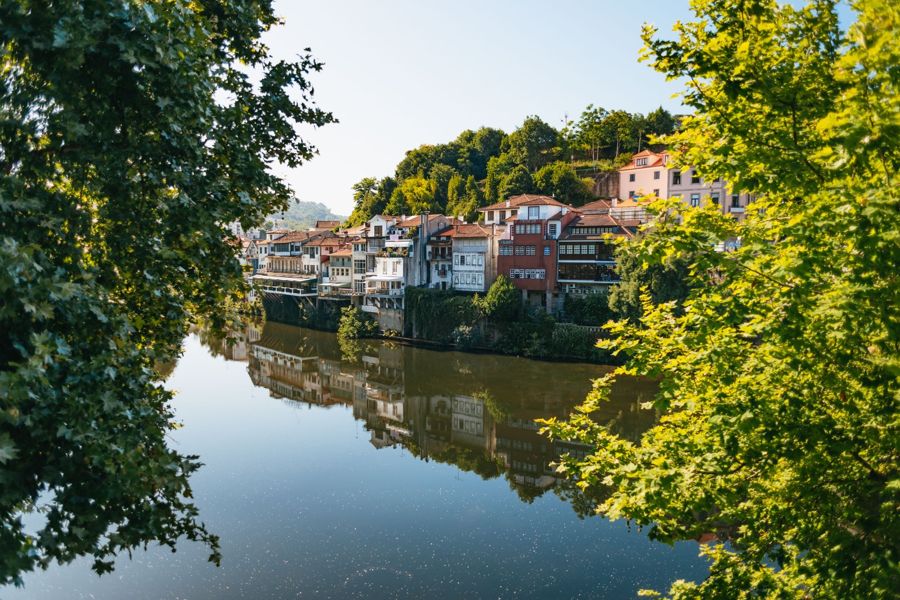
Porto: Douro Valley with Lunch (Optional), Tastings & Cruise
The same day with lunch left optional, for travellers who would rather choose where they eat. Rated 4.72 out of 5 across 8,611 reviews
The same day with lunch left optional, for travellers who would rather choose where they eat. Rated 4.72 out of 5 across 8,611 reviews
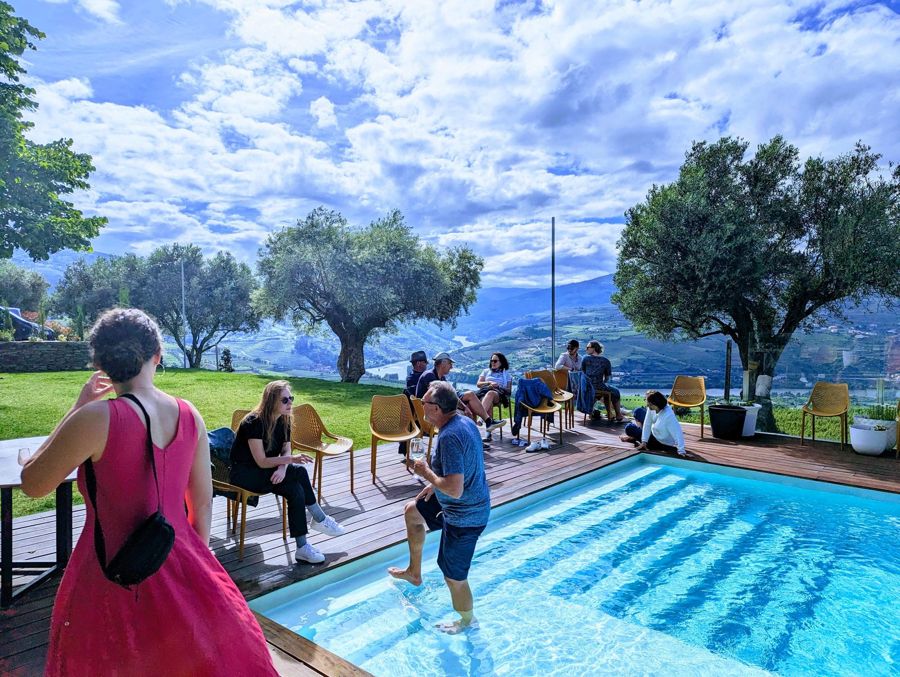
From Porto: 2 Wine Regions, Farm-to-Table Lunch & Boat
Two wine regions rather than one, with a farm-to-table lunch and a boat leg. Rated 4.85 out of 5 across 8,176 reviews
Two wine regions rather than one, with a farm-to-table lunch and a boat leg. Rated 4.85 out of 5 across 8,176 reviews
Three names for one building
The airport answers to three names, and a booking, a boarding pass and a road sign will each pick a different one.
Its full name is Francisco Sá Carneiro Airport, after the prime minister killed in an air crash in 1980. Older residents and older maps still call it Pedras Rubras, the name of the place it was built on. The airport code for Porto is OPO, which is what appears on a bag tag and in a flight search, while air traffic control uses the longer form, LPPR.
None of this is trivia. A traveller who searches for the full Portuguese name and a traveller who searches for the three-letter code get different results and sometimes different prices, and a hire car voucher issued against one name is occasionally rejected at a desk that prints the other. Put the code on the booking wherever there is a field for it.
The airport is run by ANA, the national airport company, which belongs to VINCI Airports. That matters mainly because the useful information, the live boards, the terminal notices and the disruption announcements, all live on ANA's own site rather than on the many travel pages that copy them a day late.
Geography adds a fourth complication. The airport does not sit inside the city of Porto at all. It straddles Maia, Matosinhos and Vila do Conde, three municipalities north-west of the centre, which is why some addresses give a town nobody outside the region has heard of.
- Airport code
- OPO (ICAO LPPR)
- Official name
- Francisco Sa Carneiro Airport
- Distance to the city centre
- 11 km
- Road distance from Porto
- 15.7 km
- Driving time from Porto
- 17 min
- Passengers in 2025
- 16.9 million
- Operator
- ANA, VINCI Airports
How far out it really is
Visitors arriving from London or New York tend to assume a long transfer, because that is what a capital's airport trains them to expect. Porto does not work that way.
The airport lies 11 km from the Clérigos tower in a straight line. By road it is 15.7 km, and a car covers that in about 17 minutes with clear traffic. Those two figures are computed over the open road network rather than quoted from an operator, so they describe a car that does not stop, and not a coach that loads forty people at a hotel door.
What that means in practice is that every sensible option is short. A taxi or a ride-hailing car is usually quoted at 20 to 25 minutes and somewhere around 20 to 30 euros by the city's own visitor guides, which is an estimate rather than a regulated fare. The metro takes longer than a car, though not by much, and costs a small fraction of it.
The mistake to avoid is paying for a private transfer to save time that does not exist. On a route this short, traffic decides the difference, and traffic affects the taxi and the private car equally. Book a transfer because you are arriving at three in the morning with two children and a folding cot, which is a good reason, and not because the map looks far.
- Metro single, airport zone Z4
- 2.30 EUR
- Paper Andante card
- 0.60 EUR, bought once
- Andante Tour 1, 24 hours
- 7.75 EUR
- Andante Tour 3, 72 hours
- 16.55 EUR
Checking the flight before you leave for the airport
The habit worth forming is to check the status of an inbound aircraft on the airport's own board rather than on whichever site a search puts first.
ANA runs the airport and publishes its own live board. That is the Porto airport real time arrivals official source, and it updates from the same system the screens in the hall use. Third-party trackers pull the same data with a delay, wrap it in advertising, and occasionally keep a cancelled flight on the page for hours after it disappears from the terminal.
The practical value is on the departure side. On a short ride into town, a delay of an hour is an hour in a cafe rather than an hour in a queue, so the board decides when you leave the hotel. ANA also posts operational notices there, and the airport company's own pages carry the traffic figures that tell you how busy the building is likely to be in a given season.
One caveat on all live boards: they report the aircraft, not the queue. A flight can land on time into an airport that has four other flights landing in the same ten minutes, and a passport queue behind them. Treat the board as the earliest possible moment you will see anyone, not the moment they walk out.
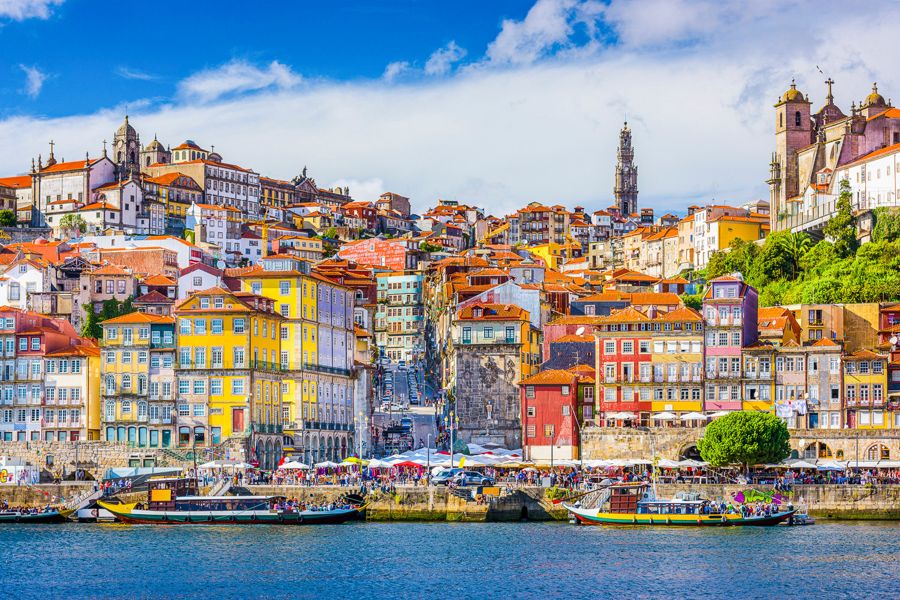
Porto: Six Bridges Cruise , 4.24/5 from 15,297 reviews. Includes a cruise past the six bridges between Porto and Vila Nova de Gaia. Best for the afternoon of an arrival day, when a short outing near the centre beats a full excursion.
★ 4.2 · 15,297 reviewsAn hour on the river on a first afternoon, when the jet lag rules out anything longer
Finding your way through the building
Arriving passengers walk one way through the building and departing passengers another, and the two paths meet only at the shops.
A Porto airport map is published by the airport company and is worth a glance before a first visit, mostly to find the metro. The station is not inside the terminal hall; it is a short covered walk from the arrivals exit, and it is signed. That walk is where most first-time visitors hesitate, because a taxi rank is visible and a train station is not.
The other thing worth locating in advance is the ticket machine. The metro does not take a paper ticket bought from a person: fares load onto a card, and the card is bought from a machine before you reach the platform. Getting that done while your bag is still on your shoulder is easier than working it out with a queue behind you.
Nothing else about the building rewards planning. It is a single passenger terminal rather than a spread of separate buildings, walking distances are short, and the connection between arrivals, the car parks and the metro is on one level of signage. Read the map for the metro walk, then put it away.
From the airport to central Porto
| Way in | Time | Cost |
|---|---|---|
| Metro line E to Trindade | about 27 min | 2.30 EUR plus 0.60 for the card |
| Taxi or ride-hailing | 20 to 25 min | about 20 to 30 EUR |
| Driving yourself | 17 min over 15.7 km | fuel, tolls and city parking |
- Time
- about 27 min
- Cost
- 2.30 EUR plus 0.60 for the card
- Time
- 20 to 25 min
- Cost
- about 20 to 30 EUR
- Time
- 17 min over 15.7 km
- Cost
- fuel, tolls and city parking
The metro is the default, and here is why
Most visitors should take the train into town, and the reason is arithmetic rather than virtue.
Line E, the violet line, runs from the airport to Trindade in the middle of the city in about 27 minutes, with a departure roughly every twenty minutes. The airport sits in fare zone Z4, so a single ride costs 2.30 euros, plus 0.60 once for the reusable paper card the fare loads onto. Two adults reach the centre for under six euros, luggage included, with no surcharge for bags.
Porto international airport is unusual among European airports of its size in this respect: the line goes into the actual centre rather than to a suburban interchange, and it is an ordinary metro fare rather than an airport premium. Nobody has to decide whether a special airport express is worth it, because there is not one.
Two things are worth knowing before you board. The card is per person, so a couple buys two, and the fare is validated at the platform rather than on the train. Visitors planning several days of travel often buy a period ticket instead: the Andante Tour costs 7.75 euros for 24 hours or 16.55 for 72 across the whole network, which pays for itself in about four rides.
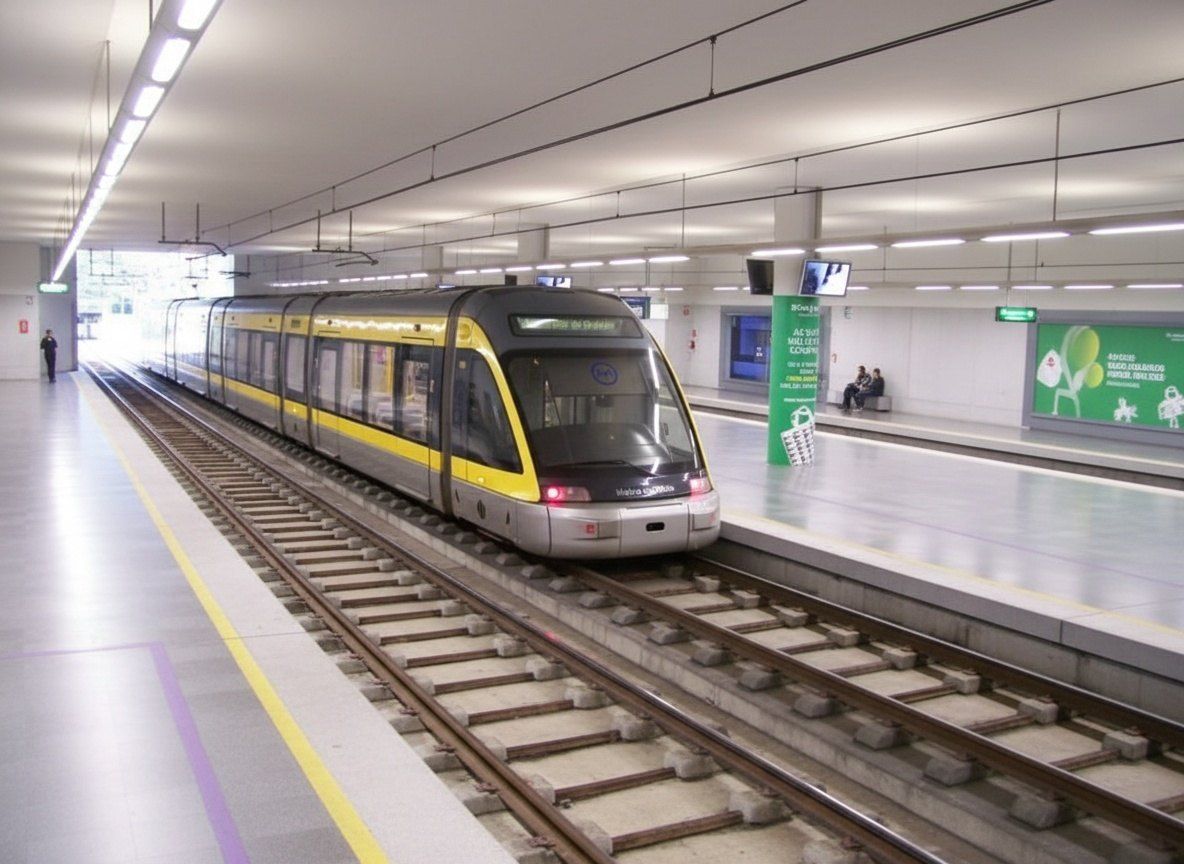 Line E runs from the airport into the centre.
Late landings and early departures
Two moments in a trip are worth planning rather than improvising: arriving late at night and leaving early in the morning.
For a late arrival, the question is simply what is still running when the aircraft actually gets in. Check the Porto airport arrivals official board for the real landing time, then decide: a car covers the 15.7 km to the centre in about 17 minutes at that hour, and the guide estimate of 20 to 30 euros is at its most reliable when the roads are empty. A pre-booked transfer is worth the money here, not because it is faster, but because a tired family with a fixed hotel address is better served by a named driver than by a decision at midnight.
For an early departure the calculation runs the other way. The metro takes about 27 minutes plus the wait, so a flight that boards at six in the morning is a taxi, not a train.
The rule that covers both: work backwards from the board, not from the timetable in your head. Airlines move departures, and the site that tells you first is the one the airport runs.
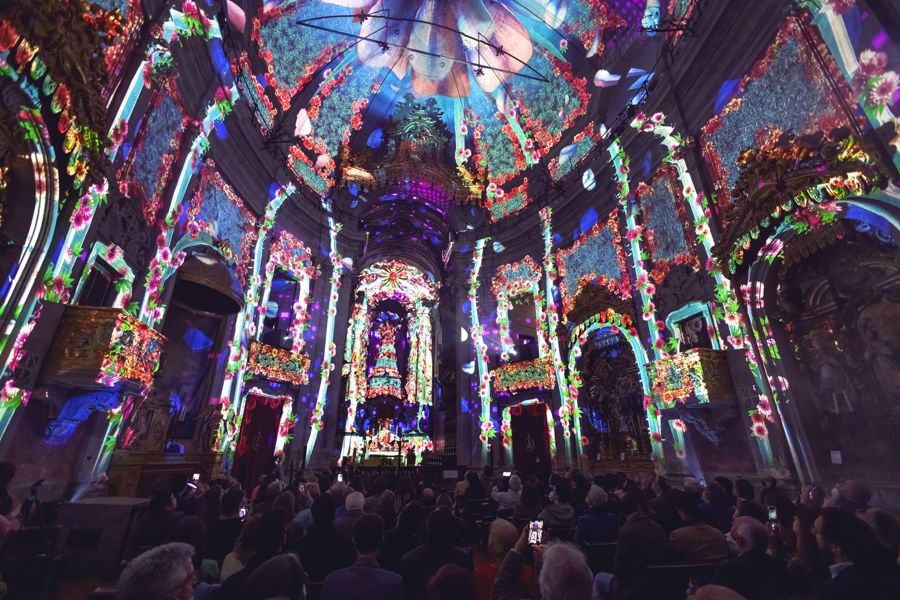
Porto: Spiritus Multimedia Show Entry Ticket , 4.50/5 from 7,763 reviews. Includes entry to the Spiritus multimedia show in central Porto. Best for an arrival evening that has an hour in it but not a day.
★ 4.5 · 7,763 reviewsAn indoor show in the city centre for the first evening, or for a rained-out afternoon
Strikes, works and the day everything changes
Portugal has an active trade union culture, and airport and railway staff strike from time to time. Roadworks close lanes. Runways get resurfaced. None of it is exotic, and all of it is announced.
Anyone searching for Porto airport news today should read the airport operator's notices first and the national press second. The Portuguese dailies, Público, Jornal de Notícias and Observador, cover a strike ballot days before the English-language travel sites pick it up, and a browser translation is enough to get the dates out of a report. What they will not tell you is which flights are affected, which is why the operator's own page stays the first stop.
The pattern to watch for is the strike with notice. Portuguese industrial action is generally announced well ahead, with minimum service levels published, so a traveller who checks a week out has time to move a booking rather than to argue at a desk.
For everything else, the honest advice is not to over-plan. The airport handled 16.9 million passengers in 2025 and ran them through without the chaos that number would cause in a poorly run building.
 Strikes and works change the plan; check before you travel.
Flying into Lisbon instead
Travellers often find a cheaper fare into the capital and assume the rest sorts itself out. It can, but the cost is a long afternoon.
The closest airport to Porto portugal is the city's own, 11 km from the centre and 17 minutes by road. The alternative, flying into Lisbon, adds a train journey of 2 hours 58 minutes on the fast Alfa Pendular, at 33.90 euros in standard class, or about 3 hours 23 minutes on the Intercidades at 26.85 euros. That is each way, and it lands you at a station rather than at your hotel.
There are two situations where it still makes sense. The first is a trip that wants both cities anyway, in which case the train is part of the holiday rather than a penalty. The second is a long-haul arrival with no direct route north, where the choice is a connection through Lisbon in the air or on the ground, and the ground option at least comes with a window and a coffee.
For a straight Porto holiday, the arithmetic rarely works. Six hours of train time and about sixty euros a head will buy back most of what a cheaper fare saved.
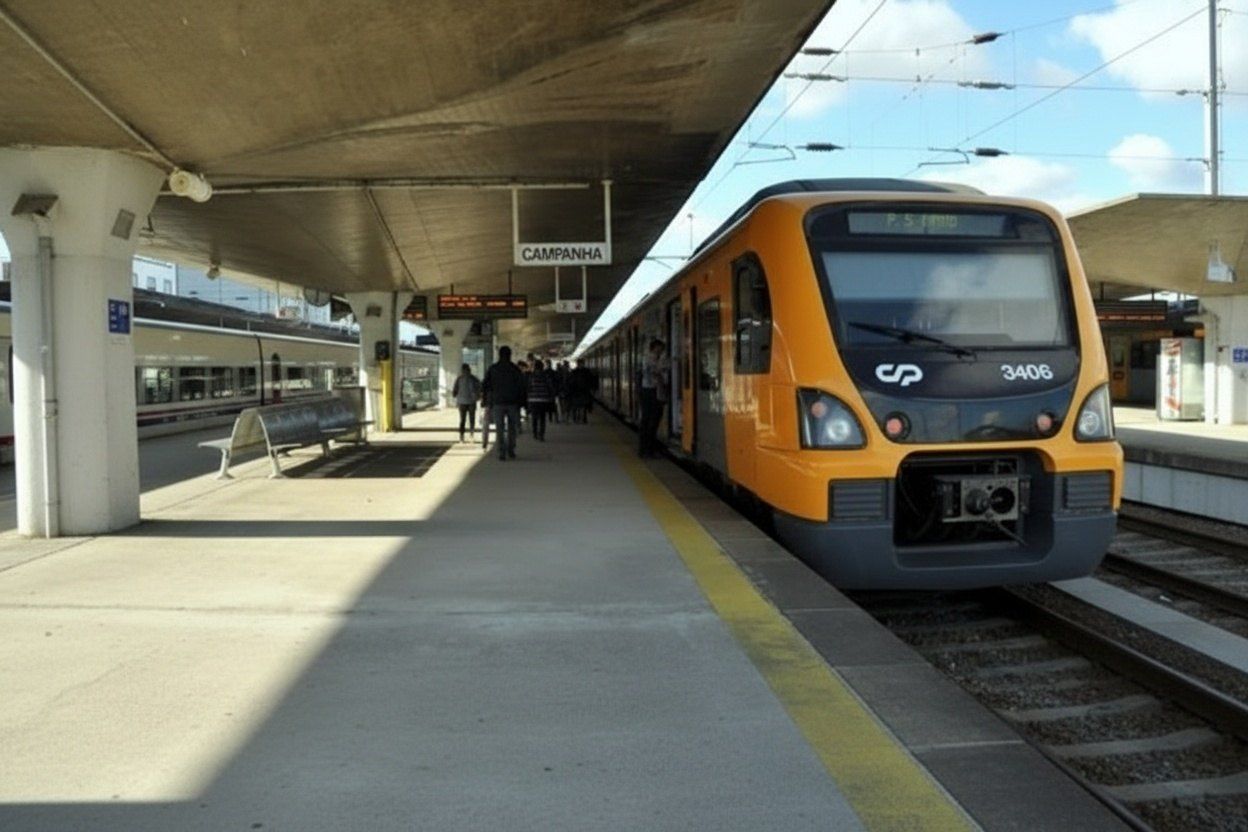 A cheaper fare into Lisbon costs a long afternoon on the train.
The size of the place
People planning a first trip ask a question that sounds naive and is not: does Porto have an airport of its own, or is this a regional strip with two flights a day?
It is neither. The airport handled 16.9 million passengers in 2025, a record for it and 6.3 per cent more than the year before, across 109,620 commercial aircraft movements. That places it firmly among Europe's mid-sized international airports, with the route network that comes with it.
Size matters for three practical reasons. Competition on the main European routes keeps fares honest, so a Porto flight is often cheaper than the equivalent flight to the capital. Frequency means a missed connection is a wait rather than a lost day. And a building running that many passengers has the infrastructure to match: a metro line, a full taxi rank, car hire desks and the staffing that a quiet regional airport cannot justify.
The other side of the number is the season. Traffic is not spread evenly across the year, and a summer Saturday morning is a different building from a Tuesday in February. Arrive earlier in August than the airline's minimum suggests.
From Porto: 2 Wine Regions, Farm-to-Table Lunch & Boat , 4.85/5 from 8,176 reviews. Includes two wine regions, a farm-to-table lunch and a boat leg, from a pickup in Porto. Best for a first full day, when the jet lag has cleared and the valley is the point of the trip.
★ 4.9 · 8,176 reviewsTwo wine regions in a day, once the trip has properly started
What happens at the border now
The passport stamp is gone, and travellers from outside the European Union meet a system instead of an ink pad.
The Entry/Exit System has been fully operational across the Schengen area since 10 April 2026. Non-EU arrivals have their face and fingerprints recorded on a first entry, and the dates of entry and exit are held digitally rather than stamped into a passport. Readers travelling on an EU passport are not affected by any of it and use the usual lanes.
The system that follows it, ETIAS, is a travel authorisation that non-EU visitors will buy online before departure. It is expected in the last quarter of 2026, and no start date has been confirmed. Anyone flying before then does not need it, and anyone told otherwise by an official-looking site selling authorisations should read the European Commission's own pages instead.
What this changes in the hall is time. The first registration takes longer than a stamp ever did, and it happens at the busiest moment of a flight's arrival. On a Porto arrival that is a queue, not a crisis, but it is a reason to expect the ride into town rather later than the aircraft's landing time.

Pao de Acucar Hotel , 8.40/10 from 9,119 reviews. A hotel in central Porto. Best for a late arrival, when the first priority is a bed within a short ride of the airport rather than the perfect neighbourhood.
★ 8.4/10 · 9,119 reviewsA central hotel for the first night, when the flight lands too late to start choosing
The first morning, and what it costs
Arrival and the first morning belong to the same budget, and two charges surprise people.
The first is the city tax. Porto charges 3 euros per person per night, collected by the hotel on top of the room price and capped at seven nights, so no stay pays more than 21 euros a person. Children under 13 are exempt. It is paid at the property, on arrival or at checkout, which is why it never appears on the booking confirmation.
The second is the assumption that one ticket covers everything. The Andante card and the Andante Tour carry you on the metro and the buses. The historic trams are a separate fare bought on board, at around 6 euros a ride, and no period transport ticket is valid on them.
If the first full day is a day out, the trains are the cheap surprise in the other direction. Braga and Guimarães are each about an hour from the city on the urban network at 3.60 euros a single, and the fare table that governs the airport ride governs those zones too. The Douro line up the river takes 1 hour 55 minutes to Régua at 11.10 euros.
A short arrival checklist
Five things, settled before the aircraft doors open, make the first two hours in Portugal uneventful.
Know the code you booked under, and carry it on any car hire or transfer voucher. Decide in advance whether this is a metro arrival or a taxi arrival, because deciding in the hall with a trolley is how a twenty-five euro difference gets spent by accident. If it is the metro, buy the card at the machine on the way past rather than at the platform.
Check the live board before leaving for the airport in either direction, and check it again if a connection is tight. It is run by the operator and it is the same feed as the screens in the terminal.
Expect the border to take longer than it used to if you hold a non-EU passport, and budget for the city tax that lands at the hotel rather than on the booking. None of these is a large amount of money or time on its own. Together they are the difference between an arrival that works and one that starts with a queue, a surcharge and a conversation at a desk. Porto is a city where the metro fares and the city charges are published plainly, so there is nothing here that has to be a surprise.
Common questions
How do I get from the airport to the centre of Porto cheaply?
Take metro line E to Trindade, about 27 minutes, with a departure roughly every twenty minutes. The airport is in fare zone Z4, so a single costs 2.30 euros, plus 0.60 once for the card it loads onto.
How long does a taxi take, and what does it cost?
Guides put it at 20 to 25 minutes and around 20 to 30 euros, which is an estimate rather than a regulated fare. By road the distance is 15.7 km and the driving time about 17 minutes with clear traffic.
Do I need to buy a transport pass before I arrive?
No. Fares load onto a card bought from a machine at the station. If you expect several days of metro and bus travel, the Andante Tour is 7.75 euros for 24 hours or 16.55 for 72 across the whole network.
Will my passport still be stamped on arrival?
Not since 10 April 2026. Non-EU travellers are registered by the Entry/Exit System with a facial image and fingerprints instead, and ETIAS is expected in the last quarter of 2026 with no confirmed date.
Is it worth flying into Lisbon and taking the train north?
Only if the trip wants both cities. The train is 2 hours 58 minutes on the Alfa Pendular at 33.90 euros standard, or about 3 hours 23 minutes on the Intercidades at 26.85 euros, each way.