Portugal Average Sunny Days per Year (2026 Data)
How many sunny days Portugal really gets: 180 fully sunny days in Faro, 133.6 in Lisbon, 3,044 hours of sunshine - official IPMA normals, Europe ranking and the 300-day claim checked.
- Published
- Updated
- 3 sources
- 6 statistics
- 9 min read

- BA in Communication & Cultural Studies, Faculdade de Letras da Universidade do Porto (FLUP); MA candidate in Urban Anthropology
- Former urban culture contributor to Publico (Fugas supplement) and Revista Visao
- 8+ years documenting the gentrification and preservation of traditional Porto commerce for municipal cultural archives
- Field researcher for independent monographs on Northern Portuguese vernacular dining and tavern culture
- Born and raised in Miragaia; 4th-generation Tripeiro living in Cedofeita, where his family has run small businesses since the 1960s
- Covers urban culture, historic tascas, contemporary architecture and the Bonfim, Cedofeita, Campanha and Fontainhas neighbourhoods
- Tests every venue anonymously on foot and refuses all comped meals, so recommendations stay unsponsored

- BA in Journalism, Universidade Nova de Lisboa; Postgraduate Diploma in Wine Business & Gastronomic Criticism, Escola de Hotelaria e Turismo do Porto (EHTP)
- Former Deputy Editor at Time Out Portugal and Lifestyle Editor at Observador
- Member of the Portuguese Guild of Gastronomic and Wine Journalists (APGCV)
- Panelist and juror for regional gastronomy competitions, including Northern Portugal Craft Beer and D.O.C. Douro wine panels
- Advisor to independent cultural trusts focusing on architectural preservation in UNESCO World Heritage zones
- Porto native (Foz do Douro); 14+ years directing lifestyle, wine and travel coverage across Porto, London and Lisbon
- Enforces the zero-paid-placement policy - every vineyard, boutique stay and dining room featured earns its place on editorial merit
Key findings
- 3,044Faro records 3,044 hours of sunshine a year - Portugal's sunniest official station (IPMA).
- 2,669Lisbon enjoys 2,669 hours of sunshine a year in the official 1971-2000 normals.
- 180Faro averages 180 days a year with at least 80% of possible sunshine - and just 9 sunless days.
- 2ndFaro is Europe's 2nd sunniest major city in the published sunshine tables, behind only Seville.
- 2,057Madeira's Funchal gets just 2,057 sunshine hours a year - warmer than the mainland but less sunny.
- 35.6%Summer alone delivers 35.6% of Lisbon's annual sunshine - winter just 15.6%.
Portugal's sunshine reputation comes with a number everyone repeats - 300 days a year - and an official record nobody quotes. The country's own meteorological service counted the sun for decades, and its station fichas answer the question precisely: Faro records 180 days a year with at least 80% of possible sunshine, plus just 9 fully sunless days, and 3,044 hours of total sunshine1. Lisbon runs 133.6 sunny days against 18 sunless ones1.
This page counts Portuguese sunshine the way IPMA's own fichas do - hours per month, sunny-day frequencies, station by station from the Algarve to Tras-os-Montes and out to Madeira - and then checks the claims against the numbers, including the famous 300-day figure and Portugal's place in the European sunshine ranking2.
What counts as a sunny day?
Before counting, a definition - because "sunny" is not a legal term. The number of sunny days in Portugal per year has no single official statistic; what IPMA's fichas count is the frequency of days by their sunshine share. A day with at least 80% of the possible sunshine counts as fully sunny here; the opposite extreme, a day with 0% sunshine, is a sunless day1. On those official bands, Faro averages 180 sunny days and 9 sunless days a year, and Lisbon 133.6 sunny days against 18 fully grey ones1.
The monthly line below shows when the grey days happen: December and January, where Lisbon still averages 3.7 and 2.1 sunless days, are the only months that regularly deliver a completely clouded day. From June to September a fully sunless day essentially does not exist - 0.2 per month or fewer in both cities1.
So how many sunny days should you budget for? At the official thresholds: roughly one day in three is fully sunny in Lisbon across a year, one day in two in the Algarve, and the sunless days cluster tightly in the four darker months - which is why a January city break feels like a gamble and a September one never does2.
- Lisboa
- Faro
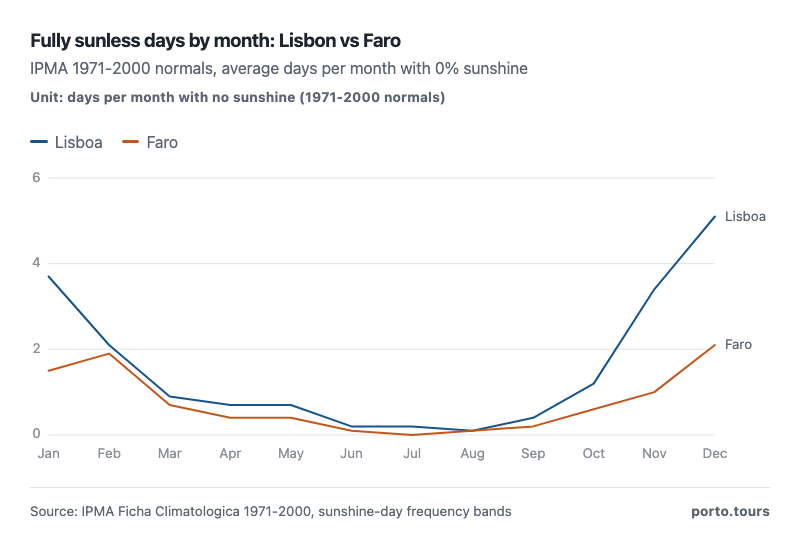
- December and January are the only months with more than 2 sunless days.
- From June to September, both cities average 0.2 sunless days or fewer per month.
- Faro never exceeds 2.1 fully sunless days in any month.
| Faro | 180.0 | 9.0 |
| Lisboa | 133.6 | 18.0 |
Portugal sunshine hours per year: the annual curve
Hours tell the sunshine story more precisely than day counts, and the national totals run from about 2,057 (Funchal, Madeira) to 3,044 (Faro) across the stations with official records1. The monthly curve is the same everywhere - a deep December-January trough, a long summer plateau above 290 hours - but the level shifts with the coast and the interior, as the four-station chart shows.
Lisbon sits in the middle: 2,669.1 hours a year, with a July peak of 331.4 hours and a December low of 119.21. Faro, the national champion, records 3,044.4 hours with July at 360.6. The line chart above adds Beja (2,742.9 hours a year) and the northern interior at Braganca (2,520.0), whose springs turn sunny fast but whose winters drag the annual total down1.
The Lisbon column chart makes the same point for planners: every month from May to September delivers more than 260 hours - that is five months of essentially reliable sun - while even the greyest month, December, averages about 4 hours of sunshine a day1. The full monthly tables for Lisbon and Faro sit below the chart, and the district ranking follows in the next section.
The station spread within one country is the second thing the numbers teach. Faro's annual total (3,044.4 hours) exceeds Lisbon's by 375 hours - five extra sunny weeks - while Braganca, five degrees of latitude further north and 690 metres higher, gives up another 524 hours against Faro. Altitude and the Atlantic coast both tax the sunshine budget: every coastal station from Setubal north stays under 2,650 hours a year, and the interior Serra stations Sunshine hours also have the stability that money series lack: an hour of sun is an hour of sun, measured by the same sensor family across decades, so the 1971-2000 normals stay directly comparable even though they predate the current climate period. They are, in one honest sentence, the only official monthly sunshine numbers Portugal has - which is exactly why this page uses them rather than newer model estimates1.would sit lower still if their fichas carried sunshine tables1.
- Faro
- Beja
- Lisboa
- Braganca
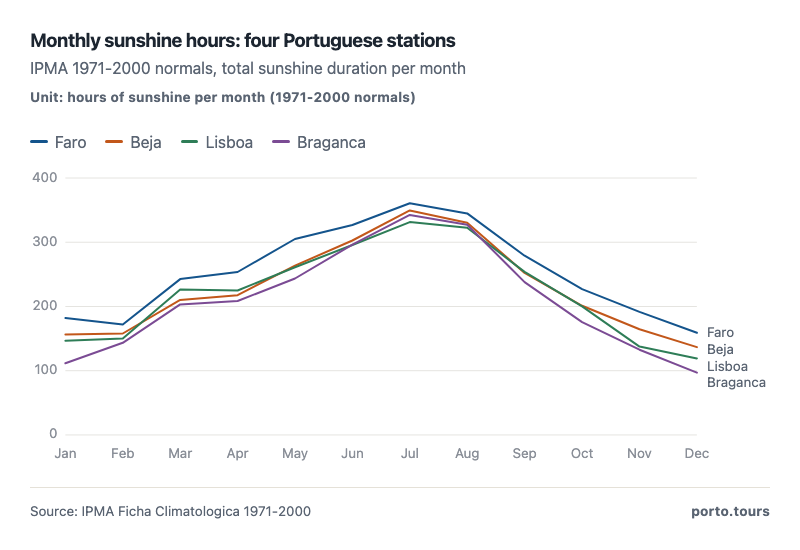
- July peaks between 342.6 h (Bragança) and 360.6 h (Faro).
- December is the darkest month everywhere: 97.1 h in Braganca, 159.0 h in Faro.
- Faro leads every single month of the year.
- 146.7JanJ
- 150.3FebF
- 226.5MarM
- 224.9AprA
- 261.1MayM
- 295.7JunJ
- 331.4JulJ
- 322.5AugA
- 253.8SepS
- 200.1OctO
- 137.5NovN
- 119.2DecD
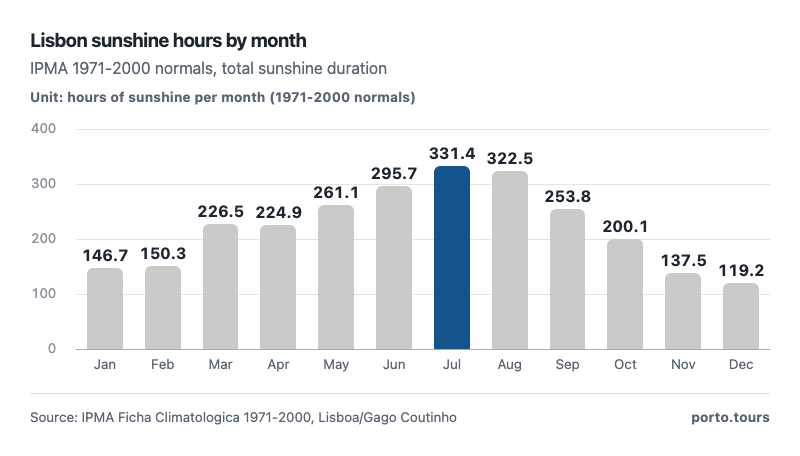
- July is Lisbon's sunniest month at 331.4 hours.
- December, at 119.2 hours, still averages about 4 hours of sun a day.
- May to September each deliver more than 250 hours - five reliably sunny months.
| Jan | 146.7 |
| Feb | 150.3 |
| Mar | 226.5 |
| Apr | 224.9 |
| May | 261.1 |
| June | 295.7 |
| July | 331.4 |
| Aug | 322.5 |
| Sept | 253.8 |
| Oct | 200.1 |
| Nov | 137.5 |
| Dec | 119.2 |
| Year | 2,669.1 |
| Jan | 182.1 |
| Feb | 172.0 |
| Mar | 242.6 |
| Apr | 253.6 |
| May | 305.0 |
| June | 326.9 |
| July | 360.6 |
| Aug | 344.9 |
| Sept | 279.1 |
| Oct | 227.0 |
| Nov | 191.6 |
| Dec | 159.0 |
| Year | 3,044.4 |
Sunshine hours, station by station
Ranked by year, the sunshine map of Portugal has a clear geography. The southern interior and the Algarve dominate: Faro 3,044 hours, Beja 2,743, Evora 2,715, Setubal 2,626, Portalegre 2,658 - all within a two-hour drive of a winter beach1. The northern interior trails: Viseu 2,407, Vila Real 2,389, Braganca 2,520, with the Serra stations cooler and greyer still1.
The most counterintuitive number on the page belongs to an island: Funchal, on Madeira, records just 2,057 hours a year - Portugal's warmest station but nowhere near its sunniest, because the marine cloud that keeps the island green also keeps the sun off its coast1. Madeira is the proof that warmth and sunshine are different measurements.
The map below colours every district with an official sunshine record; six districts (Braga, Guarda, Leiria, Porto, Santarem and the Azores) had no sunshine-recording station in 1971-2000 and appear as no data - IPMA simply never published those numbers, and this page will not invent them1.
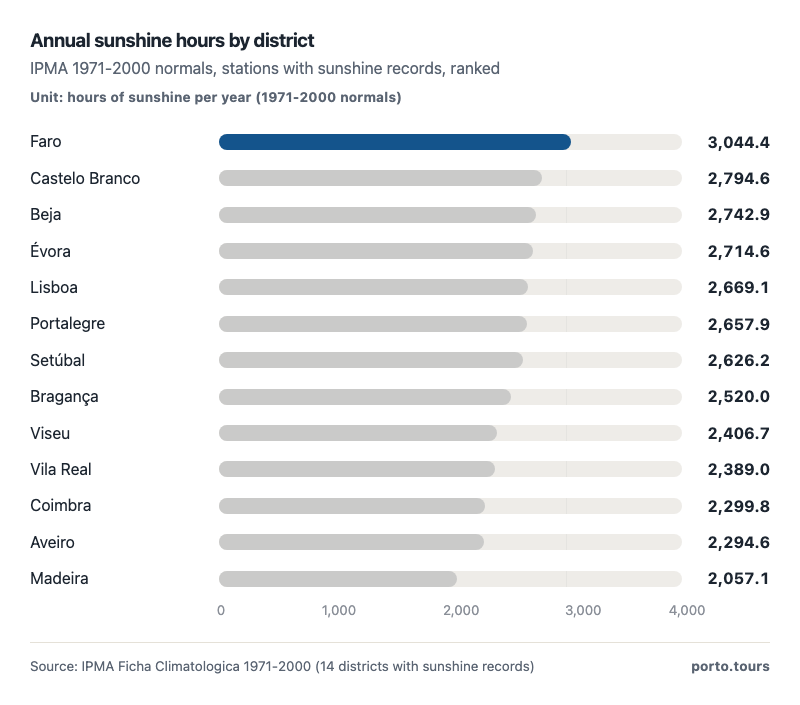
- Faro leads Portugal at 3,044 hours a year - the only station past the 3,000 mark.
- Braganca is the least sunny at 2,520 hours, yet still out-suns Rome.
- Madeira's Funchal (2,057 h) is Portugal's warm station but not its sunny one.
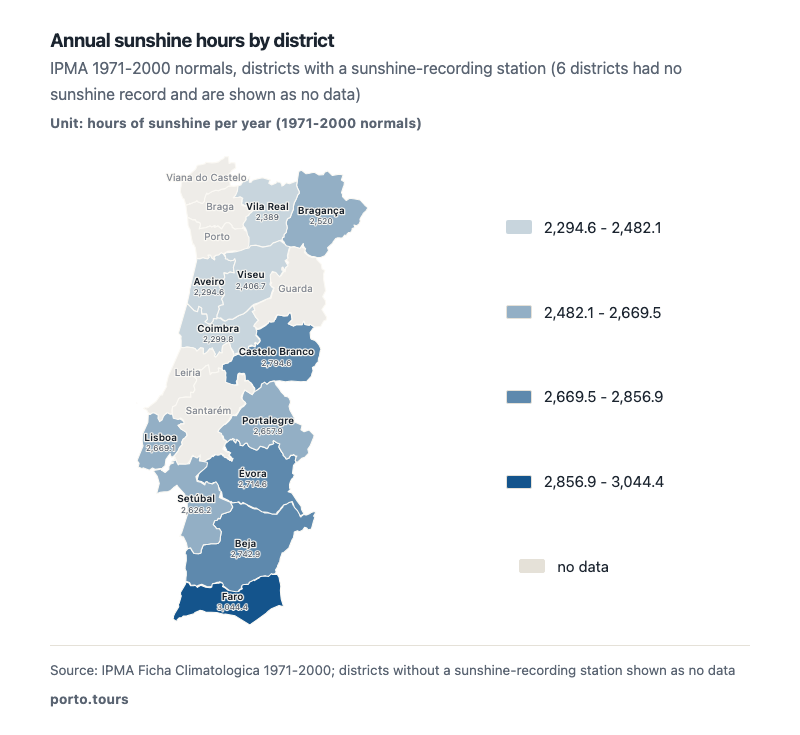
- The Algarve (3,044 h) and the southern interior (Beja 2,743 h, Evora 2,715 h) form the sunny block.
- The coolest-coloured districts are the northern interior: Bragança 2,520 h, Viseu 2,407 h.
- Madeira's 2,057 h breaks the island-sun stereotype in the official numbers.
| Faro | 3,044.4 |
| Castelo Branco | 2,794.6 |
| Beja | 2,742.9 |
| Évora | 2,714.6 |
| Lisboa | 2,669.1 |
| Portalegre | 2,657.9 |
| Setúbal | 2,626.2 |
| Bragança | 2,520.0 |
| Viseu | 2,406.7 |
| Vila Real | 2,389.0 |
| Coimbra | 2,299.8 |
| Aveiro | 2,294.6 |
| Madeira | 2,057.1 |
Portugal vs Europe: the sunshine ranking
Against Europe, Portugal's numbers are elite. In the published sunshine-duration table, Faro ranks 2nd among 22 major European cities - behind only Seville's 3,279 hours - while Lisbon's 2,669 hours beat Rome, Vienna, Paris, London, Berlin and Dublin3. The sunshine hours per year Germany vs Portugal contrast is the widest of the set: Berlin manages 1,626 hours against Lisbon's 2,669 - Portugal out-suns the German capital by 64%3. City pairs make the abstract concrete: Lisbon collects roughly the sunshine of Athens minus a cloud, Porto trades annual hours almost evenly with Rome, and a Faro winter (December's 159.0 hours) out-suns a Hamburg summer month in half the days3.
The The average sunny days per year Portugal Spain comparison settles only at the extremes: Madrid's 2,769 hours beat Lisbon's69, but Faro (3,044) out-suns Madrid outright, and Porto (2,468) sits within 125 hours of Barcelona (2,591)3. Portugal's south coast is, by the published numbers, among the two or three sunniest places in continental Europe3.
One honesty note runs under this whole section: the European table is an encyclopedia compilation whose values are attributed to each country's met service - DWD for Berlin, the Met Office for London, AEMET for Madrid - so the Portuguese figures come from IPMA itself and the foreign ones from their own national services, A second caveat is the baseline. Portugal's figures here are 1971-2000 normals; several northern cities' published values are older or use different averaging windows, and sunshine duration sensors were upgraded across Europe in the 1980s. Treat the northern European totals as ballparks with error bars of a hundred hours or so - the conclusion survives, since the gap between Faro and Dublin is 1,591 hours, nearly ten times any plausible sensor effect2.
What the comparison is good for is the shape, not the digit: Portugal's coastal south joins Seville, Athens and Madrid in Europe's sunshine premier league, its capital out-suns every capital north of the Alps, and even cloudiest-coast Porto collects more annual sun than Rome or Barcelona manage in a bad year3.with compilation caveats3.
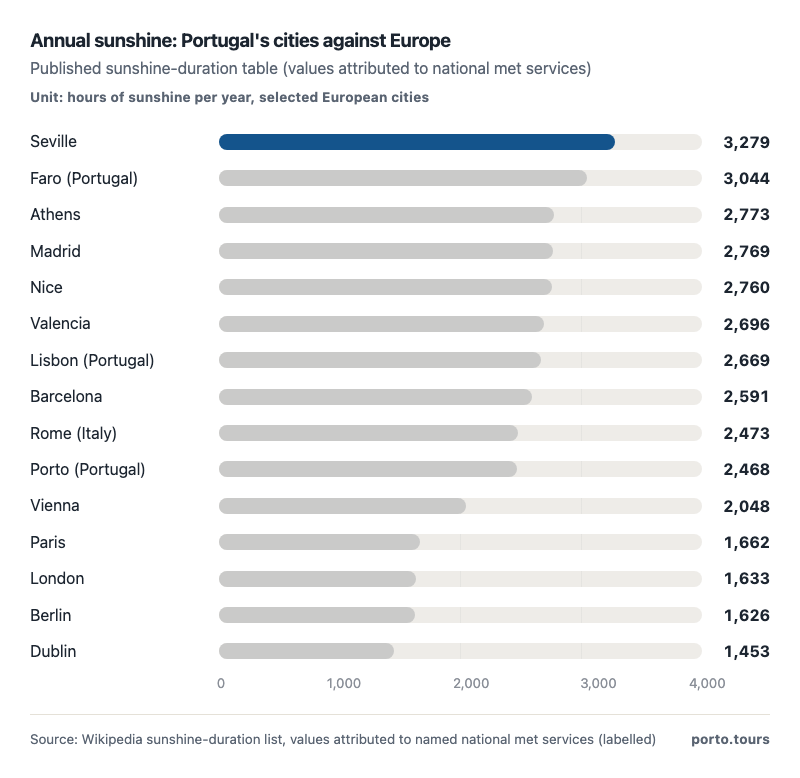
- Only Seville (3,279 h) out-suns Faro among Europe's major cities.
- Lisbon gets about 1,030 more sunshine hours a year than London.
- Porto (2,468 h) still beats Rome, Vienna, Paris, London and Berlin.
| Seville | 3,279 |
| Faro (Portugal) | 3,044 |
| Athens | 2,773 |
| Madrid | 2,769 |
| Nice | 2,760 |
| Valencia | 2,696 |
| Lisbon (Portugal) | 2,669 |
| Barcelona | 2,591 |
| Rome (Italy) | 2,473 |
| Porto (Portugal) | 2,468 |
| Vienna | 2,048 |
| Warsaw | 1,997 |
| Budapest | 1,988 |
| Amsterdam | 1,779 |
| Prague | 1,668 |
| Paris | 1,662 |
| London | 1,633 |
| Berlin | 1,626 |
| Zurich | 1,566 |
| Brussels | 1,546 |
| Dublin | 1,453 |
Lisbon, the Algarve and the 300-day claim
Sunny days per year, Lisbon, Portugal
The answer: 133.6 days a year with at least 80% of possible sunshine, plus 18 fully sunless ones - a city where roughly four days in ten carry nearly full sun1. In hours, the sunshine hours per year Lisbon Portugal figure is 2,669.1 - about 7.3 hours a day averaged across the whole year1.
Sunny days per year, Algarve, Portugal
The Algarve answer is stronger still: Faro counts 180 days at the 80% sunshine threshold and only 9 grey ones, with 3,044 hours of total sunshine1. The sunshine hours per year Algarve Portugal totals run higher still along the eastern coast - Tavira at 3,176.9 hours and Portimao at 3,018.8, July alone delivering 395 hours there - and the lagos Portugal sunshine hours per year question lands in the same range, on the same coast, though Lagos itself has no station3.
The claims, checked
Two famous numbers deserve their audit. The Portugal 300 days of sunshine per year claim appears only in marketing: no official IPMA source counts 300 sunny days anywhere in the country, and the strict official count for the Algarve is 180 days at the 80% threshold. The Portugal 3000 hours of sunshine per year claim, by contrast, is true - for the Algarve coast, where Faro's official 3,044.4 hours clears the bar1. For the whole country, the defensible national statement is simpler: between 2,057 and 3,044 hours of sunshine a year depending on the station, with the south coast the sunniest2.
Why does the 300-day claim survive every fact-check? Because it compresses three defensible numbers into one indefensible one: the Algarve has about 300 days a year with SOME direct sun (the fichas' own bands show only 9 fully sunless days), about 180 days at the 80% threshold, and 3,044 hours of total sunshine - and marketing squashed all three into "300 sunny days". Say 3,000 hours instead and you are quoting the official record rather than a rounding of a rounding2.
The claim also hides the west-east gradient. Sagres, on the battered southwest corner, sits under Atlantic cloud for much of the spring; Tavira, an hour's drive east, posts the highest July figure in the country at 395.3 hours. The Algarve is one coast in name and two in sunshine - which is exactly why station tables beat slogans3.
| 300 days of sunshine per year | No official source counts 300 sunny days; the official figure for Faro is 180 days a year at >=80% sunshine (IPMA) |
| 3,000 hours of sunshine per year | TRUE for the Algarve coast: Faro records 3,044.4 h (IPMA 1971-2000) |
| Portugal is one of Europe's sunniest countries | TRUE: Faro is 2nd, Lisbon 7th among 22 major European cities in the published table |
| Faro | 3,044.4 | July (360.6 h) | IPMA 1971-2000 (official) |
| Portimao | 3,018.8 | July (382.8 h) | APA-attributed table (ENC, labelled) |
| Tavira | 3,176.9 | July (395.3 h) | APA-attributed table (ENC, labelled) |
| Lagos | - | no station: covered by the Portimao figures on the same coast | - |
| Official IPMA record 1971-2000 | none - no sunshine recorder at Pedras Rubras in this period |
| Published figure (IPMA/NOAA-attributed) | about 2,468 hours a year (Wikipedia sunshine table, labelled) |
| Sunless days, Porto coast | not published |
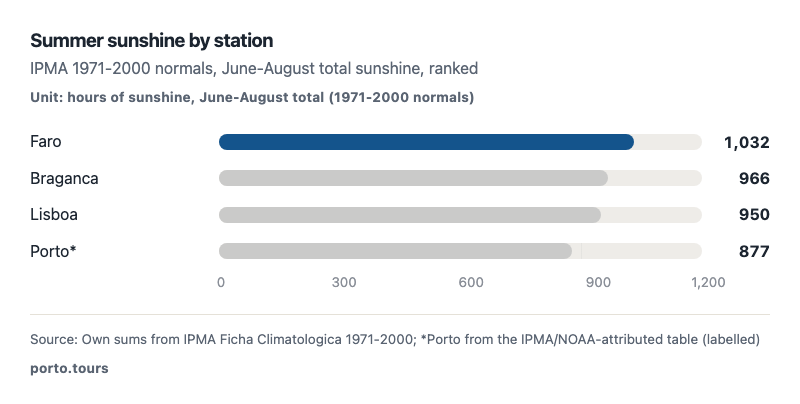
- Faro's summer delivers 1,032 hours of sunshine - the most of the four stations.
- Even Porto's Atlantic summer totals 877 hours.
- Every station's summer carries roughly 2.3 times its winter sunshine.
- Summer (Jun-Aug)35.6%35.6%
- Spring (Mar-May)26.7%26.7%
- Autumn (Sep-Nov)22.2%22.2%
- Winter (Dec-Feb)15.5%15.5%
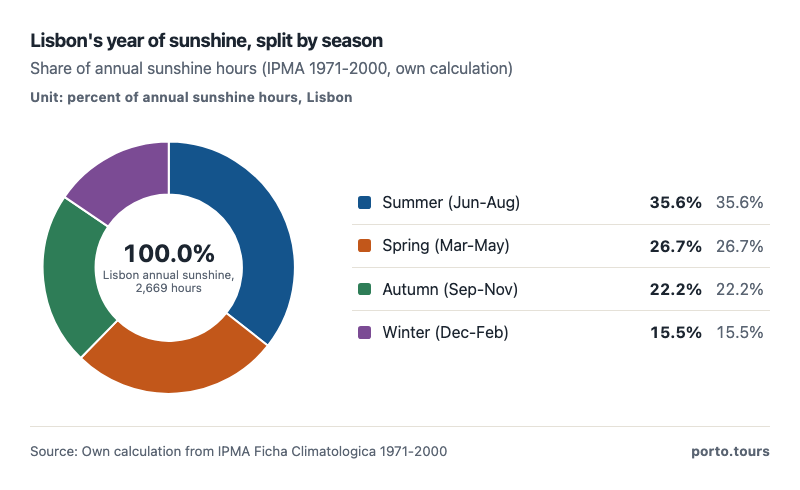
- Summer alone carries 35.6% of Lisbon's annual sunshine.
- Even Lisbon's winter share (15.5%) means about 4.5 sun-hours a day.
When to chase the sun: the practical calendar
Lay the three data families - hours, sunny-day frequencies and the seasonal shares - over a calendar and the year sorts into three tiers. The premium tier is June to September: Lisbon collects 295.7 to 331.4 hours a month, fully sunless days essentially vanish from the record, and even the Atlantic north (Porto's coast, 877 summer hours) plays along1. The value tier is March to May and October: 190-260 hours a month in Lisbon, warm afternoons, and sunshine-day frequencies that still clear 7-11 days a month in the capital1. The wildcard tier is November to February, when Lisbon averages 119-150 hours and Faro 159-182 - winter sun is real, it just carries the year's only meaningful chance of a fully grey day.
The district map adds the geographic fine print to that calendar. Winter sun-seekers should start south (Faro 3,044 hours a year) or in the southern interior (Beja 2,743), not on the northern coast - and if the choice is Madeira versus the mainland for a winter week, the fichas give the honest answer: Madeira wins on temperature (20.0 C annual mean), the mainland south wins on sunshine (Faro 3,044 hours against Funchal's 2,057)1.
| 1 | Faro annual sun | 3,044 h |
| 2 | Lisbon annual sun | 2,806 h |
| 3 | Porto annual sun | 2,468 h |
| 4 | Braganca annual sun | 2,520 h |
| 5 | Rainy days (Porto) | 105.4/year |
Conclusions
- Portugal's official sunshine numbers are excellent but specific: Faro records 3,044 hours a year and 180 days at the 80%-sunshine threshold, against Lisbon's 2,669 hours and 133.6 sunny days1.
- The famous "300 days of sunshine" claim has no official basis - the honest version is 3,000 hours on the Algarve coast, which the Faro record confirms1.
- Sunshine has a geography: the southern interior and Algarve (2,600-3,044 hours) out-sun the northern interior (2,389-2,520), and Madeira is warm but not sunny at 2,057 hours1.
- Against Europe, Portugal plays in the top tier: Faro is 2nd among 22 major cities, Lisbon out-suns Rome by 196 hours and London by more than 1,0003.
- The seasonal split is the practical takeaway: summer carries 35.6% of Lisbon's annual sunshine and the June-September stretch has essentially no sunless days, while December and January hold the only real grey-day risk1.
- Choose by station, not by slogan: the Algarve coast spans 3,019-3,177 hours across its published stations, Madeira trades sunshine for warmth at 2,057 hours, and the difference between Faro and Braganca - 524 hours a year - is larger than the gap between Rome and London1.
Methodology
- Sunshine duration normals 1971-2000 for 14 Portuguese stations (IPMA fichas)
- Sunshine-day frequency bands (>=80% and 0% of possible sunshine): Lisboa, Faro
- Europe comparison: 22 cities from the published sunshine-duration table (labelled)
Definition. Sunshine duration is the time the direct solar beam exceeds a threshold (120 W/m2 by WMO convention), summed per month and year. A 'sunny day' here follows IPMA's own frequency bands: a day with at least 80% of the possible sunshine; a 'sunless day' has 0% sunshine. The 1971-2000 normals are the latest official IPMA normals that include sunshine duration - the current 1991-2020 fichas dropped it.
Data sources. IPMA Ficha Climatologica 1971-2000 station PDFs (Lisboa, Faro, Braganca, Beja, Evora, Setubal, Viseu, Vila Real, Portalegre, Aveiro, Coimbra, Funchal); Wikipedia sunshine-duration list for the European comparison and the Porto/Algarve-coast figures (values attributed to named national met services and APA - labelled encyclopedia compilation).
Calculations. Seasonal totals (December-February, June-August), the Lisbon seasonal shares, the Europe ranking position and the Germany/London/Spain contrasts are our calculations from the published values. Monthly sums were checked against each ficha's printed annual total.
Limitations. The 1971-2000 normals predate the current climate period - recent decades run sunnier in southern Europe, so treat them as conservative. Six districts (Braga, Guarda, Leiria, Porto, Santarem, Viana do Castelo) and the Azores have no sunshine record in these normals and appear as no data. Porto's widely quoted 2,468-hour figure is encyclopedia-attributed, not an official IPMA publication. 'Sunny day' counts depend on the threshold chosen; the 300-day claim uses no stated threshold at all.
Sources
- IPMA (Instituto de Meteorologia). “Ficha Climatologica 1971-2000 - insolation duration normals, station PDFs (Lisboa, Faro, Braganca, Beja, Evora, Setubal, Viseu, Vila Real, Portalegre, Aveiro, Coimbra, Funchal).” Instituto Portugues do Mar e da Atmosfera, 2001. ipma.pt. Accessed 2026-09-18. Back to text
- Porto Tours. “Own calculations (labelled).” own calculation, 2026. porto.tours. Accessed 2026-09-18. Back to text
- Wikipedia (List of cities by sunshine duration). “Sunshine duration by city - values attributed to named national met services (DWD, Met Office, Meteo-France, AEMET, ZAMG, IPMA/NOAA) - labelled encyclopedia.” Wikipedia, 2026. en.wikipedia.org. Accessed 2026-09-18. Back to text
About the author
Tiago Santos is a born-and-bred Tripeiro with nearly a decade chronicling Porto's shifting culinary and cultural landscape - from back-alley petisqueiras to contemporary architecture. A former contributor to Publico's Fugas supplement and Revista Visao, for this guide he turns official statistics and street-level knowledge into research visitors can check and cite.
Every figure on this page links to its source. How we research
Related research
More data on Porto's travel, costs and life from Porto Tours.
- WeatherPortugal Weather by Month (2026 Data)15.66 °C Portugal's annual mean temperature (IPMA 1991-2020)Read the research →
- WeatherPorto Weather by Month (2026 Data)15.3 °C Porto's annual mean temperature, August 20.2 to January 10.2 (IPMA 1991-2020)Read the research →
- WeatherPortugal Rainfall by Month (2026 Data)76% of Lisbon's yearly rain falls October-MarchRead the research →
- EnvironmentPortugal CO2 Emissions per Capita 2000-2023 (2026 Data)3.54 t CO2 emissions per capita in Portugal 2023, down 43% since 2000Read the research →
- Travel PlanningHow Much Is a Flight to Portugal? (2026 Data)USD 675 average round trip, New York to Lisbon (Kayak average)Read the research →
- EconomyPortugal GDP per Capita (2026 Data)$32,082 Portugal's GDP per capita in 2025 (all-time high)Read the research →