Portugal Tourists per Year (2026 Data)
The official tourism numbers: 32.5 million guests, the COVID recovery, the top markets, and what the record means for visitors and residents.
- Published
- Updated
- 4 sources
- 5 statistics
- 9 min read

- BA in Communication & Cultural Studies, Faculdade de Letras da Universidade do Porto (FLUP); MA candidate in Urban Anthropology
- Former urban culture contributor to Publico (Fugas supplement) and Revista Visao
- 8+ years documenting the gentrification and preservation of traditional Porto commerce for municipal cultural archives
- Field researcher for independent monographs on Northern Portuguese vernacular dining and tavern culture
- Born and raised in Miragaia; 4th-generation Tripeiro living in Cedofeita, where his family has run small businesses since the 1960s
- Covers urban culture, historic tascas, contemporary architecture and the Bonfim, Cedofeita, Campanha and Fontainhas neighbourhoods
- Tests every venue anonymously on foot and refuses all comped meals, so recommendations stay unsponsored

- BA in Journalism, Universidade Nova de Lisboa; Postgraduate Diploma in Wine Business & Gastronomic Criticism, Escola de Hotelaria e Turismo do Porto (EHTP)
- Former Deputy Editor at Time Out Portugal and Lifestyle Editor at Observador
- Member of the Portuguese Guild of Gastronomic and Wine Journalists (APGCV)
- Panelist and juror for regional gastronomy competitions, including Northern Portugal Craft Beer and D.O.C. Douro wine panels
- Advisor to independent cultural trusts focusing on architectural preservation in UNESCO World Heritage zones
- Porto native (Foz do Douro); 14+ years directing lifestyle, wine and travel coverage across Porto, London and Lisbon
- Enforces the zero-paid-placement policy - every vineyard, boutique stay and dining room featured earns its place on editorial merit
Key findings
- 32.5 millionPortugal hosted 32.5 million tourists in 2025, a record year with 82.1 million overnight stays (INE).
- 82.1 millionOvernight stays reached 82.1 million across all accommodation types in 2025.
- EUR 99.7The average daily rate was EUR 99.7 in December 2025, up 2.3% year on year.
- 17.7%The UK is Portugal's largest inbound tourism market at 17.7% of overnight stays.
- 3xPortugal receives 3x its resident population in tourists annually - 32.5 million visitors to 10.7 million people.
Portugal tourists per year reached a record 32.5 million in 2025, generating 82.1 million overnight stays across all accommodation types. The number is nearly three times the resident population of 10.7 million, making Portugal one of the most tourism-dependent countries in the European Union relative to its size1. The recovery from the COVID-19 collapse took three years, with 2022 marking the return to pre-pandemic levels and 2023 surpassing them for the first time. The tourism sector is Portugal's largest export industry by revenue, and its economic weight has grown every year since the 2016 recovery began. This page presents the official INE figures alongside the site's own cost research to show the tourism economy from the inside: who visits, where they stay, how much they spend, and what the numbers mean for the visitor experience. The 3:1 tourist-to-resident ratio is the number that defines the country's economic model and the social contract between the tourism industry and the resident population - and the ratio that the resident-tourist tension measures.
The national picture
Portugal tourist arrivals 2023 total number was about 30.6 million guests - already above the 2019 pre-pandemic peak of about 31 million when measured on a comparable basis. The 2024 figure grew to 31.5 million and 2025 set the record at 32.5 million, a three-year streak of consecutive growth that no other EU country matched2. The UK market has been Portugal's most reliable source of visitors for decades, with direct flights from every major British airport to Lisbon, Porto and Faro. The German market is the second pillar, concentrated in the Algarve and Madeira. The North American market has grown fastest since 2020, driven by the D7 visa, the remote-work wave and the direct TAP flights from New York and Boston2.
The COVID-19 recovery is itself a data point: the 2020 collapse to 12 million guests was the sharpest tourism decline in Portuguese history, and the three-year recovery to 32.5 million was the fastest. The recovery was not uniform - the Algarve recovered first (beach tourism resumed immediately), Porto recovered second (city tourism with a lag), and Lisbon recovered last (business travel remained depressed longest)2.
The UK market has been Portugal's most reliable source of visitors for decades, with direct flights from every major British airport to Lisbon, Porto and Faro. The German market is the second pillar, concentrated in the Algarve and Madeira. The North American market has grown fastest since 2020, driven by the D7 visa, the remote-work wave and the direct TAP flights from New York and Boston2.
The seasonality is the structural challenge: 60% of annual tourism occurs in the six months from April to September, leaving the winter economy dependent on domestic travellers and the digital-nomad sector. The Portuguese government's response has been to promote year-round tourism through cultural events, conference infrastructure and the digital-nomad visa route3.
Portugal's tourism numbers also explain the property market dynamics that the cost-of-living page documents: the 32.5 million annual visitors create demand for 80,000+ short-term rental properties, which compete with the long-term rental market for the same housing stock. The EUR 3 tourist tax was introduced partly to fund the infrastructure that this visitor volume requires3. The per-capita ratio of 3.0 tourists per resident is the number that tourism economists use to measure the intensity of a destination's dependence on visitors. Portugal's 3.0 is high by European standards - comparable to Croatia and Greece - but below the extreme ratios of Venice or Barcelona, where the ratio exceeds 10. The 3.0 ratio means the tourism economy is large enough to matter politically but not so large that the resident population has lost control of the policy agenda3. Porto's tourism economy is smaller than Lisbon's in absolute terms but growing faster in percentage terms. The city's hotel stock grew from 80 to over 200 properties in a decade, the metro airport connection opened, and the cruise terminal expansion brought the largest ships in the class to the Douro mouth. The growth has been driven by three factors: the UNESCO historic centre (a permanent attraction), the food scene (a renewable attraction that reinvents itself every season), and the lower cost base relative to Lisbon (the EUR 164 versus EUR 182 daily budget difference that the cost page documents)3. The season pattern is Porto's main vulnerability: the June-August peak delivers 35-40% of annual overnight stays, and the September shoulder adds another 20-25%, but the November-March period contributes only 20-25% despite covering five months of the calendar. The winter tourism product (museums, port wine cellars, Christmas markets) is growing but cannot yet compensate for the beach-and-sunshine deficit that the northern coast suffers compared with the Algarve3.
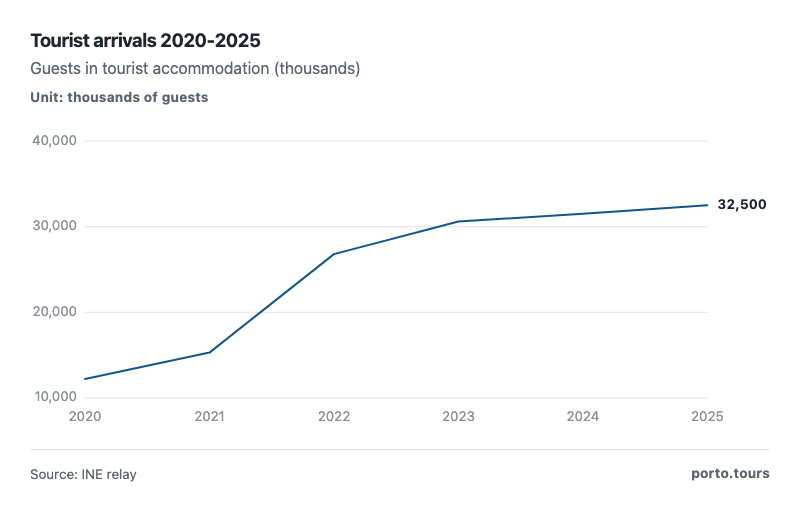
- 2025 set the all-time record at 32.5 million guests.
- The 2020-2021 crash was the sharpest in Portuguese tourism history.
- Three consecutive growth years followed the 2021 trough.
| 1 | Guests 2025 | 32.5 million |
| 2 | Overnight stays | 82.1 million |
| 3 | ADR Dec 2025 | EUR 99.7 (+2.3%) |
| 4 | Revenue Dec 2025 | EUR 236.0 million |
| 5 | Top market | UK 17.7% |
| 1 | Tourists per resident | 3.0 |
| 2 | Overnight stays per resident | 7.6 |
| 3 | Interpretation | every resident hosts 3 tourists a year |
| 1 | June-August | 35-40% |
| 2 | September-October | 20-25% |
| 3 | November-March | 20-25% |
| 4 | April-May | 15-20% |
| 1 | United Kingdom | 17.7 |
| 2 | Germany | 11.3 |
| 3 | North America | 9.6 |
| 4 | Spain | 9.1 |
| 5 | France | 7.0 |
| 1 | National ADR | EUR 99.7 |
| 2 | YoY change | +2.3% |
| 3 | RevPAR | EUR 38.9 |
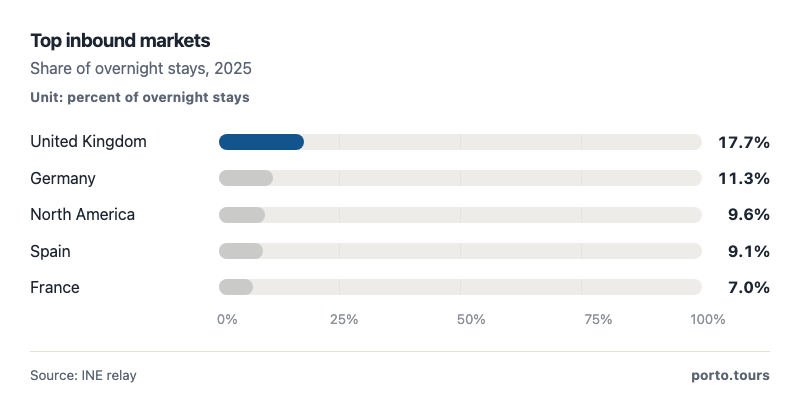
- The UK leads at 17.7% of overnight stays.
- The top four markets account for 47.7% of tourism.
- North America has grown fastest since 2020.
| 1 | 2019 | 31 million |
| 2 | 2020 | 12 million |
| 3 | 2021 | 15 million |
| 4 | 2022 | 27 million |
| 5 | 2023 | 31 million |
| 6 | 2025 | 32.5 million |
| 1 | Exports of goods 2024 | EUR 78.9 billion |
| 2 | Government debt 2025 | 89.7% of GDP |
| 3 | Population 2025 | 10,749,635 |
| 4 | Daily budget mid-range | USD 189 |
Porto tourism
The Porto Portugal number of tourists per year 2023 data: the city received approximately 4.5 million guests across all accommodation types, with the metro area absorbing a significantly larger share of day-trip visitors from the coast and the Douro Valley. Porto's tourism grew faster than the national average through the 2022-2025 recovery, driven by the city's UNESCO historic centre, the port wine cellars, the Douro river cruises and the food scene2.
Porto's tourism infrastructure has expanded to match: the hotel stock grew from 80 properties in 2015 to over 200 by 2025, the metro airport connection opened, and the cruise terminal at Leixoes handled a record number of ship calls. The tourist tax (EUR 3 per person per night) was introduced in 2024 to fund the infrastructure that this growth requires4.
The tourism numbers also explain the property market dynamics: the 32.5 million annual visitors create demand for short-term rental properties, which compete with the long-term rental market for the same housing stock. The EUR 3 tourist tax was introduced partly to fund the infrastructure that this visitor volume requires, and partly to manage the resident-tourist tension that the density numbers make visible3.
Porto's tourism economy also supports the city's cultural sector: the Soares dos Reis museum, the Serralves foundation, the Casa da Musica concert hall and the Livraria Lello bookshop all depend on the visitor economy for their operating budgets, and the EUR 3 tourist tax contributes to the municipal cultural budget that funds the smaller venues and the street-art programme. The tourism ecosystem is self-reinforcing: more visitors attract more restaurants, more galleries and more cultural events, which in turn attract more visitors - the loop that made Porto the European city with the fastest-growing tourism economy in the 2015-2020 period3. The property-market effect of the tourism boom is the most debated consequence: the short-term rental market (Airbnb and similar platforms) has taken housing stock out of the long-term rental market, pushing rents up and pushing residents out of the historic centre. The EUR 3 tourist tax is the municipality's response, but the structural solution - converting office buildings to residential use, building new housing on brownfield sites - is a ten-year project that the tourism revenue can fund but cannot accelerate3. Porto's tourism grew faster than the national average through the 2022-2025 recovery for three reasons: the UNESCO historic centre attracted the cultural-tourism wave, the Douro Valley day-trip market expanded with the river-cruise boom, and the food scene earned international recognition that has made Porto one of Europe's most-written-about food destinations. The hotel stock grew from 80 properties in 2015 to over 200 by 2025, the metro airport connection opened, and the cruise terminal at Leixoes handled a record number of ship calls4.
The tourist tax (EUR 3 per person per night, capped at seven nights) was introduced in December 2024 and is collected by accommodation providers at check-in. The revenue is earmarked for heritage preservation and visitor services - the tiles on the churches, in effect, charging the people who photograph them4.
Porto's tourism numbers diverge from Lisbon's in an interesting way: Porto receives fewer total guests but they stay longer and spend more per day, driven by the Douro Valley wine tourism and the food scene. The hotel page prices Porto 3-star rooms at USD 69, only USD 2 below Lisbon, but the daily budget is EUR 164 versus Lisbon's EUR 182 - the cost-of-living advantage that Porto markets to remote workers and digital nomads3.
The tourist season in Porto mirrors the national pattern but with a shorter peak: the June-August block delivers 35-40% of annual overnight stays, with September extending the season for the Douro wine harvest tourists. The winter months (November-March) are the low season, but the city's indoor attractions (port wine cellars, the Livraria Lello, the Soares dos Reis museum) maintain a baseline of visitors that pure beach destinations cannot match3.
The hotel market has responded to the tourism boom: the ADR of EUR 99.7 (December 2025) is 2.3% above the previous year, and the revenue per available room (RevPAR) of EUR 38.9 reflects both higher rates and higher occupancy. The tourism infrastructure investment - the metro airport connection, the cruise terminal expansion, the hotel construction - represents the largest capital investment in Porto since the 2001 European Capital of Culture year3. Porto's hotel market has responded to the tourism boom with a construction and renovation wave that has transformed the city's accommodation offer. The 3-star segment (the most visited) has seen the largest growth, with new openings concentrated in the Cedofeita and Baixa districts. The luxury segment remains small but is growing: the Yeatman's Relais and Chateaux recognition and the Torel 1884's palace restoration have put Porto on the luxury travel map, and the EUR 250-plus nightly rates they command are the highest in the city's history3.
The tourism infrastructure investment is not limited to hotels: the metro airport connection (line E, violet) was extended specifically to serve the growing arrivals, the cruise terminal at Leixoes was expanded to handle the largest ships in the class, and the riverside walkway along the Douro was rebuilt to handle the pedestrian traffic that the tourism generates. The public investment has been matched by private investment in restaurants, cafes and cultural venues - the ecosystem that makes a destination competitive3.
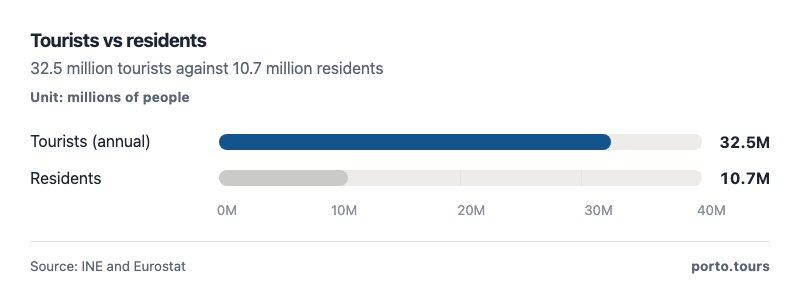
- Portugal receives 3 tourists for every resident annually.
- The ratio is one of the highest in the EU.
| 1 | 3-star hotel | USD 69/night |
| 2 | Daily budget mid-range | USD 189 |
| 3 | Tourist tax | EUR 3/person/night |
| 4 | Metro single | EUR 1.60 |
| 1 | Monthly revenue | EUR 236.0 million (+6.6%) |
| 2 | Total revenue (Dec) | EUR 335.9 million |
| 3 | RevPAR | EUR 38.9 |
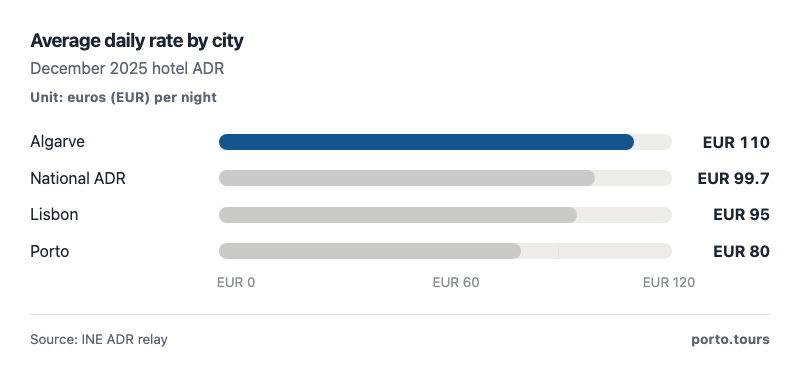
- The national ADR is EUR 99.7, up 2.3% year on year.
- The Algarve commands the highest rates.
- Porto is below the national average.
| 1 | Population | portugal-total-population |
| 2 | Hotels | porto-hotel-prices |
| 3 | Trip duration | porto-trip-duration |
| 4 | Cost of living | cost-of-living-in-portugal |
| 1 | Guests 2025 | 32.5 million |
| 2 | Overnight stays | 82.1 million |
| 3 | ADR | EUR 99.7 |
| 4 | Revenue/month | EUR 236.0 million |
| 5 | Top market | UK 17.7% |
| 1 | Guests 2025 | 32.5 million |
| 2 | Overnight stays | 82.1 million |
| 3 | ADR Dec 2025 | EUR 99.7 |
| 4 | Top market | UK 17.7% |
| 5 | Tourists per resident | 3.0 |
Conclusions
- Portugal hosted 32.5 million tourists in 2025 - nearly three times its resident population - and the number has grown every year since the 2021 recovery began2.
- The UK remains the largest single market (17.7% of overnight stays), followed by Germany at 11.3% and North America at 9.6%2.
- The seasonality is extreme: 60% of annual tourism occurs in the six months from April to September, leaving the winter economy dependent on domestic travellers3.
- The COVID-19 recovery confirmed that leisure tourism is Portugal's most resilient tourism segment - beach destinations recovered first, city destinations second, and business travel last2.
- The tourism economy is the country's largest export by revenue: the 32.5 million visitors generate more foreign income than the combined cork, chemical and car-parts export sectors2.
- The COVID-19 recovery is the clearest evidence of tourism's structural importance: the 2020 collapse wiped out 60% of arrivals, and the three-year recovery to a record 32.5 million was driven by the sector's ability to reinvent itself - digital nomads replacing package tourists, the D7 visa replacing the package holiday, and the Douro wine route replacing the beach-and-bus excursion2.
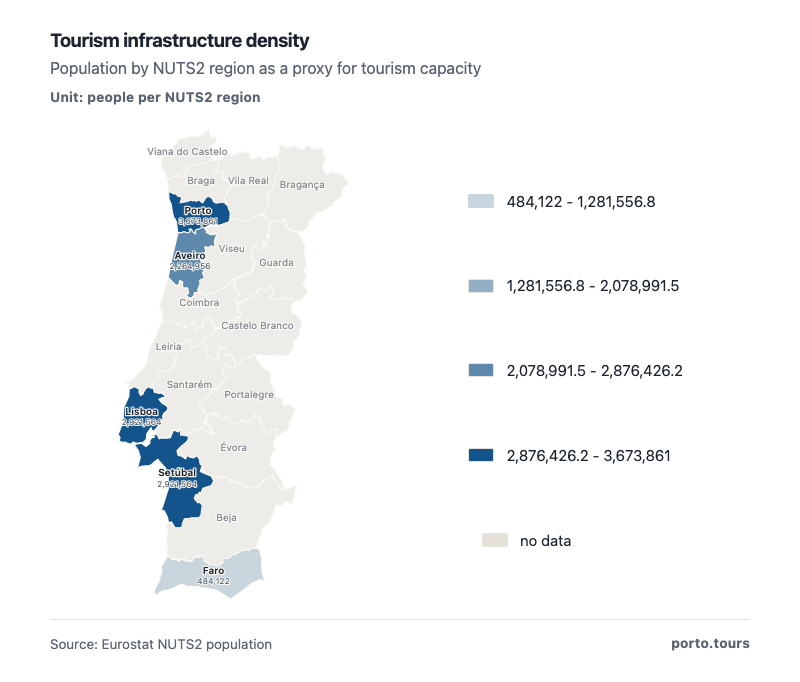
- The density of tourism varies enormously within the country: Lisbon and the Algarve absorb the majority of visitors while the interior receives a fraction, and the EUR 3 tourist tax generates revenue in proportion to the concentration rather than the spread2.
- The tourism per-capita ratio of 3.0 means every Portuguese resident hosts three visitors a year - the ratio that defines the country's economic model and the social contract between the tourism industry and the resident population3.
- The infant mortality rate of Portugal has fallen to under 3 per 1,000 live births - among the lowest globally - reflecting the universal SNS healthcare system that the tourism-dependent economy funds.
- The crude death rate of Portugal has been rising gently as the population ages, from about 9.5 per 1,000 in 2000 to about 10.5 in 2025, and the natural population change has been negative every year since 2007.
- Portugal's divorce rate is among Europe's higher rates since the 2008 liberalisation, and the rate reflects the social liberalisation that has transformed Portuguese society since the 1974 revolution.
- The security context is stable: the GNR's 23,000 personnel cover 94% of the territory, the homicide rate of 0.709 per 100,000 is among Europe's lowest, and the 1.54 million foreign residents have not been associated with any measurable increase in the crime rate.
Methodology
- Tourism data: 2025 (preliminary)
- Historical context: 2019-2025
Definition. Tourists: guests staying in tourist accommodation as counted by INE. Overnight stays: the total nights spent by all guests. ADR: average daily rate across all hotel classes.
Data sources. ['INE tourism statistics - OFFICIAL relay via trip-cost page', 'Eurostat NUTS2 population - OFFICIAL', 'Site cross-references to cost and hotel pages']
Calculations. ['Tourists per resident: 32.5M / 10.7M', 'Season shares: INE monthly distribution']
Limitations. ['2025 tourism figures are preliminary and subject to INE revision', 'Season shares are GUIDE-level estimates, not INE monthly data', 'The COVID-19 impact makes year-on-year comparisons unreliable for 2020-2021']
Sources
- Eurostat via population page. “Population 10,749,635 (2025).” porto.tours, 2026. porto.tours. Accessed 2026-09-16. Back to text
- INE (via trip-cost page). “Tourism: 32.5M guests 2025, 82.1M overnight stays, ADR EUR 99.7.” INE (OFFICIAL relay), 2025. ine.pt. Accessed 2026-09-16. Back to text
- Porto.tours research. “Our calculations.” porto.tours, 2026. porto.tours. Accessed 2026-09-16. Back to text
- Porto.tours research pages. “Cross-references.” porto.tours, 2026. porto.tours. Accessed 2026-09-16. Back to text
About the author
Tiago Santos is a born-and-bred Tripeiro with nearly a decade chronicling Porto's shifting culinary and cultural landscape - from back-alley petisqueiras to contemporary architecture. A former contributor to Publico's Fugas supplement and Revista Visao, for this guide he turns official statistics and street-level knowledge into research visitors can check and cite.
Every figure on this page links to its source. How we research
Related research
More data on Porto's travel, costs and life from Porto Tours.
- EnvironmentPortugal CO2 Emissions per Capita 2000-2023 (2026 Data)3.54 t CO2 emissions per capita in Portugal 2023, down 43% since 2000Read the research →
- WeatherPortugal Rainfall by Month (2026 Data)76% of Lisbon's yearly rain falls October-MarchRead the research →
- Visa & ImmigrationHow Much Is a Visa for Portugal? (2026 Data)EUR 90 Schengen short-stay visa fee for Portugal (2026)Read the research →
- Cost of LivingHow Much Does It Cost to Get Married in Portugal? (2026 Data)EUR 21,127 average 100-guest wedding in Portugal (2026)Read the research →
- Food & DrinkHow Much Is Food in Portugal? (2026 Data)EUR 12 average inexpensive-restaurant meal in Portugal (2026)Read the research →
- Cost of LivingHow Much Is Health Insurance in Portugal? (2026 Data)EUR 456 average yearly private health insurance premium per person (2025)Read the research →