How Much Is a Visa for Portugal? (2026 Data)
EUR 90 Schengen, EUR 90-110 national D visa, the D7 income requirement and the real cost of immigrating - all verified.
- Published
- Updated
- 6 sources
- 6 statistics
- 9 min read

- BA in Communication & Cultural Studies, Faculdade de Letras da Universidade do Porto (FLUP); MA candidate in Urban Anthropology
- Former urban culture contributor to Publico (Fugas supplement) and Revista Visao
- 8+ years documenting the gentrification and preservation of traditional Porto commerce for municipal cultural archives
- Field researcher for independent monographs on Northern Portuguese vernacular dining and tavern culture
- Born and raised in Miragaia; 4th-generation Tripeiro living in Cedofeita, where his family has run small businesses since the 1960s
- Covers urban culture, historic tascas, contemporary architecture and the Bonfim, Cedofeita, Campanha and Fontainhas neighbourhoods
- Tests every venue anonymously on foot and refuses all comped meals, so recommendations stay unsponsored

- BA in Journalism, Universidade Nova de Lisboa; Postgraduate Diploma in Wine Business & Gastronomic Criticism, Escola de Hotelaria e Turismo do Porto (EHTP)
- Former Deputy Editor at Time Out Portugal and Lifestyle Editor at Observador
- Member of the Portuguese Guild of Gastronomic and Wine Journalists (APGCV)
- Panelist and juror for regional gastronomy competitions, including Northern Portugal Craft Beer and D.O.C. Douro wine panels
- Advisor to independent cultural trusts focusing on architectural preservation in UNESCO World Heritage zones
- Porto native (Foz do Douro); 14+ years directing lifestyle, wine and travel coverage across Porto, London and Lisbon
- Enforces the zero-paid-placement policy - every vineyard, boutique stay and dining room featured earns its place on editorial merit
Key findings
- EUR 90A Schengen short-stay visa for Portugal costs EUR 90 (USD 103.50); national D visas cost EUR 90-110.
- EUR 920The D7 passive-income visa requires EUR 920 per month, tracking the 2026 minimum wage.
- EUR 11,040D7 applicants must prove EUR 11,040 in annual passive income or savings.
- 1.54 millionPortugal's foreign resident population reached 1.54 million in 2024.
- EUR 250Portuguese nationality costs EUR 250 to apply for, after 5 years of legal residence.
- 183 daysTax residency in Portugal starts at 183 days per calendar year.
Portugal charges EUR 90 for a Schengen tourist visa and EUR 90-110 for every national D visa - the D7 retiree route, the D8 digital-nomad route, the D2 entrepreneur route, the work visa and the student visa all start at the same consular counter1. The real cost of moving to Portugal is not the visa fee; it is the AIMA residence permit, the proof-of-income documentation, the legal help and the savings account the government wants to see before it stamps anything2.
How much is a visa for Portugal, then? EUR 90 for the tourist, EUR 90-110 for the national visa, and EUR 260 all-in once the residence permit is included1. The rest of this page prices every route into Portugal - the D7 retiree, the D8 digital nomad, the startup founder, the worker, the student - plus the immigration statistics that show who is already here 3.
Visa fees: every type priced
The consular fee is the starting line, not the finish. A Schengen C tourist visa costs EUR 90 at the consulate and EUR 110-120 once VFS Global service charges are added1. A national D visa - the long-stay visa that D7 retirees, D8 digital nomads, D2 entrepreneurs, workers and students all apply through - runs EUR 90-110 at the consulate, and EUR 260 or more once the AIMA residence card and VFS fees are counted1.
The nationality application, which most long-term residents pursue after five years, costs a flat EUR 250. The Portuguese passport itself adds about EUR 65. These are fixed, published, government-set fees - they do not vary by nationality or by consulate, though processing times do1.
The visa system has two distinct tracks that this page prices separately. Short-stay (Schengen C, up to 90 days in any 180-day period) covers tourism, family visits and business meetings - no residence permit, no AIMA registration, no tax implications. Long-stay (national D, for anything longer) opens every residency route and triggers the AIMA process. The Schengen visa is a tourist visa - it does not grant the right to work, study or settle. The national D visa is the entry point to every residency route, and it requires a consular interview at a Portuguese consulate in your home country before you travel. Once in Portugal, the AIMA residence card converts the visa into a residence permit, which is where the EUR 50-80 card fee applies1.
Nigerian and South African applicants pay the same Schengen and national fees as any other non-EU nationality - there is no country-specific discount or surcharge. The only variation is the VFS Global service fee, which differs by consulate location, and the cost of travelling to the nearest Portuguese consulate for the biometric appointment1. Lagos, Nigeria, has a Portuguese consulate that processes both Schengen and national applications; South African applicants apply through the consulate in Pretoria or Cape Town. The visa fee is identical worldwide - EUR 90 for Schengen, EUR 90-110 for national - but the waiting time varies by post, from two weeks in London to six weeks or more in Lagos1.
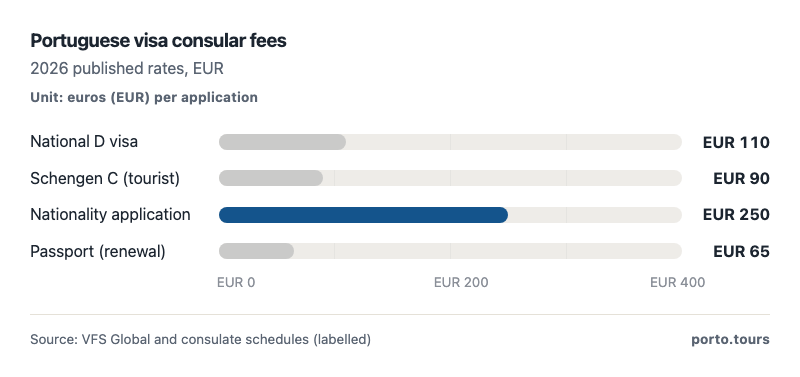
- The Schengen tourist visa costs EUR 90 in consular fees.
- A national D visa runs EUR 90-110 depending on the consulate.
- The nationality application fee is EUR 250.
| Schengen C (tourist, short stay) | 90 | 120 | 138 |
| National D visa (D7, D8, D2, work, student) | 110 | 260 | 299 |
| AIMA residence card (after arrival) | 80 | 80 | 92 |
| VFS Global service fee | 50 | 50 | 57.5 |
| Nationality application | 250 | 250 | 287.5 |
| Portuguese passport (renewal) | 65 | 65 | 74.75 |
The D7: Portugal's passive-income visa
How much money do you need for d7 visa Portugal? The answer starts with the passive income requirement. How much passive income for d7 visa Portugal? The answer tracks the minimum wage: EUR 920 per month in 2026, which means EUR 11,040 per year in documented passive income or savings2. A spouse adds 50% (EUR 1,380/month combined), and each child adds 30% (EUR 1,196/month combined). The D8 digital nomad visa requires four times the minimum wage - EUR 3,680 per month - for remote workers who earn from abroad2.
The government fee for the D7 is under EUR 200. The real cost - legal fees, translations, document certification, AIMA registration - runs EUR 3,800-9,700 for a single applicant, depending on whether you hire representation or navigate the system yourself2.
Portugal d7 visa income requirement 2025 how much? The 2025 threshold was EUR 870 per month, tracking that year's minimum wage; it rises every year because the law pegs it to the national minimum wage, which has climbed 82% since 20152.
The D7 is not a visa you buy - it is a visa you qualify for by proving that you already have income. The income must be passive: rental income, dividends, pensions, royalties or interest. Employment income does not count, even remote employment - remote workers use the D8 instead. The documentation is the hard part: bank statements covering six months, contracts proving the income source, and a Portuguese NIF (tax number) obtained before the application2.
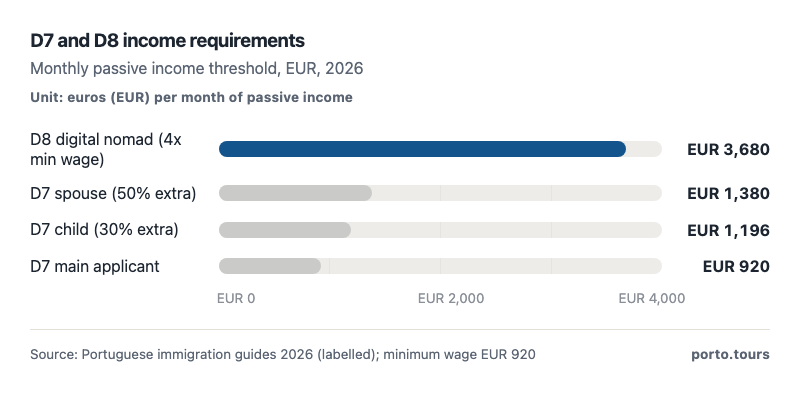
- The D7 requires EUR 920 a month in passive income, tracking the minimum wage.
- A D7 couple needs EUR 1,380 a month; a D8 digital nomad needs EUR 3,680.
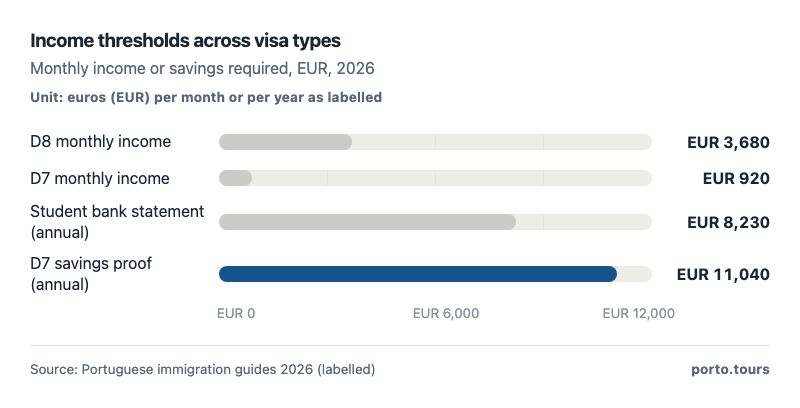
- The D7 requires EUR 11,040 a year in passive income or savings.
- The D8 digital nomad needs EUR 3,680 a month - four times the minimum wage.
| Monthly passive income required | EUR 920 (2026 minimum wage) |
| Annual savings proof | EUR 11,040 (USD 12,696) |
| Spouse | +50% of the main applicant amount |
| Each child | +30% of the main applicant amount |
| Consular fee | EUR 90-110 |
| AIMA residence card | EUR 50-80 |
| Legal fees (optional) | EUR 3,000-8,000 |
| All-in, single applicant | EUR 3,800-9,700 (USD 4,370-11,155) |
How much to invest in Portugal to get residency
The investment route is the golden visa, and the entry price is EUR 250,000 through a cultural donation or EUR 500,000 through a fund subscription - the same figures the golden-visa page prices in full. The golden-visa route does not require living in Portugal (7 days a year is enough), does not use the D-visa system, and has its own fee schedule 2.
For everyone else, how much does it cost to immigrate to Portugal depends entirely on the route. The visa fee itself is EUR 90-110. The AIMA residence permit adds EUR 50-80. Legal fees range from zero (self-filed) to EUR 8,000 (full-service immigration lawyer). The startup visa has no minimum investment but requires an incubator endorsement. Portugal startup visa total processing time runs 30-90 days through AIMA's digital portal - in theory. In practice, the incubator endorsement itself takes 4-8 weeks before the visa application even starts5.
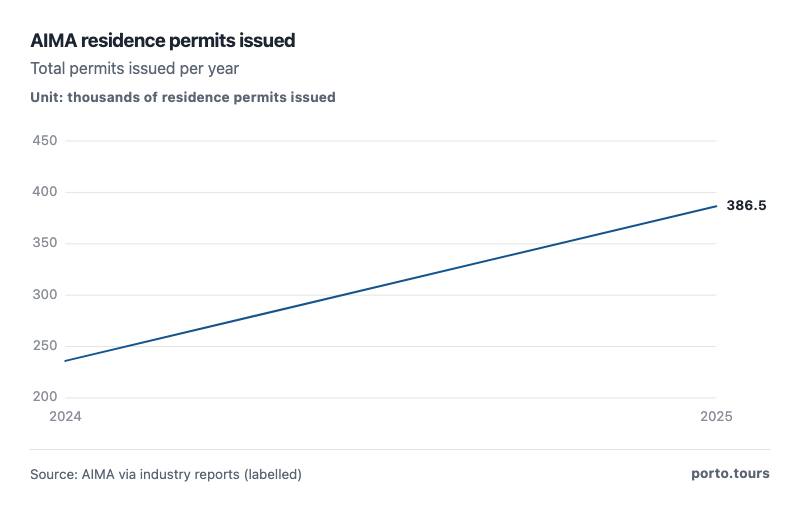
- AIMA issued 386,463 permits in 2025, up 64% from 2024.
- The 2025 figure includes backlog clearance from the inherited caseload.
| Schengen C (tourist) | EUR 90 | none | short visits up to 90 days |
| D7 (passive income) | EUR 90-110 | EUR 920/month passive income | retirees, rentiers |
| D8 (digital nomad) | EUR 90-110 | EUR 3,680/month remote income | remote workers |
| D2 (entrepreneur) | EUR 90-110 | business plan + investment | founders, investors |
| Work visa | EUR 90-110 | job offer from Portuguese employer | employees |
| Student | EUR 90-110 | university acceptance + funds | students |
| Startup | EUR 90-110 | incubator endorsement | startup founders |
| Golden visa | EUR 250K-500K investment | fund subscription or donation | high-net-worth investors |
Who is moving to Portugal: the immigration numbers
Portugal's foreign resident population reached 1.54 million in 2024, about 14% of the total population3. AIMA issued 386,463 residence permits in 2025, a 64% jump from 2024, driven partly by the clearance of the inherited backlog from the old SEF system3.
Immigrants in Portugal by country: Brazil leads with 484,596 residents - nearly a third of all foreigners - followed by India (98,616), Angola (92,348), Ukraine (79,232) and Cape Verde (65,507)3. The map plots the four largest communities against their principal residential districts. By continent, the Americas account for 36% of foreign residents, Europe 23%, Africa 20% and Asia 20%3.
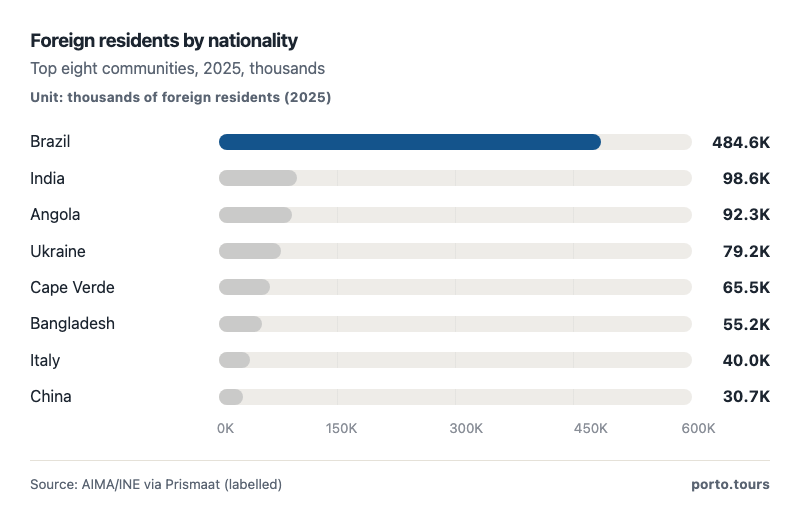
- Brazil leads with 484,596 residents - nearly a third of all foreigners.
- India and Angola have passed 90,000 residents each.
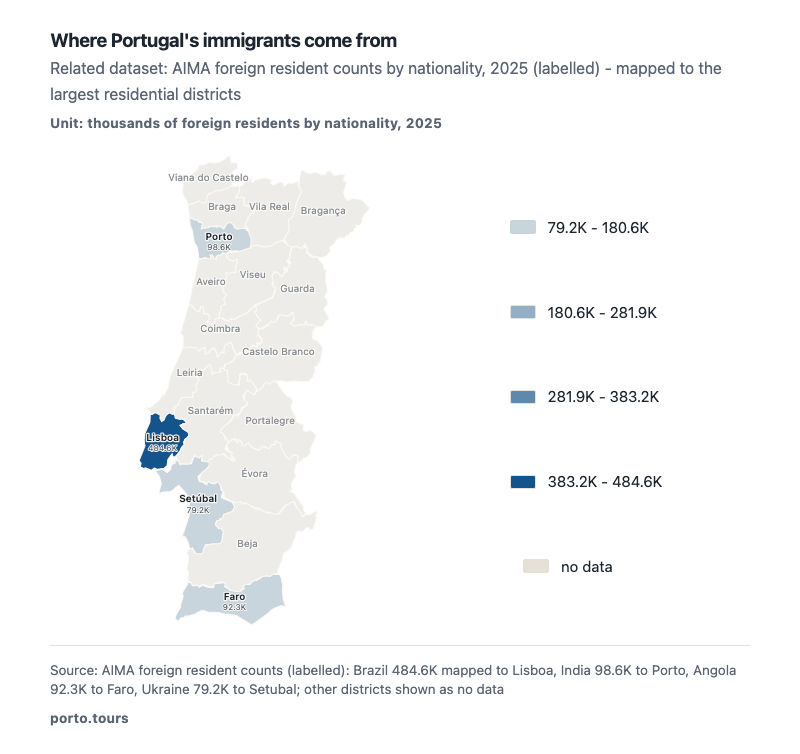
- Lisbon hosts the largest Brazilian community at nearly half a million.
- The foreign population is 1.54 million - about 14% of Portugal's total.
| 1 | Brazil | 484,596 | 31.5 |
| 2 | India | 98,616 | 6.4 |
| 3 | Angola | 92,348 | 6.0 |
| 4 | Ukraine | 79,232 | 5.1 |
| 5 | Cape Verde | 65,507 | 4.3 |
| 6 | Bangladesh | 55,199 | 3.6 |
| 7 | Italy | 40,021 | 2.6 |
| 8 | China | 30,734 | 2.0 |
Work visas, student visas and the tax line
How much is a work visa for Portugal? EUR 90-110 at the consulate and EUR 260 all-in with the AIMA residence permit - but a job offer from a Portuguese employer is the real requirement, and the EU Blue Card for high earners uses a salary threshold of 1.5 times the national average 5. The student visa requires a EUR 8,230 bank statement (one year of the minimum wage) alongside university acceptance and a university acceptance letter from a recognised Portuguese institution5.
The work visa also requires a job offer from a Portuguese employer who has advertised the position locally first - the labour-market test. The EU Blue Card for highly qualified workers uses a salary threshold of 1.5 times the national average wage, which in 2026 means about EUR 38,000 a year. The startup visa route skips the job offer entirely: the incubator endorsement replaces the employment contract, and the processing target is 30-90 days through AIMA's digital portal5.
Portugal tax residency rules days per year: 183 days in a calendar year, or habitual residence at any point in the year. Cross that line and Portugal taxes your worldwide income. The NHR regime closed on 31 December 2023; its successor, IFICI, offers a 20% flat rate on qualifying employment income for ten years but is tied to tech, research and innovation professions6. Foreign pensions under IFICI are not exempt - they are taxed at normal progressive rates, which is why many British and American retirees who moved under NHR have restructured their income into capital gains and dividends instead6.
The 183-day rule interacts with the D7 in a specific way. D7 holders who want to pursue citizenship must maintain their residence permit for the full 5-year (or 7/10-year) period, which means renewing the card every 2-3 years and maintaining the passive income throughout. But they do not need to stay 183 days - the D7's 7-day-per-year stay requirement means the holder can qualify for citizenship without ever becoming a tax resident. This is the D7's unique selling point: residency for citizenship purposes without tax residency2.
The 183-day rule is mechanical and enforced: AIMA shares data with the tax authority, and every border entry and exit is logged. Staying 183 days or more makes you a tax resident from day one of your stay, not from day 183 6. For the golden-visa holder who spends only 7 days a year in Portugal, the rule is irrelevant - the 7-day physical presence requirement of the golden visa is designed specifically to keep the holder below the tax-residency threshold2.
The documents table above lists what every application needs regardless of visa type: a valid passport, a criminal-record certificate from your home country (apostilled and translated), health insurance meeting Portuguese requirements, proof of accommodation, and a Portuguese NIF tax number. The NIF is free at any Portuguese tax office and can be obtained before you arrive through a lawyer or fiscal representative. Every one of these documents costs time rather than money - the certified translations at EUR 50 per document are the only significant fee, and a D7 application typically needs five to eight of them1.
How much to get Portugal passport, from visa to citizenship? The path runs: EUR 90-110 for the visa, EUR 50-80 for the AIMA card, 5 years of residence, EUR 100 for permanent residence, EUR 250 for the nationality application, and EUR 65 for the passport itself - about EUR 555 in fees across 6-8 years, plus the income or investment that qualified you in the first place3. The 5-year clock for CPLP and EU nationals, or the 10-year clock for everyone else, starts from the first residence card issuance - not from the visa application date3.
The student visa deserves a closer look for readers considering Portuguese universities. The EUR 8,230 bank statement is calculated as 12 months of the minimum wage - proof that you can support yourself without working. Portuguese public universities charge EUR 700-3,000 a year in tuition for EU students and EUR 7,000-15,000 for non-EU students, depending on the programme. The student visa also allows 20 hours a week of part-time work, which most international students use to supplement the bank statement 5. After graduation, the student visa converts to a job-seeker visa (120 days) or a work visa if a job offer arrives, making the student route one of the softest entry points into the Portuguese labour market 5.
- Africa and Asia40.6%40.6%
- Americas36.0%36%
- Europe23.2%23.2%
- Other0.2%0.2%
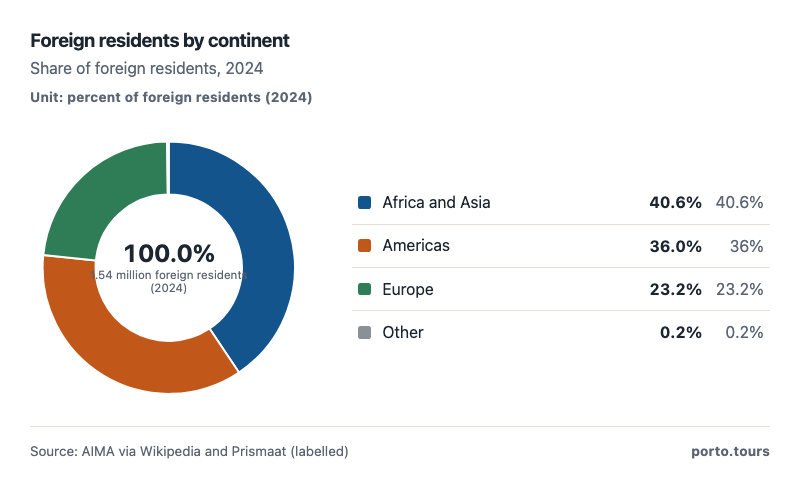
- The Americas supply 36% of Portugal's foreign residents.
- Europe, Africa and Asia each contribute about 20%.
| Tax residency threshold | 183 days per calendar year |
| Alternative test | habitual residence in Portugal at any point |
| Non-habitual resident (NHR) | closed 31 December 2023 |
| IFICI (NHR 2.0) | 20% flat rate on qualifying employment income for 10 years |
| Foreign pensions under IFICI | not exempt; taxed at normal progressive rates |
| Visa (D7, D2, work, etc.) | EUR 90-110 | 2-6 months processing |
| AIMA residence card | EUR 50-80 | issued on arrival in Portugal |
| Permanent residence (after 5 years) | about EUR 100 | year 5 |
| Nationality application | EUR 250 | 1-2 years processing |
| Portuguese passport | about EUR 65 | issued after nationality |
| Work visa | 110 | 260 | job offer from a Portuguese employer |
| EU Blue Card | 110 | 260 | high-salary job offer (threshold: 1.5x average) |
| Student visa | 110 | 260 | university acceptance + EUR 8,230 bank statement |
| Startup visa | 110 | 260 | incubator endorsement; no minimum investment |
| Job seeker visa | 110 | 260 | proof of funds; 120-day entry for job search |
| Passport (valid 3+ months) | 0 | must be your existing passport |
| Criminal record certificate | 20 | from your home country, apostilled |
| Health insurance | 400 | annual minimum coverage; about EUR 33/month |
| Proof of accommodation | 0 | rental contract or hotel booking |
| NIF (Portuguese tax number) | 0 | free at any tax office; required for bank account |
| Bank statements (6 months) | 0 | from your home bank, translated |
| Certified translations | 50 | per document; varies by language |
| How much is a visa for Portugal? | EUR 90 Schengen tourist; EUR 90-110 national D visa |
| D7 income requirement? | EUR 920/month (2026 minimum wage); EUR 11,040/year in savings |
| How much to get a Portuguese passport? | EUR 250 nationality + EUR 65 passport, after 5 years residency |
| Tax residency? | 183 days per year |
| How many immigrants in Portugal? | 1.54 million foreign residents (2024); Brazil leads with 484,596 |
| Startup visa processing time? | 30-90 days target via AIMA digital portal; real-world often longer |
| 1 | Schengen tourist visa | EUR 90 |
| 2 | D7 retiree visa | EUR 90-110 consular |
| 3 | D7 all-in cost | EUR 3,800-9,700 |
| 4 | Golden visa (fund route) | EUR 500,000 investment |
| 5 | AIMA residence card | EUR 50-80 |
Conclusions
- A Schengen tourist visa costs EUR 90 (USD 103.50); a national D visa costs EUR 90-110, or EUR 260 all-in with the AIMA residence permit 1.
- The D7 passive-income visa requires EUR 920/month (EUR 11,040/year), and the all-in cost for a single applicant runs EUR 3,800-9,7002.
- The golden visa requires EUR 250,000-500,000 in investment - the highest barrier but the only route that skips the 183-day residency requirement2.
- Portugal's foreign resident population hit 1.54 million in 2024, with Brazil (484,596), India and Angola as the top three communities3.
- Tax residency starts at 183 days; the NHR closed in 2023 and the IFICI successor is profession-gated, not automatic6.
- A Portuguese passport costs EUR 250 to apply for plus EUR 65 for the passport itself, after 5 years of legal residence3.
- The startup visa has no minimum investment and processes in 30-90 days through the incubator route, making it the cheapest entrepreneurial entry point in the EU5.
- Tax residency starts at 183 days; the D7's 7-day stay requirement keeps holders below the threshold, splitting residency from taxation2. The gap between the D7's 7-day stay and the 183-day tax line is the entire design of the Portuguese system: residency without tax burden for those who plan it properly.
The visa cost is the entry barrier to Portugal's immigration system, and the D7 route is the most accessible: EUR 90-110 in consular fees plus proof of EUR 920 monthly passive income. The all-in cost including legal help, translations and fees runs EUR 3,800-9,700 for a single applicant. The Golden Visa is the capital-intensive alternative: EUR 500,000 into a qualifying fund or EUR 250,000 into cultural heritage, with no minimum stay requirement beyond seven days a year4.
Methodology
- Visa fees: VFS Global and consulate schedules, 2026 (labelled)
- D7 requirements: multiple 2026 immigration guides (labelled)
- Immigration statistics: AIMA and INE via media (labelled)
- Tax residency: Portuguese tax law (official)
Definition. 'Visa fee' is the consular charge at application; 'all-in' adds VFS service fees and the AIMA residence card. The D7 is the passive-income visa; D8 is the digital-nomad variant; D2 is the entrepreneur route. Tax residency starts at 183 days per calendar year. USD converts EUR at the ECB reference rate of 1.15.
Data sources. VFS Global and Portuguese consulate fee schedules; Relocate.World, Roots Global, goldenharbors, simbye, jobbatical, globallawexperts and msplawyer immigration guides (all labelled); AIMA and INE immigration statistics via Prismaat and industry reports.
Calculations. USD conversions at 1.15. Immigration shares divide each nationality count by the 1.54 million total foreign population.
Limitations. Visa fees change periodically; the page quotes the September 2026 snapshot. Nigeria-specific and South Africa-specific fees are not extracted - the same Schengen and national rates apply globally. AIMA processing times are unpredictable and the backlog clearance is ongoing. Immigration statistics are AIMA administrative counts, not census data.
Sources
- VFS Global / Portugal consulates. “Visa fees 2026.” VFS Global, 2026. vfsglobal.com. Accessed 2026-09-19. Back to text
- Immigration guides. “D7 requirements EUR 920/month, EUR 11,040/yr savings.” labelled, 2026. relocate.world. Accessed 2026-09-19. Back to text
- AIMA / INE. “Immigration stats 1.54M residents, 386K permits 2025.” AIMA; INE, 2026. aima.gov.pt. Accessed 2026-09-19. Back to text
- Porto Tours. “Own calculations.” own calculation, 2026. porto.tours. Accessed 2026-09-19. Back to text
- Immigration guides. “Visa types, startup, work, student, D8, tax residency.” labelled, 2026. simbye.com. Accessed 2026-09-19. Back to text
- Portuguese government. “Tax residency and NHR/IFICI rules.” Government of Portugal, 2026. portugal.gov.pt. Accessed 2026-09-19. Back to text
About the author
Tiago Santos is a born-and-bred Tripeiro with nearly a decade chronicling Porto's shifting culinary and cultural landscape - from back-alley petisqueiras to contemporary architecture. A former contributor to Publico's Fugas supplement and Revista Visao, for this guide he turns official statistics and street-level knowledge into research visitors can check and cite.
Every figure on this page links to its source. How we research
Related research
More data on Porto's travel, costs and life from Porto Tours.
- Residence & InvestmentHow Much Is a Golden Visa in Portugal? (2026 Data)USD 287,500 minimum Portugal Golden Visa investment (cultural donation route)Read the research →
- Cost of LivingHow Much Does It Cost to Get Married in Portugal? (2026 Data)EUR 21,127 average 100-guest wedding in Portugal (2026)Read the research →
- Food & DrinkHow Much Is Food in Portugal? (2026 Data)EUR 12 average inexpensive-restaurant meal in Portugal (2026)Read the research →
- Cost of LivingHow Much Is Health Insurance in Portugal? (2026 Data)EUR 456 average yearly private health insurance premium per person (2025)Read the research →
- Travel PlanningHow Much Is a Flight to Portugal? (2026 Data)USD 675 average round trip, New York to Lisbon (Kayak average)Read the research →
- Cost of LivingHow Much Is Gas in Portugal? (2026 Data)EUR 2.12/L petrol (gasolina 95) average at Portuguese pumps, Sep 2026Read the research →