Portugal Median Income (2026 Data)
Portugal median income: EUR 12,646 per year (Eurostat 2024). Salaries, minimum wage history, the Europe ranking, regional medians and inequality - all in one page.
- Published
- Updated
- 6 sources
- 6 statistics
- 9 min read

- BA in Communication & Cultural Studies, Faculdade de Letras da Universidade do Porto (FLUP); MA candidate in Urban Anthropology
- Former urban culture contributor to Publico (Fugas supplement) and Revista Visao
- 8+ years documenting the gentrification and preservation of traditional Porto commerce for municipal cultural archives
- Field researcher for independent monographs on Northern Portuguese vernacular dining and tavern culture
- Born and raised in Miragaia; 4th-generation Tripeiro living in Cedofeita, where his family has run small businesses since the 1960s
- Covers urban culture, historic tascas, contemporary architecture and the Bonfim, Cedofeita, Campanha and Fontainhas neighbourhoods
- Tests every venue anonymously on foot and refuses all comped meals, so recommendations stay unsponsored

- BA in Journalism, Universidade Nova de Lisboa; Postgraduate Diploma in Wine Business & Gastronomic Criticism, Escola de Hotelaria e Turismo do Porto (EHTP)
- Former Deputy Editor at Time Out Portugal and Lifestyle Editor at Observador
- Member of the Portuguese Guild of Gastronomic and Wine Journalists (APGCV)
- Panelist and juror for regional gastronomy competitions, including Northern Portugal Craft Beer and D.O.C. Douro wine panels
- Advisor to independent cultural trusts focusing on architectural preservation in UNESCO World Heritage zones
- Porto native (Foz do Douro); 14+ years directing lifestyle, wine and travel coverage across Porto, London and Lisbon
- Enforces the zero-paid-placement policy - every vineyard, boutique stay and dining room featured earns its place on editorial merit
Key findings
- EUR 12,646Portugal's median annual income is EUR 12,646 - about EUR 1,054 a month (Eurostat 2024).
- EUR 1,602The gross average monthly salary in Portugal reached EUR 1,602 in 2024 (INE).
- EUR 920The minimum wage in 2026 is EUR 920 a month, up 82% since 2015.
- 5.20Portugal's richest 20% earn 5.20 times the share of the poorest 20% (2024).
- 16.6%At 16.6%, Portugal's population at risk of poverty, close to the EU-27 rate.
- EUR 13,820Grande Lisboa posts the country's highest regional median income, EUR 13,820 a year.
Portugal's median income - the exact middle of what residents earn - reached EUR 12,646 a year in 2024 - the median income Portugal 2024 data, per Eurostat's harmonised series, and INE's own household survey puts the latest figure higher still1. The median matters more than the average: averages are pulled up by the top of the distribution, while the median is the income of the person exactly halfway up the ladder - and in Portugal that person earns about EUR 1,054 a month2.
This page counts Portuguese incomes the way the statisticians do: the median and the mean, side by side, from 2015 to 2024; the salary statistics behind them (gross EUR 1,602 a month, net EUR 1,142); the minimum wage's 82% climb since 2015; the regional map from Lisbon's suburbs to the northern interior; and the inequality measures that show who is being left behind as the series climbs3.
Median salary Portugal: the honest starting point
Salary statistics start with a distinction most articles skip: there are three different "median income" numbers, and they are all correct. The median equivalised net income - Eurostat's harmonised measure, which counts all household income divided by household members - reached EUR 12,646 in 20241. INE's own household survey (ICOR 2025) reports EUR 14,465 for the same reference year; the difference is survey design, and this page keeps the two series separate throughout3. And the median net salary - what an employed person takes home - was EUR 980 a month in 2024, a different statistic entirely from household income3.
The trend is the unambiguous part. The median has risen every single year of the series: from EUR 8,435 in 2015 to EUR 12,646 in 2024, a 50% climb that outpaced inflation for most of the period. The projection continues the slope to roughly EUR 18,000 by 2050 - our calculation, not a forecast2. What is the median income in Portugal, then? EUR 12,646 a year - with the honest caveat that the household measure and the salary measure answer different questions, and the sections below keep them apart2.
Projection: linear trend of 2015–2025 yearly values, 95% prediction range. Our calculation, not a forecast.
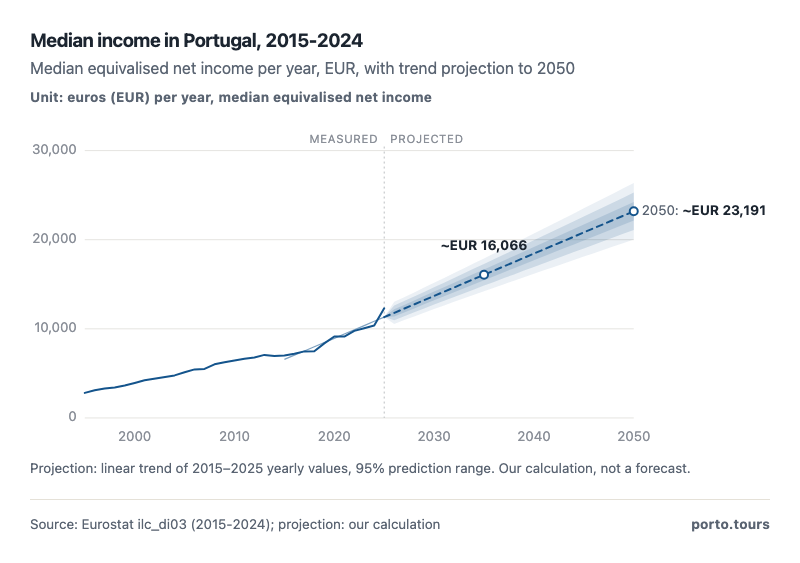
- The median rose from EUR 8,435 in 2015 to EUR 12,646 in 2024 - up 50%.
- Every year of the series set a new high; the series has never fallen.
- The projection reaches about EUR 18,000 by 2050 - our calculation, not a forecast.
| 1995 | 2,811 |
| 1996 | 3,109 |
| 1997 | 3,290 |
| 1998 | 3,426 |
| 1999 | 3,643 |
| 2000 | 3,923 |
| 2001 | 4,226 |
| 2004 | 4,776 |
| 2005 | 5,124 |
| 2006 | 5,447 |
| 2007 | 5,500 |
| 2008 | 6,020 |
| 2009 | 6,256 |
| 2010 | 6,462 |
| 2011 | 6,648 |
| 2012 | 6,780 |
| 2013 | 7,070 |
| 2014 | 6,941 |
| 2015 | 7,013 |
| 2016 | 7,210 |
| 2017 | 7,467 |
| 2018 | 7,488 |
| 2019 | 8,364 |
| 2020 | 9,145 |
| 2021 | 9,133 |
| 2022 | 9,771 |
| 2023 | 10,076 |
| 2024 | 10,373 |
| 2025 | 12,301 |
Median household income vs the mean: why the gap matters
The median household income Portugal statistics describe the middle of the distribution: half of residents live in households with more equivalised income, half with less. The mean - the total divided by everyone - is always higher, because top incomes pull it up. In 2024 the mean equivalised income (EUR 13,243) exceeded the median (EUR 12,646) by about 5%1. That five-percent gap is the standard fingerprint of inequality, and tracking it over time is the cleanest way to see whether growth is shared or concentrated.
For households, the equivalisation matters practically: a couple with two children needs less than four singles to reach the same standard of living, because the scales assume shared housing and heating. That is why the median household income figures here are per equivalent adult, not per household - a household of four can easily have EUR 30,000 of combined income and still sit near the national median per person - the Portugal average income per person, by contrast, is the mean (EUR 13,243 in 2024), which runs higher than the median1.
- Mean income
- Median income
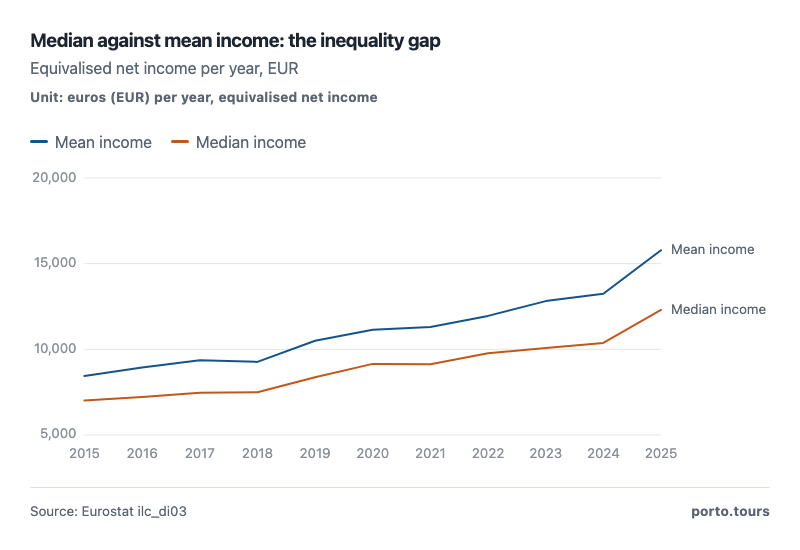
- The mean sits above the median in every year - income concentrates at the top.
- In 2024 the mean (EUR 13,243) exceeded the median (EUR 12,646) by about 5%.
| Median household equivalised income 2024 (EUR/yr) | 12,646 |
| Mean household equivalised income 2024 (EUR/yr) | 13,243 |
| Median monthly equivalent (EUR) | 1,054 |
| Households at risk of poverty 2024 (%) | 16.6 |
What is the median salary in Portugal?
Salary statistics run behind the household numbers by a year: INE's quarterly earnings survey put the gross average monthly salary at EUR 1,602 in 2024 and EUR 1,694 in 2025 - the median salary Portugal 2025 statistics track the same upward arc - with the regular base salary at EUR 1,277 - while the net median salary (what the middle earner actually receives) was EUR 980 a month in 20243. The gross-net gap is the tax and social-security wedge, and it is why salary negotiations in Portugal revolve around net figures while the law and statistics report gross.
By sector, the base monthly pay still ranges widely: public administration (EUR 1,035.5) and health (EUR 1,004.8) sit above construction (EUR 973.2) and agriculture (EUR 916.2), while tourism and hospitality pays the lowest base at EUR 872.7 - below the all-employee average of EUR 1,143.44. The sector bar shows the ranking.
The gross-to-net gap is the first surprise for newcomers: EUR 1,602 gross shrinks to about EUR 1,142 net after social security and IRS withholding. Portugal's progressive tax system means the median earner pays a lower effective rate than the average, but the wedge is wide enough that gross salary negotiations and net take-home are fundamentally different conversations. A EUR 1,600 gross salary delivers roughly EUR 1,140 in the bank - and on that income you live comfortably in Porto or Braganca, but only modestly in central Lisbon2. and the salary table prices the roles people search for most4. The occupation keywords that dominate search tell the same sector story from the worker's side. How much do nurses make in Portugal? Nurses in the public health service sit inside the health sector, whose base monthly pay averaged EUR 1,004.8 - and senior nurses with service time earn well above it. How much do teachers make in Portugal? Public school teachers fall under public administration, averaging EUR 1,035.5 monthly, with seniority-based progression that takes experienced teachers well past EUR 1,500. How much do doctors make in Portugal? Physicians are the top of the public pay scale: hospital specialists start near EUR 2,900 a month and senior consultants reach EUR 4,000+, per the official career tables - the health sector average above only captures the base because doctor overtime and on-call pay sit outside it4.
How much do lawyers make in Portugal? Private-sector lawyers bill by the case and the aggregators do not track their incomes - the honest answer is that the profession spans from EUR 900 junior associate stipends to partner-level incomes that never touch a salary table. How much does a waiter earn in Portugal? Waiters sit inside tourism and hospitality, the lowest-paying sector at EUR 872.7 base monthly pay - the figure that makes the minimum-wage increases matter most, because waiters are the sector's largest occupation4. How much do Portugal soccer players make? The Primeira Liga's stars earn six-figure monthly salaries that official statistics never capture - average league pay runs near EUR 30,000 a month at the big clubs, but that economy lives entirely outside the income distribution this page measures2.
How much is a good salary in Portugal, then? The data gives three honest anchors: EUR 980 net is the median take-home, so anything above it out-earns half the country; EUR 1,602 gross matches the average worker; and EUR 2,000 net puts you in roughly the top quartile - enough for a comfortable life in Porto or a comfortable-plus one in Lisbon, where the rent premium eats most of the difference2.
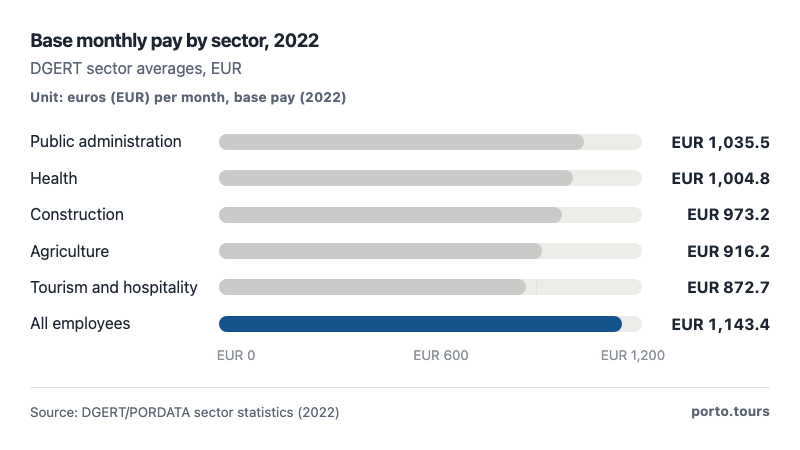
- Tourism and hospitality pays the lowest base salary: EUR 872.7 a month.
- Public administration (EUR 1,035.5) pays 19% above the tourism sector.
- The all-employee average of EUR 1,143.4 exceeds every listed sector.
| All employees (average) | 1,143.4 |
| Public administration | 1,035.5 |
| Health | 1,004.8 |
| Construction | 973.2 |
| Agriculture | 916.2 |
| Tourism and hospitality | 872.7 |
| Gross average salary 2024 | 1,602 |
| Gross average salary 2025 | 1,694 |
| Net average salary 2024 | 1,142 |
| Net median salary 2024 | 980 |
| Minimum wage 2026 | 920 |
How much is minimum wage in Portugal?
The minimum wage in 2026 is EUR 920 a month, up EUR 50 from 2025 - the largest single increase of the series and the tenth consecutive annual rise5. The history table shows the arc: EUR 505 in 2015, EUR 645 by 2021, EUR 870 in 2025. That is an 82% climb in eleven years, a pace at which the minimum wage has outgrown both inflation and the median income - which is why the gap between the minimum and the median keeps narrowing, a deliberate policy choice rather than a market outcome5.
The minimum wage matters for the median because Portugal has so many earners near it: roughly one in five employees earns within a few euros of the statutory floor, so each increase ripples through the whole lower half of the distribution and pushes the median up with it 5.
Projection: linear trend of 2015–2026 yearly values, 95% prediction range. Our calculation, not a forecast.
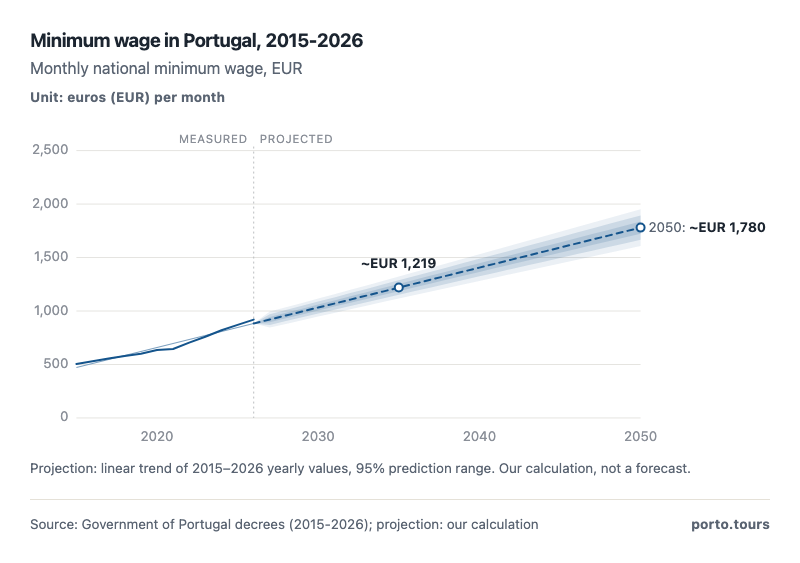
- The minimum wage rose from EUR 505 in 2015 to EUR 920 in 2026 - up 82%.
- The 2026 increase of EUR 50 is the largest single-year step of the series.
- Every year of the last decade delivered an increase; none has been reversed.
| 2015 | 505 |
| 2016 | 530 |
| 2017 | 557 |
| 2018 | 580 |
| 2019 | 600 |
| 2020 | 635 |
| 2021 | 645 |
| 2022 | 705 |
| 2023 | 760 |
| 2024 | 820 |
| 2025 | 870 |
| 2026 | 920 |
Portugal against Europe: the income ranking
The European ranking is where the median meets reality. At EUR 12,646, Portugal's median sits at 59% of the EU-27 median of EUR 21,582 - below Italy (20,605), Spain (19,307) and Greece (10,850) except that Greece trails it by EUR 1,796, and far below Germany (27,619) and France (25,557)1. The bar chart shows the full ranking with the EU average as the yardstick.
Price levels soften the gap: Portuguese consumer prices run at 85.3% of the EU average, so a euro of median income buys more in Porto than in Paris6. But the convergence story is about direction as much as level - the median grew 50% in a decade while the EU median grew far slower, and the projection says Portugal closes roughly a third of its remaining gap by 2050 at current slopes - our calculation, not a forecast2.
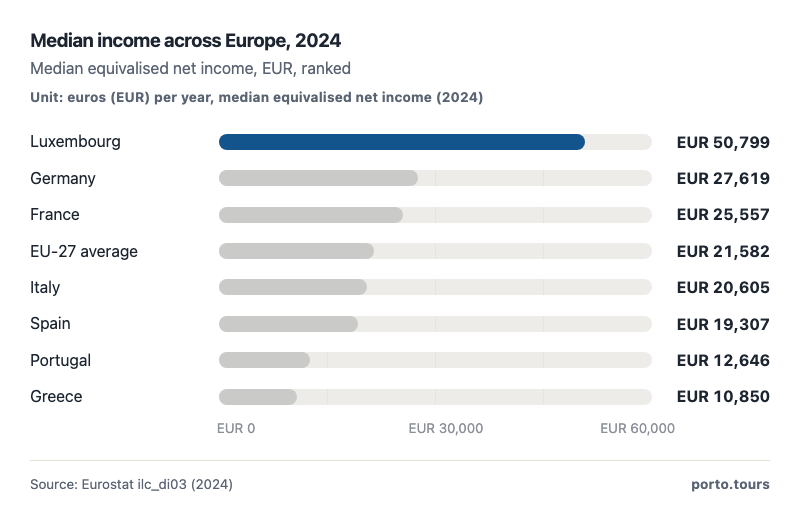
- Portugal's EUR 12,646 median is 59% of the EU-27 average.
- Germany's median is 2.2 times Portugal's; Greece trails Portugal by EUR 1,796.
| Luxembourg | 50,799 |
| Germany | 27,619 |
| France | 25,557 |
| EU-27 average | 21,582 |
| Italy | 20,605 |
| Spain | 19,307 |
| Portugal | 12,646 |
| Greece | 10,850 |
The regional divide: where the median actually lives
INE's local income statistics map the median to the ground. Grande Lisboa posts the highest regional median at EUR 13,820 per person; the Porto metropolitan area sits at EUR 12,336, within EUR 20 of the national median of EUR 12,316; and Alto Tamega e Barroso, in the northern interior, trails at EUR 10,370 - a EUR 3,450 spread between the country's published bookends3. The municipality table adds the extremes: Oeiras (EUR 17,250), Lisbon city (EUR 15,188) and Cascais (EUR 14,524) top the ranking3.
What counts as a good salary by region? The honest benchmark: in the interior north, a salary near the national median puts you above the local median; in Lisbon, you need roughly 13% more than the national median just to match your neighbourhood. The district map below carries the same story in colour2.
What the regional numbers also explain is the internal migration pattern: young workers gravitate toward Grande Lisboa and the Porto metropolitan area because that is where the salaries clear the cost-of-living hurdle, leaving the interior districts with the oldest populations and the thinnest tax base - a cycle that reinforces the income gap every year 3.
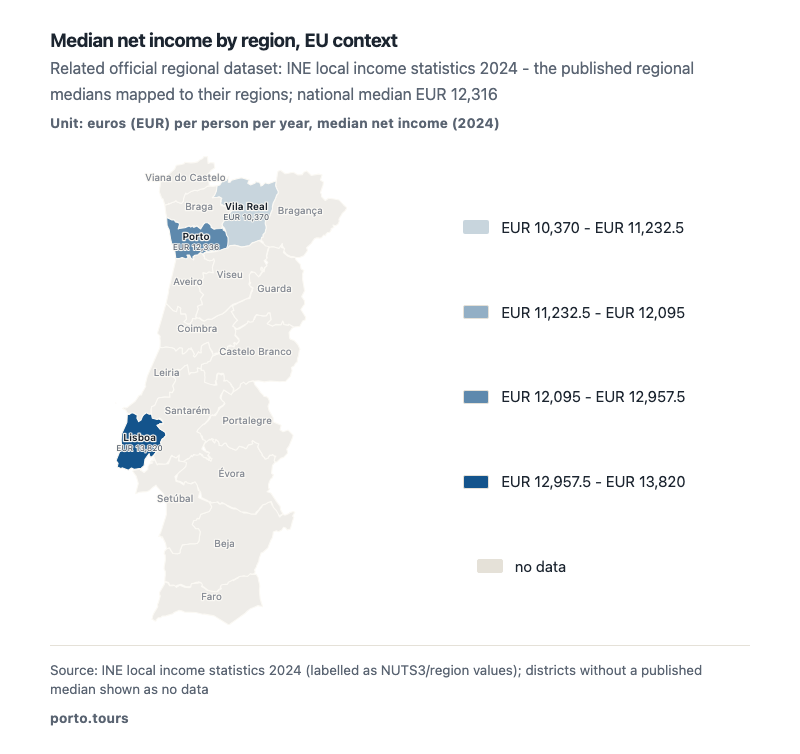
- Grande Lisboa's EUR 13,820 median is Portugal's highest published regional income.
- The Porto metropolitan area (EUR 12,336) sits within EUR 20 of the national median.
- Alto Tamega e Barroso (EUR 10,370) anchors the interior's lower half.
| Grande Lisboa | 13,820 |
| A.M. Porto | 12,336 |
| Portugal (national) | 12,316 |
| Alto Tamega e Barroso | 10,370 |
| Oeiras (municipality, top) | 17,250 |
| Lisboa (municipality) | 15,188 |
| Cascais (municipality) | 14,524 |
Inequality and the poverty line
The distribution measures round the picture out. The S80/S20 ratio - the richest fifth's income share against the poorest fifth's - fell from 6.01 in 2015 to 5.20 in 2024, a decline of about 13%; the EU-27 average ratio is 4.66, so Portugal remains more unequal than the bloc even as the gap narrows1. The Gini coefficient tells the same story at 30.9% against the EU's 29.4%1.
The poverty line follows the median - it is set at 60% of median income, so it rises as the median rises. In 2024 the threshold was EUR 8,679 a year (about EUR 723 a month), and 16.6% of residents sat below it - close to the EU-27's 16.2%, and INE's national calculation puts the 2024 rate at 15.4%, the lowest in twenty years3. Median net salary Portugal 2026 figures will test whether that record survives another year of wage growth above inflation 2.
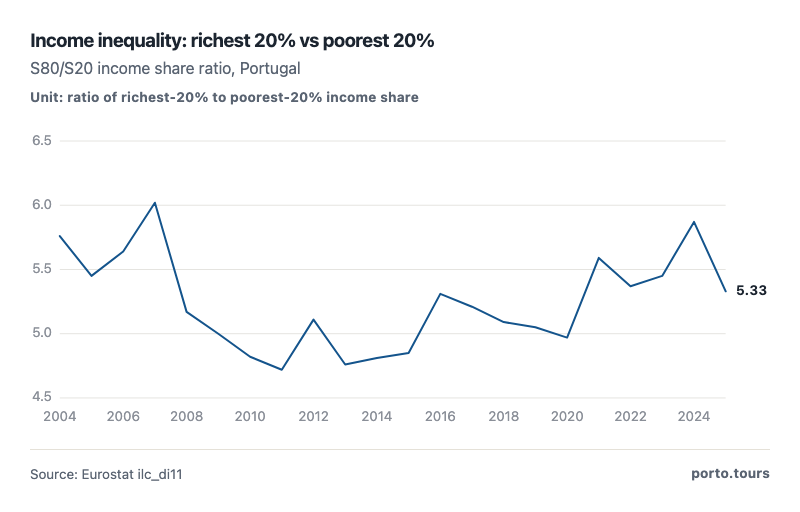
- The ratio peaked at 6.01 in 2015 and fell to 5.20 by 2024.
- Inequality is down about 13% over the decade - the ratio has never returned to its 2015 level.
| Eurostat ilc_di03 (2024 income) | 2024 | 12,646 |
| INE ICOR 2025 (2024 incomes) | 2024 | 14,465 |
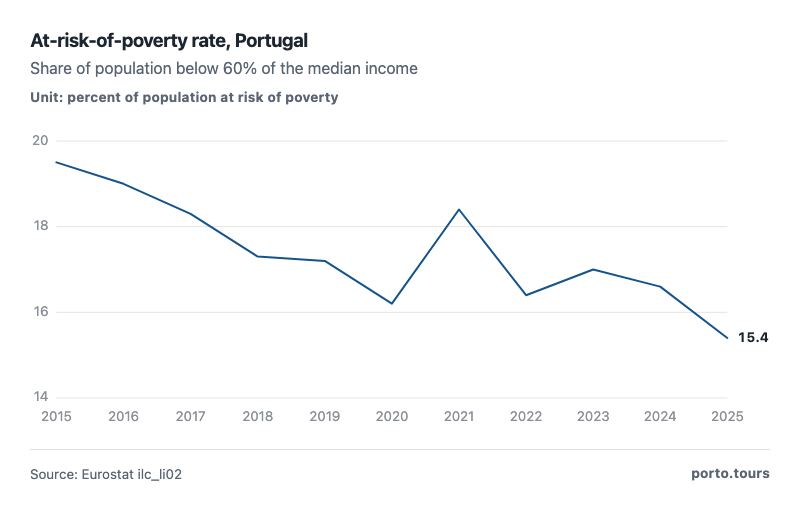
- The rate fell from 19.5% in 2015 to 16.6% in 2024.
- 2025 marked the lowest reading of the series at 15.4%.
| At-risk-of-poverty rate 2024 | 16.6% |
| EU-27 rate 2024 | 16.2% |
| INE national rate 2024 | 15.4% (lowest in 20 years) |
| Poverty threshold 2024 | EUR 8,679/yr (~EUR 723/mo) |
| Rate 2015 (start of series) | 19.5% |
Conclusions
- Portugal's median income reached EUR 12,646 in 2024 (Eurostat), up 50% since 2015, and INE's household survey puts the latest figure higher still at EUR 14,4651.
- The median net salary is EUR 980 a month against a gross average of EUR 1,602 - the wedge between gross and net is the first thing every salary conversation in Portugal must settle3.
- The minimum wage's 82% climb since 2015 to EUR 920 in 2026 has narrowed the gap between the floor and the median faster than any market force could5.
- Against Europe, Portugal's median is 59% of the EU-27 figure - behind Italy and Spain but ahead of Greece, and converging at roughly a third of the remaining gap per generation 1.
- Region decides experience: Grande Lisboa's EUR 13,820 median clears the national figure by 12%, while Alto Tamega e Barroso sits EUR 1,950 under it - the map is the real cost-of- living guide3.
The gap between the national median and the capital is one of the widest in Western Europe: a worker in Lisboa district earns roughly a third more than the national median, while a worker in the interior regions earns a third less. That spread explains why remote workers with foreign salaries report feeling wealthy in Porto while local median earners describe the same city as tight, and why any affordability figure quoted without an income context misleads in both directions.
Methodology
- Median and mean equivalised net income: 2015-2024 (Eurostat ilc_di03)
- Minimum wage: 2015-2026 (official decrees)
- Regional median incomes: 2024 (INE local income statistics)
- Inequality and poverty: S80/S20, Gini, at-risk rates (Eurostat, INE)
Definition. Median equivalised net income is the middle of the distribution of household disposable income divided by the equivalised household size (Eurostat scale), so it compares residents, not salaries. The poverty threshold is 60% of the national median. S80/S20 is the ratio of the richest 20%'s income share to the poorest 20%'s. 'Median net salary' refers to employed persons' take-home pay and is a different series from household income.
Data sources. Eurostat ilc_di03 (median and mean equivalised net income, 2015-2024, Portugal + EU comparison); INE ICOR 2025 household income survey and quarterly earnings statistics; INE local income statistics 2024; DGERT/PORDATA sector base pay 2022; Government of Portugal minimum-wage decrees; Eurostat ilc_di11 (S80/S20) and ilc_li02 (at-risk-of-poverty).
Calculations. Monthly equivalents divide annual figures by 12. The 50% and 59% and 85.3% comparisons are our calculations from the published series. The projection is an ordinary least-squares trend with a 95% prediction interval, computed by the renderer; our calculation, not a forecast.
Limitations. Eurostat and INE label income reference years differently - Eurostat's '2024' and INE's 2024 releases are offset by roughly one year, so the two series are shown separately and never mixed. Equivalised income is not the same as salary. Sector pay is base salary by industry (2022), not by occupation; role-specific salaries vary within every sector. Regional medians are published only for selected regions; the map shows those with values and marks the rest as no data.
Sources
- Eurostat. “Median and mean equivalised net income (ilc_di03), Portugal and EU comparison, 2015-2024.” European Commission - Eurostat, 2026. ec.europa.eu. Accessed 2026-09-18. Back to text
- Porto Tours. “Own calculations (labelled).” own calculation, 2026. Porto.tours. Accessed 2026-09-18. Back to text
- Statistics Portugal / INE. “ICOR 2025 household income survey; regional local income 2024; tourism earnings.” Instituto Nacional de Estatistica, 2026. ine.pt. Accessed 2026-09-18. Back to text
- DGERT / PORDATA. “Base monthly pay by sector, 2022.” Direcao-Geral do Emprego e Relacoes Laborais; PORDATA, 2024. pordata.pt. Accessed 2026-09-18. Back to text
- Government of Portugal. “National minimum wage 2026: EUR 920/month (council of ministers, 17 Dec 2025).” Government of Portugal, 2025. Portugal.gov.pt. Accessed 2026-09-18. Back to text
- European Commission / Eurostat. “Price level indices and income statistics, Portugal vs EU27 (2025).” European Commission - Eurostat, 2026. ec.europa.eu. Accessed 2026-09-18. Back to text
About the author
Tiago Santos is a born-and-bred Tripeiro with nearly a decade chronicling Porto's shifting culinary and cultural landscape - from back-alley petisqueiras to contemporary architecture. A former contributor to Publico's Fugas supplement and Revista Visao, for this guide he turns official statistics and street-level knowledge into research visitors can check and cite.
Every figure on this page links to its source. How we research
Related research
More data on Porto's travel, costs and life from Porto Tours.
- EconomyPortugal GDP per Capita (2026 Data)$32,082 Portugal's GDP per capita in 2025 (all-time high)Read the research →
- EconomyUnemployment Rate of Portugal (2026 Data)6.0% Portugal's unemployment rate in 2025 - near historic lowsRead the research →
- EnvironmentPortugal CO2 Emissions per Capita 2000-2023 (2026 Data)3.54 t CO2 emissions per capita in Portugal 2023, down 43% since 2000Read the research →
- WeatherPortugal Rainfall by Month (2026 Data)76% of Lisbon's yearly rain falls October-MarchRead the research →
- Visa & ImmigrationHow Much Is a Visa for Portugal? (2026 Data)EUR 90 Schengen short-stay visa fee for Portugal (2026)Read the research →
- Cost of LivingHow Much Does It Cost to Get Married in Portugal? (2026 Data)EUR 21,127 average 100-guest wedding in Portugal (2026)Read the research →