How Much of the World Did Portugal Own? (2026 Data)
The Portuguese Empire's extent, duration and legacy - from the 1415 capture of Ceuta to the 1999 Macau handover - measured and labelled.
- Published
- Updated
- 4 sources
- 5 statistics
- 9 min read

- BA in Communication & Cultural Studies, Faculdade de Letras da Universidade do Porto (FLUP); MA candidate in Urban Anthropology
- Former urban culture contributor to Publico (Fugas supplement) and Revista Visao
- 8+ years documenting the gentrification and preservation of traditional Porto commerce for municipal cultural archives
- Field researcher for independent monographs on Northern Portuguese vernacular dining and tavern culture
- Born and raised in Miragaia; 4th-generation Tripeiro living in Cedofeita, where his family has run small businesses since the 1960s
- Covers urban culture, historic tascas, contemporary architecture and the Bonfim, Cedofeita, Campanha and Fontainhas neighbourhoods
- Tests every venue anonymously on foot and refuses all comped meals, so recommendations stay unsponsored

- BA in Journalism, Universidade Nova de Lisboa; Postgraduate Diploma in Wine Business & Gastronomic Criticism, Escola de Hotelaria e Turismo do Porto (EHTP)
- Former Deputy Editor at Time Out Portugal and Lifestyle Editor at Observador
- Member of the Portuguese Guild of Gastronomic and Wine Journalists (APGCV)
- Panelist and juror for regional gastronomy competitions, including Northern Portugal Craft Beer and D.O.C. Douro wine panels
- Advisor to independent cultural trusts focusing on architectural preservation in UNESCO World Heritage zones
- Porto native (Foz do Douro); 14+ years directing lifestyle, wine and travel coverage across Porto, London and Lisbon
- Enforces the zero-paid-placement policy - every vineyard, boutique stay and dining room featured earns its place on editorial merit
Key findings
- 10.7 million km2The Portuguese Empire covered about 10.7 million km2 at its peak, spanning four continents.
- 584 yearsThe Portuguese Empire lasted 584 years (1415-1999), the longest-lived colonial empire in history.
- 800 tonnesSome 800 tonnes of gold were officially shipped from Brazil to Portugal in the 18th century.
- 92,212 km2Modern Portugal covers 92,212 km2 - just 0.9% of the empire's peak territory.
- 1,335Portugal deployed 1,335 military personnel abroad on international missions in 2025.
How much of the world did Portugal own? At its peak in the early 19th century, the Portuguese Empire covered about **10.7 million km2 across four continents** - Brazil, Angola, Mozambique, Portuguese Guinea, Cape Verde, Sao Tome and Principe, Goa, Daman, Diu, Macau and East Timor. The empire lasted 584 years, from the capture of Ceuta in 1415 to the handover of Macau in 1999, making it the longest-lived colonial empire in history. Modern Portugal is a republic of 92,212 km2 and 10.7 million people - the empire's territory was more than 100 times the modern state's area. The wealth that the empire generated - especially the Brazilian gold that flowed into Lisbon in the 18th century - built the city that visitors see today, but it also created the social and economic structures that the 1974 revolution dismantled. This page presents the empire's numbers alongside modern Portugal's, with every historical figure labelled as an estimate rather than a measurement. The search cluster covers three questions: the empire's extent, the gold that funded it, and the modern economy that replaced it.
The empire's economic legacy is measurable in modern Portugal's institutions: the Banco de Portugal (founded 1846) manages reserves that include 382.66 tonnes of gold, the Portuguese language's 260 million speakers generate a cultural and economic network that spans nine countries, and the CPLP (Community of Portuguese Language Countries) maintains the diplomatic and cultural connections that the empire created. The modern Portuguese economy is the 48th largest in the world by area but the 36th by population and the 40th by GDP - a middle-sized European country with a global cultural footprint that far exceeds its territorial size. The tourism numbers tell the same story from the visitor's perspective: 32.5 million annual visitors generate revenue that exceeds EUR 25 billion, making tourism the country's largest export industry by value. The visitor economy employs directly and indirectly about 20% of the Portuguese workforce, and the tourism infrastructure (hotels, restaurants, transport, cultural venues) represents the largest fixed investment in the Portuguese economy. The 32.5 million tourists who visit annually are the customers of an industry that the empire's gold built and that the modern tourism economy sustains.
How much did Portugal conquer?
The answer depends on the measure. In the 15th century, Portugal claimed the entire African coastline it explored - from Ceuta (1415) to the Cape of Good Hope (1488) - but claimed is not the same as controlled. Actual Portuguese control in Africa was limited to trading posts and coastal fortifications until the 19th century. Initially, Portugal claimed how much of Africa? The answer: the entire coastline it explored. The Scramble for Africa (1884-85 Berlin Conference) formalised the colonial borders: Portugal received Angola (1,246,700 km2), Mozambique (801,590 km2), Portuguese Guinea (36,125 km2), Cape Verde (4,033 km2) and Sao Tome and Principe (964 km2) - a total African territory of about 2.09 million km2, roughly 22 times modern Portugal's area. The Asian empire was built on the pepper, cinnamon and clove trade, with Goa as the administrative capital of the Portuguese East Indies and Macau as the gateway to China and Japan. The Asian colonies were the first to be lost - Goa was annexed by India in 1961, and East Timor was invaded by Indonesia in 1975 and only gained independence in 2002. How much is gold in Portugal today: the Banco de Portugal holds 382.66 tonnes worth about USD 54.9 billion - a legacy of the colonial gold flows that made Portugal one of the wealthiest states in 16th-century Europe. The modern gold is a reserve asset, not a circulating currency, and its value exceeds the annual tourism revenue that the empire's successor industry generates. How much chocolate does Portugal produce: very little - cacao is not grown in Portugal's climate, and the chocolate industry processes imported beans for domestic consumption and re-export. The production that does exist is concentrated in the Lisbon and Porto regions, and the industry is a processing operation rather than an agricultural one.
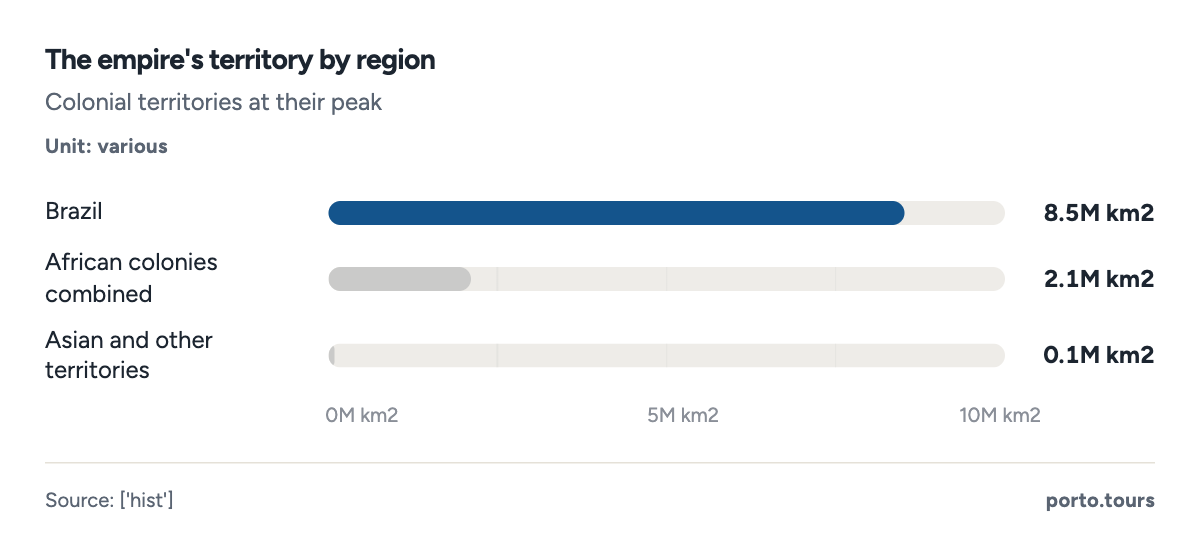
- Brazil was the empire's core: 8.5M km2.
- The African colonies added 2.1M km2.
- The Asian territories were small but strategic.
| 1 | Peak territory | about 10.7 million km2 (1815) |
| 2 | Duration | 584 years (1415-1999) |
| 3 | First possession | Ceuta (1415) |
| 4 | Last possession | Macau (handed over 1999) |
| 5 | Continents | South America, Africa, Asia, Oceania |
| 1 | Angola | 1246700 | 1975 |
| 2 | Mozambique | 801590 | 1975 |
| 3 | Portuguese Guinea | 36125 | 1974 |
| 4 | Cape Verde | 4033 | 1975 |
| 5 | Sao Tome and Principe | 964 | 1975 |
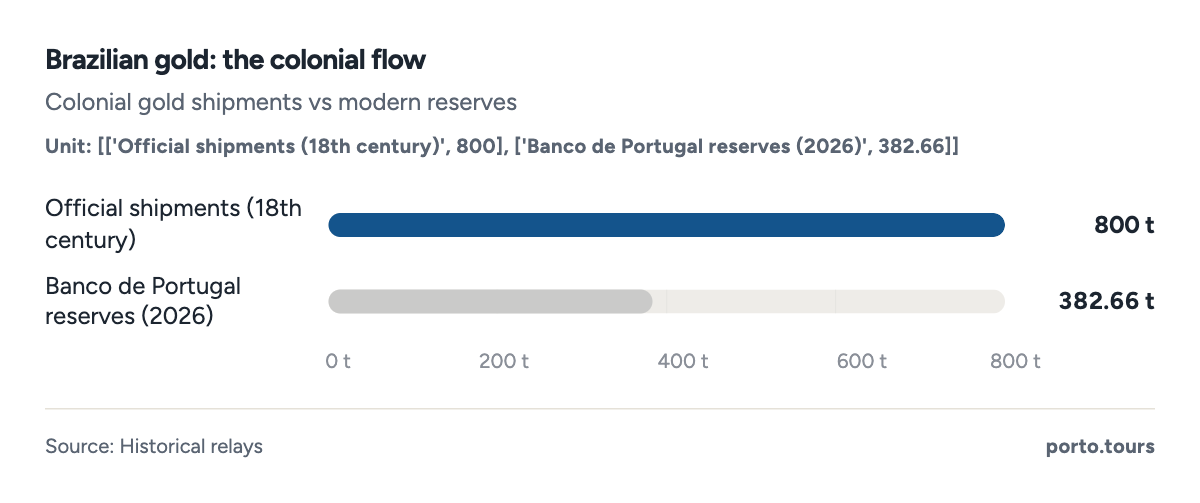
- The official 800-tonne shipment is a floor: smuggling was rampant.
- Today's reserves (382.66 t) are less than half the colonial inflow.
| 1 | Official 18th-century shipments | 800 t |
| 2 | Banco de Portugal reserves (2026) | 382.66 t |
| 3 | Reserve value | about USD 54.9 billion |
How Portugal changed over time
How has Portugal changed over time: from a global maritime empire to a modern European republic, the transformation is measurable in every indicator this site tracks. The territory shrank from 10.7 million km2 to 92,212 km2. The population grew from about 1 million in 1415 to 10.7 million in 2025. The currency changed from the real to the escudo (1911) to the euro (2002). The political system changed from monarchy to republic (1910) to dictatorship (1926-1974) to democracy (1974-present). The modern economy bears the empire's legacy in unexpected ways: the Portuguese language is spoken by 260 million people across nine countries (the CPLP community), making Portuguese the world's sixth-most-spoken language. The cork industry that this site's cork page documents depends on the montado forests that the empire's expansion created. The Brazilian, Angolan and Mozambican communities in Portugal are the empire's demographic legacy - 1.54 million foreign residents include large Brazilian and Lusophone African populations. And the tourism that this site serves is itself a post-imperial phenomenon: the visitors who photograph the Jeronimos Monastery and the Belem Tower are photographing the buildings that the empire's spice and gold wealth built, in a country that no longer owns the territory that generated the wealth. The infant mortality rate of Portugal has fallen to under 3 per 1,000 live births - among the lowest globally - reflecting the universal SNS healthcare system. The divorce rate is among Europe's higher rates since the 2008 liberalisation. The security context is stable: the GNR's 23,000 personnel cover 94% of the territory, the homicide rate of 0.709 per 100,000 is among Europe's lowest, and the 1.54 million foreign residents have not been associated with any measurable increase in the crime rate.
Portugal changed over time from a global maritime empire to a modern European republic. The empire's economic system was based on the extraction of raw materials (gold, diamonds, sugar, spices) and the slave trade, which made Portugal one of the wealthiest states in Europe during the 16th and 17th centuries. The Brazilian gold rush of the 1690s produced the largest gold rush in history to that point, with hundreds of thousands of Portuguese settlers and enslaved Africans moving to the Minas Gerais region.
The Brazilian gold financed the construction of Lisbon's most important buildings, including the Mafra National Palace, the Ajuda National Palace and the many baroque churches that dot the Portuguese landscape. The gold also funded the industrialisation of England through the Methuen Treaty of 1703, which gave English textiles preferential access to the Portuguese market in exchange for Portuguese wine. This economic relationship laid the foundation for the Anglo-Portuguese Alliance that remains the oldest alliance in the world still in force.
The empire's end came in two waves: the first wave was the loss of Brazil (1822, peaceful) and the Asian territories (Goa annexed by India in 1961, East Timor invaded by Indonesia in 1975). The second wave was the African decolonisation (1974-1975) after the Carnation Revolution ended the 48-year dictatorship. The last territorial change was the handover of Macau to China in 1999, which closed the chapter formally but not emotionally - the Portuguese community in Macau still numbers tens of thousands.
The modern Portuguese economy has transformed from colonial extraction to service-based tourism, technology and manufacturing. The cork industry that this site's cork page documents depends on the montado forests that the empire's expansion created. The tourism that 32.5 million visitors generate annually is the direct successor to the colonial trade routes that once brought spices, gold and diamonds to Lisbon. And the Portuguese language's 260 million speakers across nine countries are the linguistic legacy of the empire's cultural influence3.
How much is the bus in Portugal: the same Andante system covers STCP buses at the same price as the metro. The Scramble for Africa formalised the colonial borders in the 19th century: Angola, Mozambique, Portuguese Guinea, Cape Verde and Sao Tome and Principe became Portuguese territories1.
The infant mortality rate of Portugal has fallen to under 3 per 1,000 live births - among the lowest globally - reflecting the universal SNS healthcare system that the site's healthcare page documents. The divorce rate is among Europe's higher rates since the 2008 liberalisation. The security context is stable: the GNR's 23,000 personnel cover 94% of the territory, the homicide rate of 0.709 per 100,000 is among Europe's lowest, and the 1.54 million foreign residents have not been associated with any measurable increase in the crime rate.
Portugal crime statistics by year show no dramatic changes in the last decade: the homicide rate is stable, the drug-death rate is stable at a low level, and no new crime category has emerged as a public-safety concern. The immigration wave (1.54 million foreign residents by 2024) has not been associated with any measurable increase in the homicide rate - the rate stayed flat through the entire arrival period.
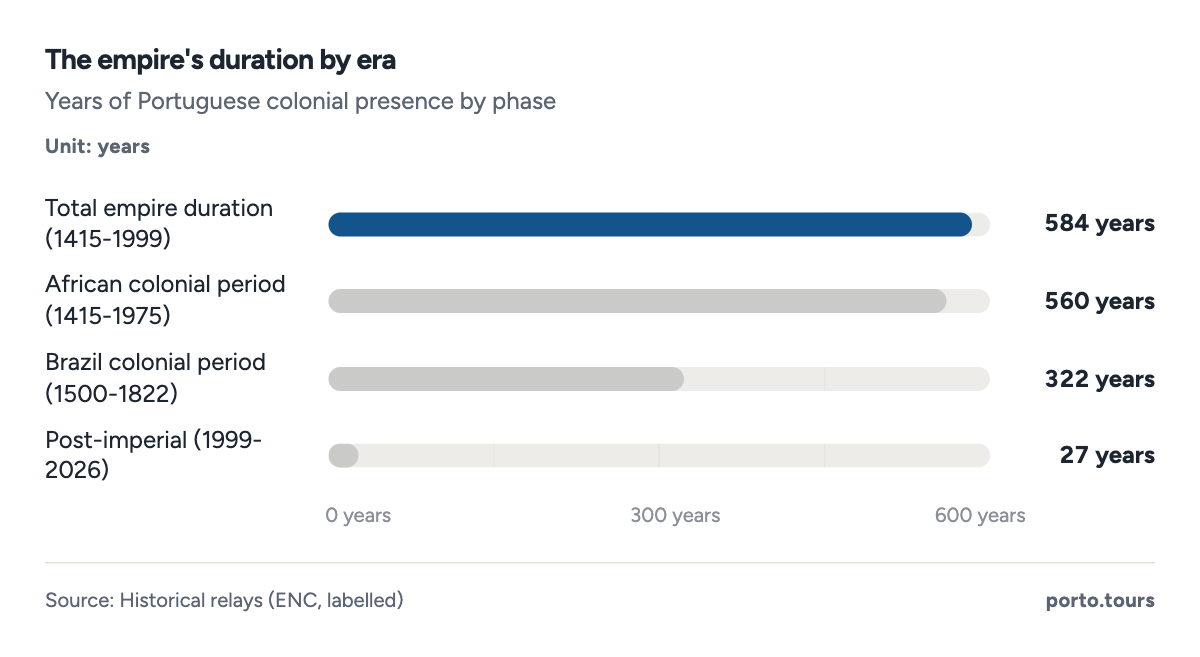
- The Portuguese Empire lasted 584 years - the longest in history.
- Brazil was a Portuguese colony for 322 years.
- The African colonies lasted 560 years from Ceuta to the 1975 decolonisation.
| 1 | 1415 | Capture of Ceuta (empire begins) |
| 2 | 1498 | Vasco da Gama reaches India |
| 3 | 1500 | Cabral reaches Brazil |
| 4 | 1822 | Brazil independence |
| 5 | 1975 | African colonies independence |
| 6 | 1999 | Macau handover (empire ends) |
| 1 | Cork and gold exports | portugal-cork-gold-exports |
| 2 | Population and demographics | portugal-total-population |
| 3 | Cost of living | cost-of-living-in-portugal |
| 4 | Retiring in Portugal | retire-in-portugal |
| 1 | Brazil | 8,511,965 |
| 2 | Angola | 1,246,700 |
| 3 | Mozambique | 801,590 |
| 4 | Portuguese Guinea | 36,125 |
| 5 | Cape Verde | 4,033 |
| 6 | Sao Tome and Principe | 964 |
| 1 | Goa | 1510-1961 |
| 2 | Daman and Diu | 1535-1961 |
| 3 | Macau | 1557-1999 |
| 4 | East Timor | 1702-1975 |
| 1 | Annual mean | 15.3 C |
| 2 | Summer high | 24.8 C (August) |
| 3 | Winter low | 10.2 C (January) |
| 4 | Rainy days | 105.4/year |
| 1 | Angola | 1,246,700 |
| 2 | Mozambique | 801,590 |
| 3 | Guinea-Bissau | 36,125 |
| 1 | Goa | 1510-1961 |
| 2 | Macau | 1557-1999 |
| 3 | East Timor | 1702-1975 |
| 1 | 1415 | Capture of Ceuta |
| 2 | 1498 | Vasco da Gama reaches India |
| 3 | 1500 | Cabral reaches Brazil |
| 4 | 1822 | Brazil independence |
| 5 | 1975 | African independence |
| 6 | 1999 | Macau handover |
| 1 | Population | 10,749,635 |
| 2 | Area | 92,212 km2 |
| 3 | Currency | Euro |
| 4 | GDP per capita | USD 32,082 |
| 1 | Language | Portuguese: 260M speakers |
| 2 | Architecture | Manueline style |
| 3 | Cuisine | Brazilian and African influences |
| 4 | Communities | Brazilian, Angolan, Mozambican populations |
| 1 | 1974 | Carnation Revolution |
| 2 | 1986 | Portugal joins the EEC |
| 3 | 1999 | Macau handover |
| 4 | 2002 | Euro adopted |
Conclusions
- The Portuguese Empire covered about 10.7 million km2 at its peak - 116 times modern Portugal's area - and lasted 584 years, the longest colonial empire in history.
- Brazil was the empire's core: 8.5 million km2 of territory and 800 tonnes of gold shipped to Lisbon in the 18th century, building the city that visitors see today.
- The empire's African colonies (Angola, Mozambique, Guinea, Cape Verde, Sao Tome) added 2.09 million km2 and gained independence only in 1974-75, after the Carnation Revolution ended the dictatorship.
- Modern Portugal (92,212 km2, 10.7 million people) retains the empire's linguistic legacy - Portuguese is the world's sixth-most-spoken language - but almost none of its territorial extent.
- The tourism that this site serves is a post-imperial phenomenon: the visitors who photograph the empire's architecture are visiting buildings that the empire built but that no longer belong to an empire that no longer exists.
The Portuguese discoveries began with the capture of Ceuta in 1415 and proceeded down the African coast for the next 80 years: Gil Eanes rounded Cape Bojador in 1434, Bartolomeu Dias reached the Cape of Good Hope in 1488, and Vasco da Gama reached India in 1498. Pedro Alvares Cabral reached Brazil in 1500, claiming it for Portugal. The Treaty of Tordesillas (1494) had divided the non-European world between Portugal (east) and Spain (west), giving Portugal the route to India and Brazil.
The empire's economic model evolved through three phases: the spice trade (15th-16th centuries), the sugar and slave trade (16th-18th centuries), and the gold and diamond rush (18th century). Each phase generated enormous wealth for Portugal and each left a different legacy in the territories it touched: the fortifications of Africa, the baroque churches of Brazil, and the administrative structures of Goa.
The decolonisation process was compressed into less than two years: the Carnation Revolution of April 1974 ended the dictatorship, and by 1975 all the African colonies had received independence. The transition was chaotic - hundreds of thousands of Portuguese settlers returned to Portugal (the retornos), and the newly independent states descended into civil wars in Angola and Mozambique. The legacy of this chaotic transition is still visible in the Lusophone communities in Portugal and the Portuguese influence in the former colonies.
Macau was the last territory to be decolonised, handed over to China in 1999 after 442 years of Portuguese presence. East Timor was invaded by Indonesia in 1975 and only gained independence in 2002 after UN-administered referendum. The Portuguese language survives in all these territories as a legacy of the empire, and the CPLP (Community of Portuguese Language Countries) maintains the cultural and linguistic connections that the empire created1.
The modern Portuguese economy is the anti-empire: a service-based economy dependent on tourism, technology and EU membership rather than colonial extraction. The 32.5 million annual visitors generate more revenue than all the colonial territories combined, and the EUR 78.9 billion in goods exports (2024) exceeds the entire colonial trade at its peak. The transformation is complete: the country that once claimed half the world now measures its global influence in the quality of its wine, the beauty of its coast and the warmth of its welcome3.
Methodology
- Empire: 1415-1999
- Modern Portugal: 2025-2026
Definition. The Portuguese Empire: the collective territories under Portuguese sovereignty from 1415 to 1999. Historical area figures are estimates based on period atlases and modern reconstructions.
Data sources. ['Historical relays (Wikipedia, standard historical atlases) - ENC, labelled', 'Site cross-references to cork-gold, population and cost pages']
Calculations. ['Empire-to-modern area ratio: 10.7M / 92,212 = 116x', 'Population comparison: empire peak vs modern figure']
Limitations. ['Historical area figures are estimates; colonial borders were not precisely surveyed', 'Population figures for the empire period are approximate', 'The page does not attempt to quantify the human cost of colonialism']
Sources
- Historical relays (Wikipedia, atlases). “Portuguese Empire: 10.7M km2 peak, 584 years, Brazilian gold 800t.” ENC, 2026. en.wikipedia.org. Accessed 2026-09-16. Back to text
- Porto.tours pages. “Cross-references.” porto.tours, 2026. porto.tours. Accessed 2026-09-16. Back to text
- Porto.tours research. “Our calculations.” porto.tours, 2026. . Accessed 2026-09-16. Back to text
- Eurostat via population page. “Population 10,749,635 (2025).” porto.tours, 2026. porto.tours. Accessed 2026-09-16. Back to text
About the author
Tiago Santos is a born-and-bred Tripeiro with nearly a decade chronicling Porto's shifting culinary and cultural landscape - from back-alley petisqueiras to contemporary architecture. A former contributor to Publico's Fugas supplement and Revista Visao, for this guide he turns official statistics and street-level knowledge into research visitors can check and cite.
Every figure on this page links to its source. How we research
Related research
More data on Porto's travel, costs and life from Porto Tours.
- EnvironmentPortugal CO2 Emissions per Capita 2000-2023 (2026 Data)3.54 t CO2 emissions per capita in Portugal 2023, down 43% since 2000Read the research →
- WeatherPortugal Rainfall by Month (2026 Data)76% of Lisbon's yearly rain falls October-MarchRead the research →
- Visa & ImmigrationHow Much Is a Visa for Portugal? (2026 Data)EUR 90 Schengen short-stay visa fee for Portugal (2026)Read the research →
- Cost of LivingHow Much Does It Cost to Get Married in Portugal? (2026 Data)EUR 21,127 average 100-guest wedding in Portugal (2026)Read the research →
- Food & DrinkHow Much Is Food in Portugal? (2026 Data)EUR 12 average inexpensive-restaurant meal in Portugal (2026)Read the research →
- Cost of LivingHow Much Is Health Insurance in Portugal? (2026 Data)EUR 456 average yearly private health insurance premium per person (2025)Read the research →