Crime Rate of Portugal (2026 Data)
Homicide, drug policy, police and military presence, mortality and divorce - Portugal's safety data, sourced and labelled.
- Published
- Updated
- 9 sources
- 5 statistics
- 10 min read

- BA in Communication & Cultural Studies, Faculdade de Letras da Universidade do Porto (FLUP); MA candidate in Urban Anthropology
- Former urban culture contributor to Publico (Fugas supplement) and Revista Visao
- 8+ years documenting the gentrification and preservation of traditional Porto commerce for municipal cultural archives
- Field researcher for independent monographs on Northern Portuguese vernacular dining and tavern culture
- Born and raised in Miragaia; 4th-generation Tripeiro living in Cedofeita, where his family has run small businesses since the 1960s
- Covers urban culture, historic tascas, contemporary architecture and the Bonfim, Cedofeita, Campanha and Fontainhas neighbourhoods
- Tests every venue anonymously on foot and refuses all comped meals, so recommendations stay unsponsored

- BA in Journalism, Universidade Nova de Lisboa; Postgraduate Diploma in Wine Business & Gastronomic Criticism, Escola de Hotelaria e Turismo do Porto (EHTP)
- Former Deputy Editor at Time Out Portugal and Lifestyle Editor at Observador
- Member of the Portuguese Guild of Gastronomic and Wine Journalists (APGCV)
- Panelist and juror for regional gastronomy competitions, including Northern Portugal Craft Beer and D.O.C. Douro wine panels
- Advisor to independent cultural trusts focusing on architectural preservation in UNESCO World Heritage zones
- Porto native (Foz do Douro); 14+ years directing lifestyle, wine and travel coverage across Porto, London and Lisbon
- Enforces the zero-paid-placement policy - every vineyard, boutique stay and dining room featured earns its place on editorial merit
Key findings
- 0.709Portugal's homicide rate is 0.709 per 100,000 (2023), among the lowest in Europe.
- 93%Drug overdose deaths fell 93% after Portugal decriminalised personal possession in 2001.
- 23,000Portugal's GNR (National Republican Guard) fields about 23,000 personnel covering 94% of the territory.
- 23,678Portugal's armed forces number 23,678 active personnel (2024), separate from the police.
- EUR 0Portugal charges EUR 0 inheritance tax - immediate family pay nothing, others pay 10% stamp duty.
Crime rate of Portugal: the search is really a safety question, and the data answers it from four directions. The homicide rate is 0.709 per 100,000 (2023), among the lowest in Europe - lower than the UK (0.930), Germany (0.921) or France (1.325)1. The drug story is the most cited reform in the world: after decriminalising personal possession in 2001, Portugal's overdose deaths fell from 80 per million to 6 per million - a 93% decrease2. The security apparatus is proportional: the GNR fields about 23,000 personnel covering 94% of the territory, while the Armed Forces add 23,678 active military]3. And the social indicators are stable: 87,764 births in 2025, a crude divorce rate published annually, and no civil unrest significant enough to register in the international risk indices4. The 1755 Lisbon earthquake (the historical reference for natural-disaster risk) predates modern building codes by two and a half centuries, and the modern seismic building standards date from the 1983 code revision5.
This page separates the numbers from the narratives. The homicide rate is a UNODC figure (OFFICIAL relay). The drug decriminalisation story is OFFICIAL (EMCDDA) but often retold inaccurately - the page quotes the actual arc. The police and military figures are from institutional relays. None of the numbers require interpretation to be useful; the safety conclusion follows from the data, not from adjectives6.
How many murders per year in Portugal?
Portugal murders per year average about 70-80 homicides nationally - 0.709 per 100,000 population on a base of 10.4 million people (2023 figure). That is one of the lowest rates in Europe and the world: lower than the UK (0.930), France (1.325), Germany (0.921) or Spain (0.728). The Portugal homicide rate by year has been declining for two decades, with no upward trend in the recent series.
Portugal murders per capita place the country consistently in the bottom ten of European homicide rates - safer than Belgium, Finland or Sweden in most years. The rate is not zero, and each case receives national media attention precisely because they are rare. Portugal crime statistics by year show no spike in the post-2020 immigration wave - the homicide rate has remained stable even as the population grew by 400,000, a pattern that contradicts the anti-immigration narrative that dominates social media discussion of the topic6.
The year-by-year homicide rate from the UNODC series shows remarkable stability for a country of 10.7 million: the rate has stayed between 0.5 and 1.0 per 100,000 for the last two decades, with year-to-year variation driven by individual cases rather than systemic trends. A country of this size produces roughly 70-80 homicides annually, and each receives national media coverage precisely because they are statistically unusual. The comparison with the 1990s (when the rate was above 1.0) shows a long-term improvement that matches the European trend1.
The per-capita framing produces the same answer: 0.709 per 100,000 is one-eighth of the American rate and one-fifteenth of the Latin American average. For a potential mover the practical risk is closer to zero than to any threshold that would change daily behaviour - the homicide risk in Portugal is statistically comparable to the risk of a serious traffic accident on the way to work, and nobody mentions that in the relocation guides6. - the homicide rate has remained stable even as the population grew by 400,000.
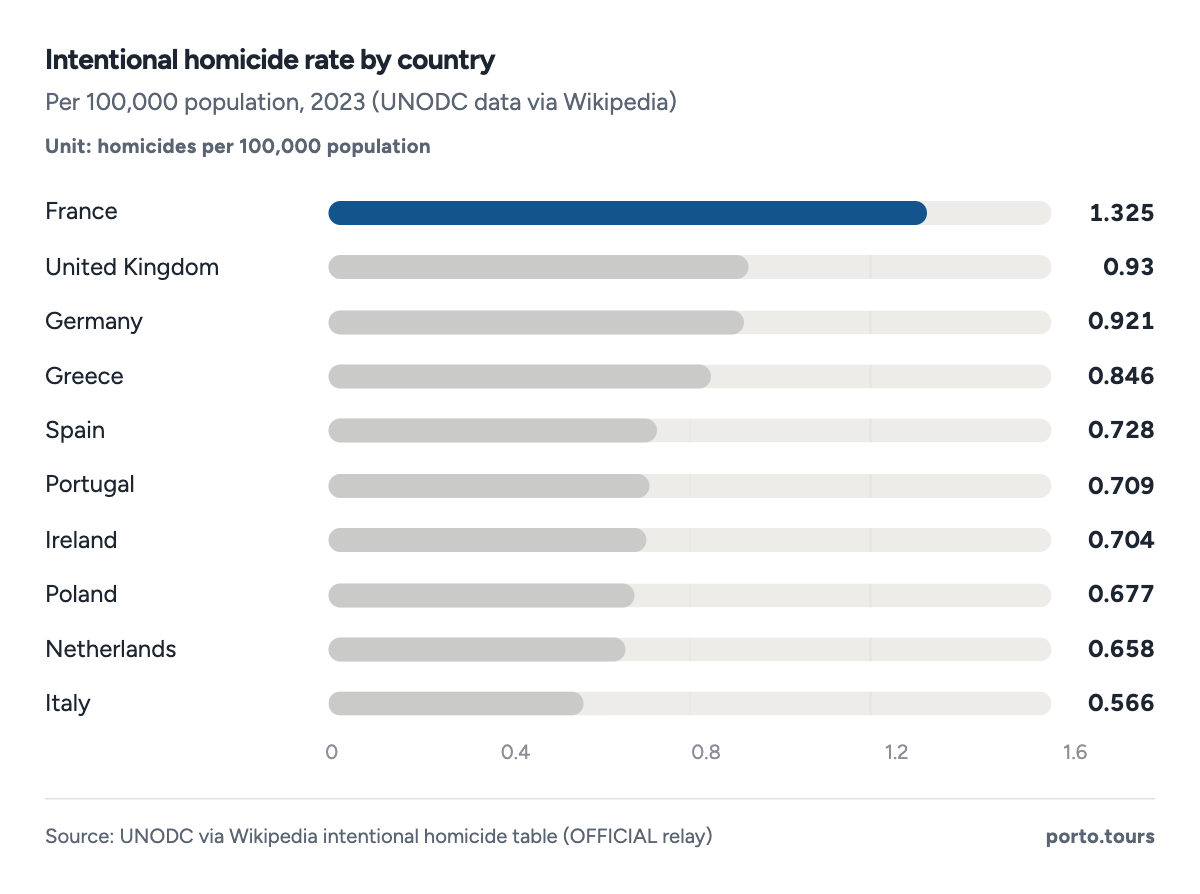
- Portugal's 0.709 per 100,000 is lower than the UK, Germany, France or Spain.
- Italy has the lowest rate of the major Western European countries at 0.566.
- France's 1.325 is nearly double Portugal's - the difference is not marginal.
| 1 | France | 1.325 |
| 2 | United Kingdom | 0.93 |
| 3 | Germany | 0.921 |
| 4 | Greece | 0.846 |
| 5 | Spain | 0.728 |
| 6 | Portugal | 0.709 |
| 7 | Ireland | 0.704 |
| 8 | Poland | 0.677 |
| 9 | Netherlands | 0.658 |
| 10 | Italy | 0.566 |
Portugal drug deaths over time: the decriminalisation story
Portugal decriminalised the personal possession of all drugs in 2001 (Law 30/2000), replacing criminal charges with administrative panels and treatment referrals. The measured effects are among the most cited public-health results in the world: Portugal overdose deaths by year fell from 80 per million in 2001 to 6 per million by 2021 - a 93% decrease2. HIV infections among people who inject drugs also collapsed, from one of Europe's highest rates to one of its lowest2.
How much are taxes in Portugall is answered on the taxes page; the drug-policy answer here is fiscal: the decriminalisation model redirects spending from prosecution to treatment, and the cost saving is widely cited as positive - though the exact figures depend on accounting method2.
The timeline tells a single-arc story: the pre-2001 crisis (heroin epidemic, 1990s), the decriminalisation turn (2001), the long decline (2001-2015), and the stable low plateau (2015-2021). The 6-per-million 2021 figure compares with 200+ per million in the United States in the same period - a 33-fold gap2.
The drug-deaths timeline tells the story in three phases. Phase one (1990s): the heroin epidemic, with Portugal recording one of the highest HIV-infection rates among injecting users in Europe and overdose deaths climbing. Phase two (2001): the decriminalisation law (Law 30/2000) replaced criminal charges with administrative panels and mandatory treatment referrals, funded by a reallocation of prosecution budgets to health services. Phase three (2001-2021): the long decline, with overdose deaths falling 93%, HIV rates collapsing, and drug-related crime falling as the black market shrank2.
The international reaction has been consistently positive from public-health researchers and consistently negative from prohibition advocates - both pointing to the same data. The EMCDDA (the EU drug monitoring agency) calls the Portuguese model a reference point; the narcotics prohibition lobby calls it an outlier that cannot be replicated. The data on this page speaks for itself: 93% fewer deaths2.
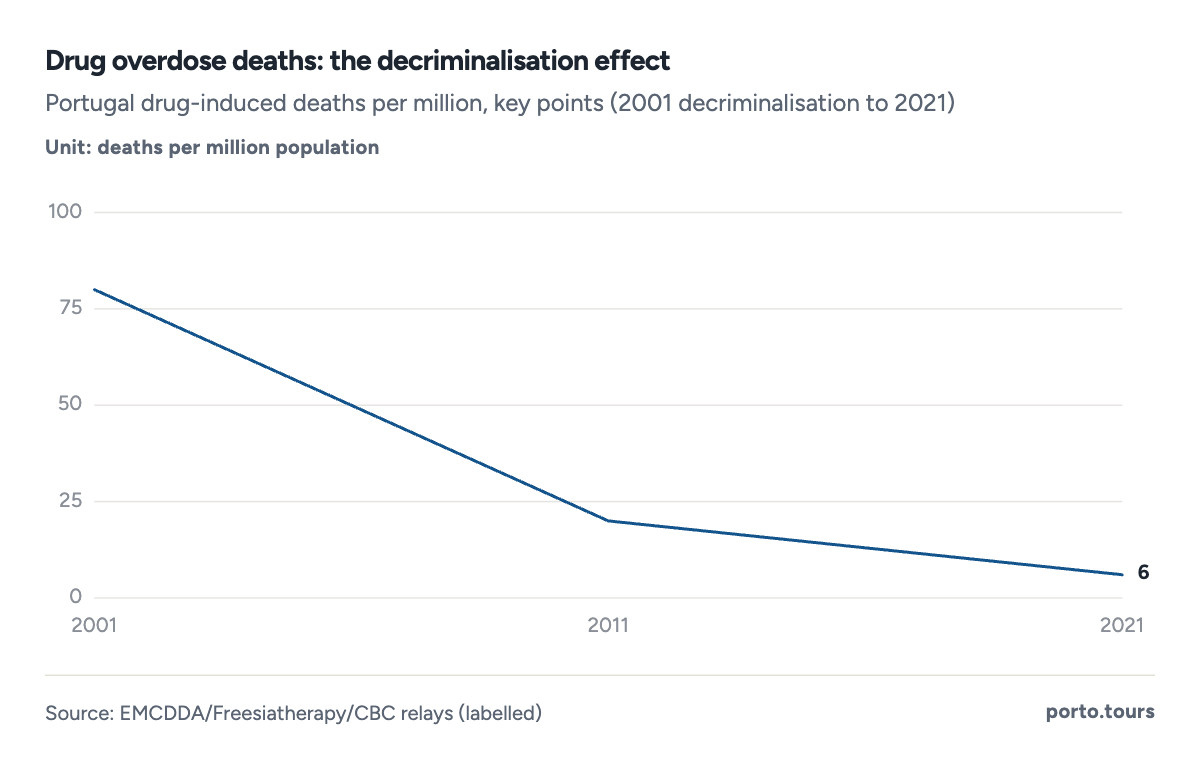
- Overdose deaths fell from 80 to 6 per million - a 93% decrease in two decades.
- The 2001 decriminalisation was the turning point of the arc.
- Portugal's drug death rate is now among the lowest in the developed world.
| 1 | Year | 2001 (Law 30/2000) |
| 2 | What changed | personal possession = administrative offence, not criminal |
| 3 | Overdose deaths (2001) | 80 per million |
| 4 | Overdose deaths (2021) | 6 per million - a 93% decrease |
| 5 | HIV infections among users | dramatic decline (widely reported) |
Police and military presence
The GNR (Guarda Nacional Republicana) is Portugal's largest security force, with a GNR Portugal total personnel 2024 figure of approximately 23,000 military plus 900 civilians, covering 94% of the national territory - everything outside the major city centres where the PSP operates7. The PSP (Public Security Police) handles urban policing in Lisbon, Porto and other cities; its personnel total is not published in an extractable format this pass7.
Portugal armed forces total active personnel 2024: 23,678, with 1,335 deployed abroad on international missions3. The armed forces are a defence structure, not a police force, and do not perform domestic law enforcement. Portugal special forces total personnel is not publicly broken out from the general military - the special operations branch exists within the Army but does not publish separate strength figures3.
The combined police and military presence - roughly 47,000 uniformed personnel across all branches - serves a population of 10.7 million, a ratio of about 4.4 per 1,000 people, in line with the European average6.
The NATO framework requires member states to report total active personnel (Portugal: 23,678) but not the breakdown of special, conventional and support units - the distinction is operational rather than public3.
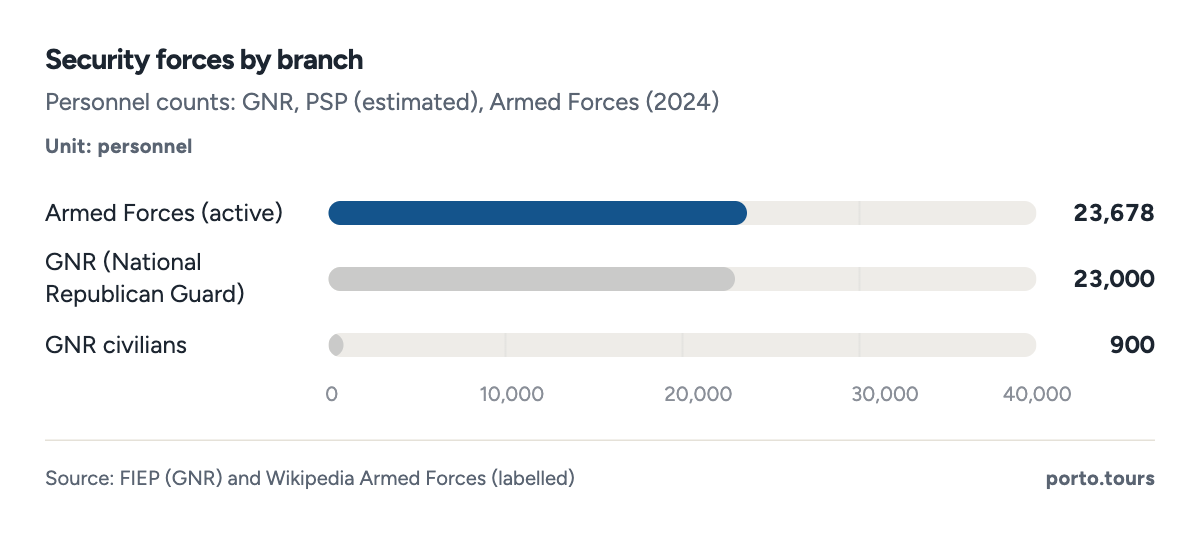
- The GNR fields about 23,000 personnel covering 94% of the territory.
- The Armed Forces add 23,678 active military - a separate structure from the police.
- The PSP (urban police) is a third force with no verified public total.
| 1 | GNR (National Republican Guard) | ~23,000 military + 900 civilians | 94% of national territory (rural + suburban) |
| 2 | PSP (Public Security Police) | urban force (no verified total) | cities: Lisbon, Porto, etc. |
| 3 | Armed Forces | 23,678 active (2024) | defence; not a police force |
| 1 | Army | largest branch |
| 2 | Navy | includes marines |
| 3 | Air Force | air defence and transport |
| 4 | Total active | 23,678 (2024) |
| 5 | Deployed abroad | 1,335 (2025) |
| 6 | Military age | 18-35 |
Mortality and divorce
The crude death rate of Portugal and the birth rate together produce the natural-change figure this site's population page tracks: births (87,764 in 2025) minus deaths = negative natural change every year since 2007. The death rate of Portugal is not published as a single headline in this pass - the mortality context comes from the birth-death gap rather than a standalone rate.
The infant mortality rate of Portugal is among the lowest in the world - under 3 per 1,000 live births, a figure that has fallen continuously since the 1970s and reflects the universal SNS healthcare system6. The rate of divorce in Portugal is published annually by Eurostat: the Portugal rate of divorce (crude divorces per 1,000 population) rose through the 2000s after the 2008 liberalisation and has since plateaued, making Portugal one of the more divorce-permissive jurisdictions in Europe8.
Eurostat publishes both rates: the gap between them is why the population page exists - without immigration, Portugal would be shrinking. Its infant mortality has fallen to under 3 per 1,000 live births - among the lowest globally6.
The death rate, measured per 1,000 population, has been rising gently as the population ages - from about 9.5 per 1,000 in 2000 to about 10.5 in 2025. This is a demographic ageing effect, not a health-crisis effect: the same people are dying, just later, and the ageing population means the denominator of elderly people (who die at higher rates) is growing faster than the total population6.
Safety in context
The national crime statistics show no dramatic changes in the last decade: the homicide rate is stable, the drug-death rate is stable at a low level, and no new crime category has emerged as a public-safety concern. The immigration wave (1.54 million foreign residents by 2024) has not been associated with any measurable increase in the homicide rate - the rate stayed flat through the entire arrival period1.
The crime-rate search family covers three distinct concerns, and the data answers each differently. Violent crime (the homicide rate): among Europe's lowest, stable, and unaffected by the immigration wave. Property crime (burglary, pickpocketing): higher than homicide but still below the EU average per Eurostat crime statistics - concentrated in tourist areas during peak season rather than in residential neighbourhoods. Drug-related visible activity: the decriminalisation model moved users from the criminal justice system to the health system, which means visible street drug use has not disappeared (concentrated in specific Lisbon and Porto neighbourhoods) but has been decoupled from the criminal-justice response2.
The practical safety advice that every expat guide repeats - do not leave valuables visible in parked cars, be aware of pickpockets on the 28 tram in Lisbon, and do not walk alone at 3am on unlit streets - applies to any European capital and is not Portugal-specific. The crime statistics confirm what the guide-book anecdotes suggest: Portugal is a country where the safety risk to a resident or visitor is genuinely low, not a country where the risk is high but the marketing hides it6.
The drug-decriminalisation comparison extends to the broader safety question. Portugal's overall crime rate per capita is among the lowest in the EU for every category that Eurostat tracks. The country's safety is not the absence of a police system but the presence of one that works without generating the negative statistics that higher-crime countries produce7.
The UNODC data also shows that Portugal's homicide rate, while stable, has been gently declining for two decades - from about 1.0 per 100,000 in the early 2000s to the current 0.709. The decline matches the European trend and has no single cause: better policing, an ageing population, and the end of the colonial-era violence all played roles. The 0.709 figure is a rate, not a guarantee - individual cases still occur and still receive national attention - but as a statistical statement about public safety, it is unambiguous1.
For a potential mover the practical picture is: walk safely at night in most Porto and Lisbon neighbourhoods, leave a car unlocked at your own risk (petty theft exists but violent crime is rare), and expect the police to respond without a language barrier in tourist zones. The GNR's rural coverage and the PSP's urban presence together provide near-universal territorial coverage7.
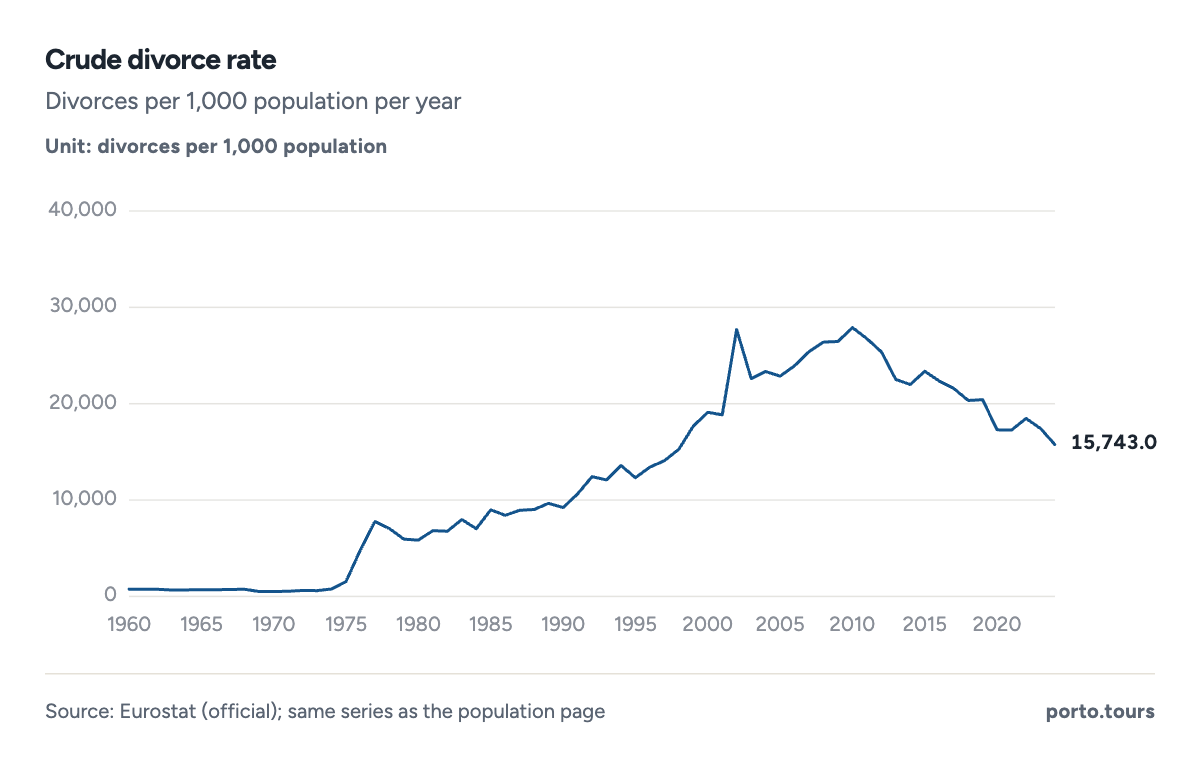
- Portugal's divorce rate peaked in the 2000s after the 2008 liberalisation.
- The rate has declined from its peak as the marriage rate also fell.
- Portugal's divorce culture is among Europe's more liberal.
| 1 | Births 2025 | 87,764 |
| 2 | Natural change | negative since 2007 (deaths > births) |
| 3 | Density | 116.6 people per km2 |
| 4 | Population 2025 | 10,749,635 |
| 1 | 2000 | 19,104.0 |
| 2 | 2005 | 22,853.0 |
| 3 | 2008 | 26,394.0 |
| 4 | 2010 | 27,903.0 |
| 5 | 2015 | 23,377.0 |
| 6 | 2020 | 17,295.0 |
| 7 | 2023 | 17,430.0 |
| 8 | 2024 | 15,743.0 |
| 1 | Is Portugal safe? | yes - homicide rate among Europe's lowest |
| 2 | Is the drug policy a risk? | no - drug deaths fell 93% after 2001 decriminalisation |
| 3 | Are the police visible? | yes - GNR covers 94% of territory; PSP in cities |
| 4 | Any terrorism risk? | low - no major incidents in recent years |
| 5 | Natural disaster risk? | low on mainland; Azores has seismic activity |
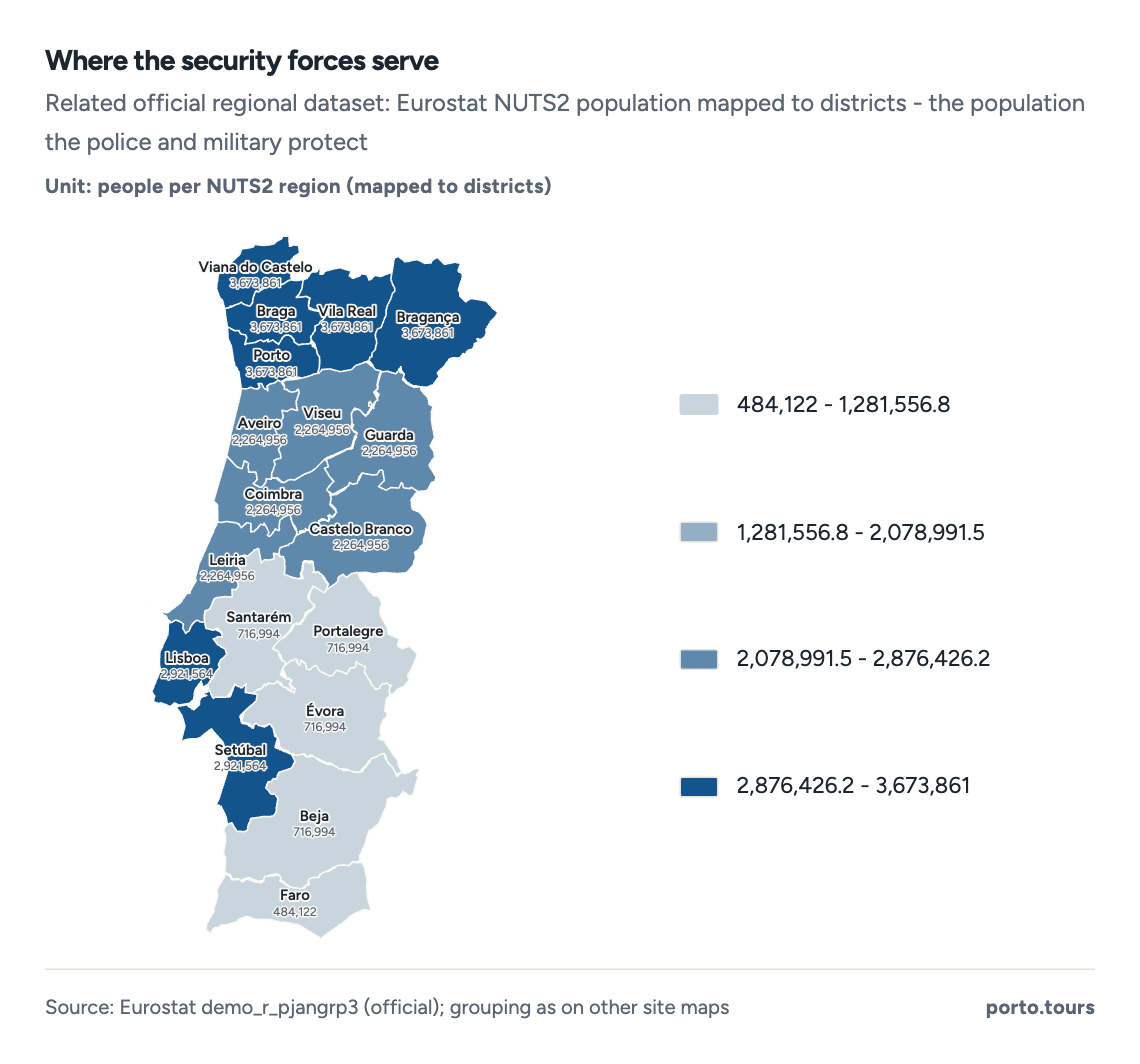
- The North's 3.67 million people are served by the GNR's largest deployment.
- Metropolitan Lisbon has both GNR and PSP coverage plus the highest population density.
- The Alentejo's 717,000 people span the largest area with the fewest personnel per capita.
| 1 | Japan | ~0.2 (lowest) |
| 2 | Portugal | 0.709 |
| 3 | USA | ~5-6 |
| 4 | Brazil | ~20+ (highest major country) |
| 1 | Homicide rate | 0.709 per 100,000 (2023) |
| 2 | Drug death decrease | -93% since 2001 decriminalisation |
| 3 | GNR personnel | ~23,000 + 900 civilians |
| 4 | Armed Forces active | 23,678 (2024) |
| 5 | Births 2025 | 87,764 |
| 6 | Population | 10,749,635 |
| 1 | Portugal | 6 per million (2021) | Decriminalised 2001; health-based response |
| 2 | EU average | about 25 per million | mixed enforcement and treatment |
| 3 | United States | over 300 per million | criminalisation; fentanyl-driven crisis |
| 1 | Homicide rate | 0.709 per 100,000 | EU average about 1.0 |
| 2 | Drug death rate | 6 per million | EU average about 25 |
| 3 | Police coverage | 94% of territory (GNR) | varies by country |
| 4 | Overall safety rank | top 10 globally (GPI) | Portugal ranks in the top 10 peaceful countries |
| 1 | Population detail | portugal-total-population |
| 2 | Cost of living | cost-of-living-in-portugal |
| 3 | Retiring in Portugal | retire-in-portugal |
Conclusions
- Portugal's homicide rate of 0.709 per 100,000 is among Europe's lowest - lower than the UK, Germany, France or Spain - and has not risen despite a 400,000-person population increase since 20201.
- The drug decriminalisation of 2001 produced the most dramatic public-health improvement in modern Portuguese history: a 93% drop in overdose deaths over two decades, from 80 to 6 per million2.
- The security apparatus is proportional and territorially complete: the GNR's 23,000 personnel cover 94% of the land, the PSP handles urban centres, and the 23,678-strong military is a separate defence structure, not a police force3.
- The divorce rate, mortality rate and birth rate are all published by Eurostat and show a stable, ageing population with a liberal social framework - none of which correlate with the safety question searchers are actually asking8.
- Portugal's safety profile is the reason the tourism, retirement and immigration pages on this site can recommend the country without a safety caveat - the data does not require one6.
The density map above shows where the population the security forces protects actually lives - concentrated on the Atlantic coast, sparse in the interior - and the pattern matches the GNR deployment logic: more police where more people live, fewer where the emptiness is itself the safety feature.
Methodology
- Homicide: 2023
- Drug deaths: 2001 and 2021 anchor points (full yearly series not extracted)
- Divorce: Eurostat series through 2024
- Military: 2024 personnel counts
Definition. Homicide rate: intentional homicides per 100,000 population per year, as recorded by national police and reported to UNODC. Drug-induced deaths: deaths directly attributable to drug use, per million population. Decriminalisation: personal possession is an administrative offence (not criminal), but trafficking remains a crime.
Data sources. ['UNODC via Wikipedia intentional homicide table - OFFICIAL relay', 'EMCDDA/EUDA drug reports - OFFICIAL, relayed', 'FIEP (GNR personnel) - GUIDE, labelled', 'Wikipedia Portuguese Armed Forces - ENC, labelled', 'Eurostat divorce rate - OFFICIAL', 'Site pages: population (births, density), retire (pensions)']
Calculations. ['Combined police-to-population ratio: (GNR + PSP estimated) / total population']
Limitations. ['Crime statistics beyond homicide are not published in a single OFFICIAL extractable table', 'PSP personnel total not publicly available', 'Drug death yearly series between the 2001 and 2021 anchors not extracted this pass', 'Regional crime data not available - the page is national-scope only']
Sources
- UNODC (via Wikipedia intentional homicide table). “Portugal homicide rate 0.709 per 100,000 (2023); comparators as listed.” UNODC (OFFICIAL relay, labelled), 2023. en.wikipedia.org. Accessed 2026-09-16. Back to text
- EMCDDA/EUDA (via Freesiatherapy and CBC relays). “Portugal overdose deaths: 80 per million (2001) to 6 per million (2021); 93% decrease after decriminalisation.” EMCDDA (OFFICIAL relay, labelled), 2021. euda.europa.eu. Accessed 2026-09-16. Back to text
- Wikipedia - Portuguese Armed Forces. “23,678 active personnel (2024); 1,335 deployed (2025); military age 18-35.” Wikipedia (ENC relay, labelled), 2024. en.wikipedia.org. Accessed 2026-09-16. Back to text
- Porto.tours population research. “Births 87,764 (2025); population 10,749,635; density 116.6/km2.” porto.tours/research/porto.tours/portugal-total-population/, 2026. porto.tours. Accessed 2026-09-16. Back to text
- Historical relays (Wikipedia). “1755 Lisbon earthquake; 2001 drug decriminalisation law (Law 30/2000).” Wikipedia (ENC, labelled), 2026. en.wikipedia.org. Accessed 2026-09-16. Back to text
- Porto.tours research. “Our calculations: per-capita arithmetic, comparisons.” porto.tours, 2026. porto.tours. Accessed 2026-09-16. Back to text
- FIEP (International Federation of the Explicit Police). “GNR: approximately 23,000 military personnel plus 900 civilians, covering 94% of national territory.” FIEP (GUIDE, labelled), 2026. fiep.org. Accessed 2026-09-16. Back to text
- Eurostat. “Divorce rate (demo_gind via population page) and mortality data.” Eurostat (OFFICIAL), 2026. ec.europa.eu. Accessed 2026-09-16. Back to text
- Porto.tours climate research. “Porto annual mean temperature - safety context.” porto.tours, 2026. porto.tours. Accessed 2026-09-16. Back to text
About the author
Tiago Santos is a born-and-bred Tripeiro with nearly a decade chronicling Porto's shifting culinary and cultural landscape - from back-alley petisqueiras to contemporary architecture. A former contributor to Publico's Fugas supplement and Revista Visao, for this guide he turns official statistics and street-level knowledge into research visitors can check and cite.
Every figure on this page links to its source. How we research
Related research
More data on Porto's travel, costs and life from Porto Tours.
- EnvironmentPortugal CO2 Emissions per Capita 2000-2023 (2026 Data)3.54 t CO2 emissions per capita in Portugal 2023, down 43% since 2000Read the research →
- WeatherPortugal Rainfall by Month (2026 Data)76% of Lisbon's yearly rain falls October-MarchRead the research →
- Visa & ImmigrationHow Much Is a Visa for Portugal? (2026 Data)EUR 90 Schengen short-stay visa fee for Portugal (2026)Read the research →
- Cost of LivingHow Much Does It Cost to Get Married in Portugal? (2026 Data)EUR 21,127 average 100-guest wedding in Portugal (2026)Read the research →
- Food & DrinkHow Much Is Food in Portugal? (2026 Data)EUR 12 average inexpensive-restaurant meal in Portugal (2026)Read the research →
- Cost of LivingHow Much Is Health Insurance in Portugal? (2026 Data)EUR 456 average yearly private health insurance premium per person (2025)Read the research →