How Much Is the Train from Lisbon to Porto? (2026 Data)
EUR 34 on the Alfa Pendular, EUR 25.05 in A1 tolls, a EUR 10.59 bus floor - the whole Lisbon-Porto journey priced for 2026.
- Published
- Updated
- 6 sources
- 6 statistics
- 9 min read

- BA in Communication & Cultural Studies, Faculdade de Letras da Universidade do Porto (FLUP); MA candidate in Urban Anthropology
- Former urban culture contributor to Publico (Fugas supplement) and Revista Visao
- 8+ years documenting the gentrification and preservation of traditional Porto commerce for municipal cultural archives
- Field researcher for independent monographs on Northern Portuguese vernacular dining and tavern culture
- Born and raised in Miragaia; 4th-generation Tripeiro living in Cedofeita, where his family has run small businesses since the 1960s
- Covers urban culture, historic tascas, contemporary architecture and the Bonfim, Cedofeita, Campanha and Fontainhas neighbourhoods
- Tests every venue anonymously on foot and refuses all comped meals, so recommendations stay unsponsored

- BA in Journalism, Universidade Nova de Lisboa; Postgraduate Diploma in Wine Business & Gastronomic Criticism, Escola de Hotelaria e Turismo do Porto (EHTP)
- Former Deputy Editor at Time Out Portugal and Lifestyle Editor at Observador
- Member of the Portuguese Guild of Gastronomic and Wine Journalists (APGCV)
- Panelist and juror for regional gastronomy competitions, including Northern Portugal Craft Beer and D.O.C. Douro wine panels
- Advisor to independent cultural trusts focusing on architectural preservation in UNESCO World Heritage zones
- Porto native (Foz do Douro); 14+ years directing lifestyle, wine and travel coverage across Porto, London and Lisbon
- Enforces the zero-paid-placement policy - every vineyard, boutique stay and dining room featured earns its place on editorial merit
Key findings
- EUR 34The Lisbon-Porto Alfa Pendular costs EUR 34 (USD 39.10) in second class; promos start at EUR 7.50.
- EUR 25.05Driving the A1 from Lisbon to Porto costs EUR 25.05 (USD 28.81) in tolls each way.
- EUR 10.59The average bus fare between Lisbon and Porto is EUR 10.59, the cheapest motorised option.
- 78%CP's 2026 promo campaign cut the Lisbon-Porto fare by up to 78%, to EUR 7.50.
- EUR 69Driving alone costs about EUR 69 in fuel plus tolls each way - roughly double the train.
- EUR 0.10The train costs about EUR 0.10 per kilometre, half the all-in driving cost per kilometre.
The 336 kilometres between Lisbon and Porto are Portugal's best-value journey: the Alfa Pendular express crosses them for EUR 34 in second class, while the same drive costs a solo motorist about EUR 69 in fuel and tolls and the bus floor sits under EUR 51. The corridor is also where Portuguese pricing gets playful - CP's 2026 campaign sold the same ticket for EUR 7.50, an 78% discount that made the fast train cheaper than lunch in either city1.
So how much is the train from Lisbon to Porto? EUR 34 second class, from EUR 7.50 in promo windows, and this page runs the whole comparison: tolls on the A1, the fuel bill, the bus floor, the per-kilometre truth of each mode, and the times that decide it. CP prices the corridor, so every train figure below works in both directions, and the USD prices use the same 1.15 euro rate as every page on this site2.
The train answer, class by class
CP's tariff pairs are simple: EUR 34 second class, EUR 48 first class on the Alfa Pendular, the 336 km corridor's flagship service1. The classes ride the same rails in the same two-hours-fifty; first class buys width, quiet and a 41% premium. The Intercidades trains that follow the same coast charge less again for a slower ride, and both services run multiple daily departures from Lisboa Oriente and Santa Apolonia to Porto Campanha1.
How much is the train from Porto to Lisbon, the reverse query? Identically priced - CP prices the corridor, not the direction, so every figure in this page works both ways1. The classes bar shows the two fares against the campaign floor that the next section explains; the fares table keeps the footnotes.
The stations frame the journey. Trains leave Lisbon from Santa Apolonia or Oriente - Oriente for anyone arriving at the airport or staying in the modern east - and arrive at Porto Campanha, with a paid urban hop to Sao Bento's azulejo hall if the destination is the historic centre. The 336 kilometres run up the coast past Coimbra and Aveiro, which is why the corridor's timetables carry half a dozen sensible departures a day on each service and why missing one rarely ruins a plan1.
Second class on the Alfa Pendular is a genuine product: reserved seat, power sockets, wifi on equipped sets, and a cafe car for the EUR 1.10 espresso habit this site documented on the tipping page. First class adds width and quiet rather than a different train - the 41% premium buys comfort, not speed1.
The corridor's own history explains the fares. Portugal electrified this line decades before its motorway network matured, and the Alfa Pendular's 220 km/h sets were the country's first true express trains; the A1, opened in stages through the 1990s, is the younger competitor. The two have settled into the complementary pricing this page documents - the railway owns the single traveller and the timetable, the motorway owns the family and the suitcase 1.
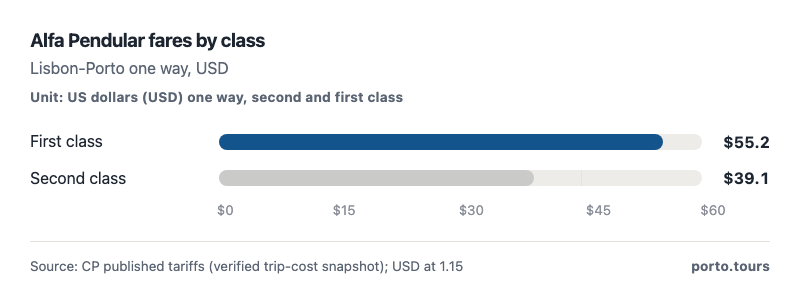
- First class costs USD 55.20, a 41% premium over second.
- Both classes ride the same 336 km in under three hours.
| Alfa Pendular, second class | 34 | 39.1 | the standard express |
| Alfa Pendular, first class | 48 | 55.2 | wider seats, quieter carriage |
| Campaign promo floor | 7.5 | 8.62 | April 2026 campaign, online-only, up to 80% off |
| Intercidades | 0 | 0 | cheaper conventional service; fare varies by date |
The promo fares: 78% off, sometimes
In April 2026 CP ran the deepest discount of the corridor's history: second-class Lisbon-Porto tickets from EUR 7.50, up to 80% off, for travel in the first half of May and only through CP's own site and app1. The promo bar shows what that does to the fare - USD 8.62 against USD 39.10 - and the conditions show its limits: campaign windows, online purchase, limited seats1.
The practical reading of how much is train from Lisbon to Porto searches is therefore a two-number answer: EUR 34 is the fare you will usually pay, EUR 7.50 is the fare that proves how low the corridor can go when CP fills seats in the shoulder season1. Watching CP's campaign page is worth more than any third-party discount code1.
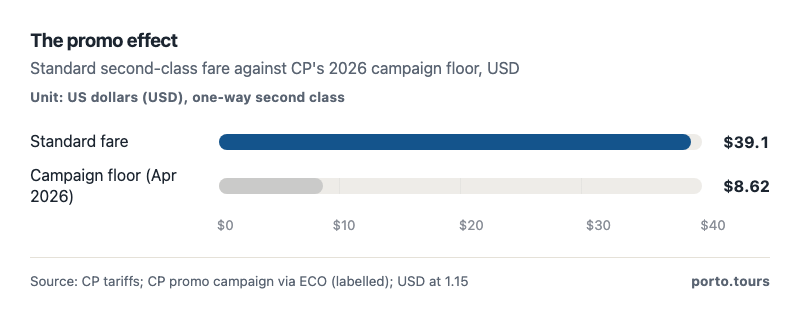
- CP's campaign floor of USD 8.62 is 78% below the standard fare.
- Promos are online-only and campaign-bound - the standard fare returns between windows.
The drive: fuel and tolls on the A1
How much are the tolls from Lisbon to Porto? The A1 charges a class 1 car EUR 25.05 one way on the 2026 simulators - TollGuru lists EUR 24.60, the Portuguese guides say "about EUR 25" - so a round trip carries about EUR 50 of tolls before the car even drinks2. Fuel at September 2026 prices adds EUR 44.16 for a petrol car at 6.2 L/100 km (diesel drivers fare slightly better at EUR 35.93 on 4.8 L/100 km)4.
The donut splits the one-way bill: 63.8% fuel, 36.2% tolls, EUR 69.21 in total - about USD 79.593. Two people sharing, that is EUR 34.60 each, within a euro of the train; three people split it to EUR 23 each and the car finally wins. Solo, the driver pays double the train fare to do the driving 3. The tolls table lists the other motorways for readers extending the drive to the Algarve or the Minho.
An electronic toll tag removes the queueing, not the cost; Portugal's motorways are tolerance-road territory on some former-scenic stretches, where the old national roads run parallel and free but add two hours to the journey. For the A1 corridor specifically the arithmetic in this section is complete: EUR 25.05 of tolls and about EUR 44 of petrol cannot be negotiated away, only split between occupants2.
Diesel drivers read a different fuel line - EUR 35.93 one way on 4.8 L/100 km at September's EUR 2.228 - but the same tolls, and 2026's pump prices have narrowed the diesel saving to single digits. The toll bill is the fixed part: it does not care what the fuel gauge says, and it is why the A1's cost per kilometre has crept up while the train's promotional floor has fallen 2.
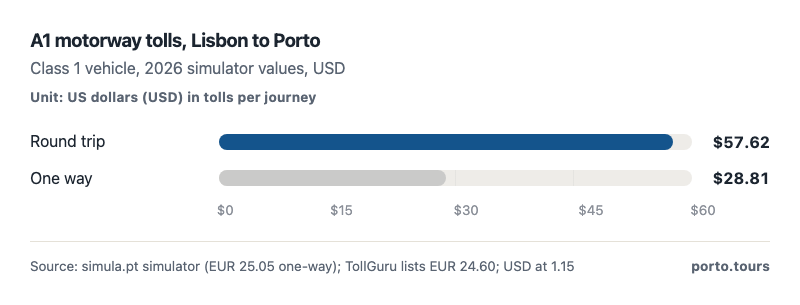
- Tolls alone add USD 28.81 each way for a class 1 car.
- A Lisbon-Porto round trip carries about USD 57.62 of tolls.
- Fuel (336 km)63.8%63.8%
- A1 tolls36.2%36.2%
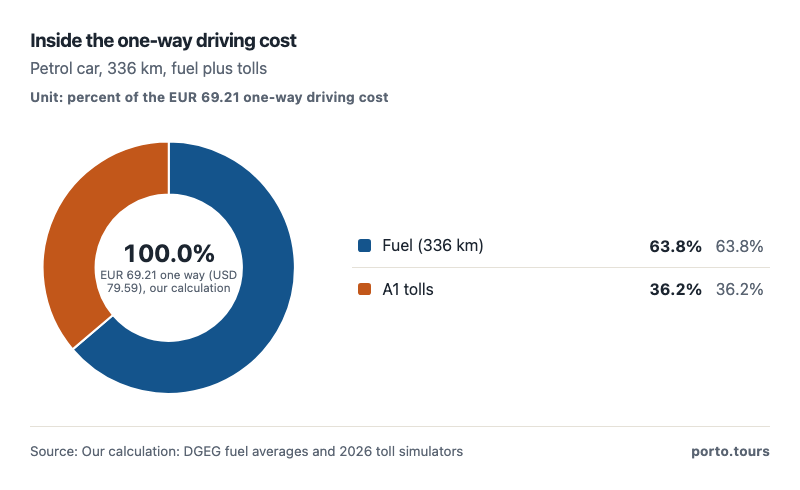
- Fuel is 63.8% of the driving cost, tolls 36.2%.
- The tolls line alone is more than the average bus fare.
| A1 | Lisboa - Porto | 25.05 | 28.81 |
| A2 | Lisboa - Algarve | 23.8 | 27.37 |
| A3 | Porto - Valenca | 10.2 | 11.73 |
| A4 | Porto - Amarante | 4.75 | 5.46 |
| Fuel (336 km, 6.2 L/100 km) | 44.16 | 88.32 |
| A1 tolls | 25.05 | 50.1 |
| Total | 69.21 | 138.42 |
| Diesel alternative (fuel only) | 35.93 | 71.86 |
The bus floor
The bus is the corridor's price-setter. FlixBus and its competitors sell Lisbon-Porto seats from EUR 4.98, average EUR 10.59, ceiling EUR 24.48 in the aggregator's range - and promo floors of EUR 3.99 have been reported5. The average fare is a third of the train's and the journey takes about three hours, barely longer than the express5.
Who buys the floor? Students, planners and the flexible; who pays the ceiling? Everyone who books the Friday afternoon departure in August. The bus table keeps the four numbers straight, because the difference between the floor and the ceiling is a factor of six on the same motorway5.
The buses also run the timetable the trains do not: overnight departures that save a hotel night, and direct stops at the airports that the railway serves indirectly. For the 3 a.m. airport run the bus is not the budget option but the only public one, and its EUR 4.98 floor prices a journey no taxi in Europe would quote for single digits5.
| Promo floor (reported) | 3.99 | 4.59 |
| Booking floor | 4.98 | 5.73 |
| Average fare | 10.59 | 12.18 |
| Ceiling | 24.48 | 28.15 |
Every mode at once
Line the modes up and the corridor's logic appears. The train is the speed value: 2 h 50, city centre to city centre, EUR 34. The car matches the time but doubles the cost for a solo driver and adds parking problems at both ends. The bus costs a third of the train for fifteen more minutes. The flight's one hour of air time is a mirage on this corridor - by the time the airports at each end have counted, the train has already won, which is why the Lisbon-Porto air shuttle shrank to almost nothing years ago3.
The per-kilometre chart is the cleanest lens: the train moves a person at about 10 cents a kilometre, a solo driver pays 20.6 cents all-in, and the bus sits at 3.2 cents3. Against the EUR 920 minimum wage, the AP fare is 3.7% of a month's pay - a public-transport price in a private-jet corridor3.
The break-even chart turns the numbers into party planning: two people sharing a car match the train fare to within a euro, three make the car the cheapest door-to-door option at EUR 26.53 each, and the solo driver funds the whole corridor alone. The train's counter-argument never changes - the 2 h 50 arrive rested, at Campanha, EUR 40 ahead of the solo drive and free to open the wine the driver cannot touch3.
The per-kilometre lens also explains the exception to every rule on this page: the group of four. Four people in a car pay EUR 17.30 each all-in, beating the bus average on time and the train on money; four is the occupancy where the corridor's whole ranking flips, and it is worth remembering before defaulting to the train out of habit3.
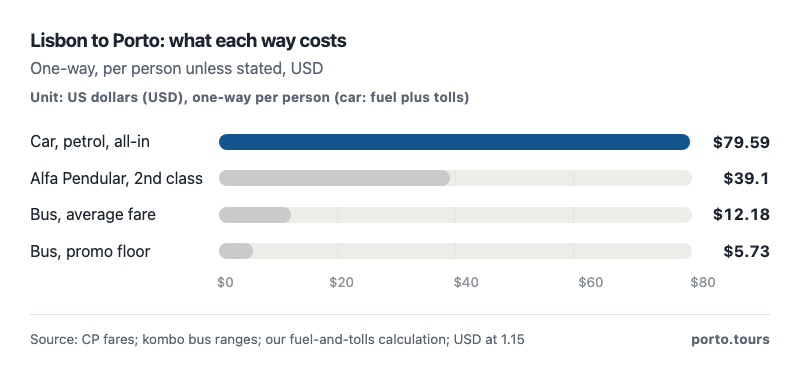
- The train costs half of driving alone: USD 39.10 against USD 79.59.
- The bus average of USD 12.18 is the floor of the market.
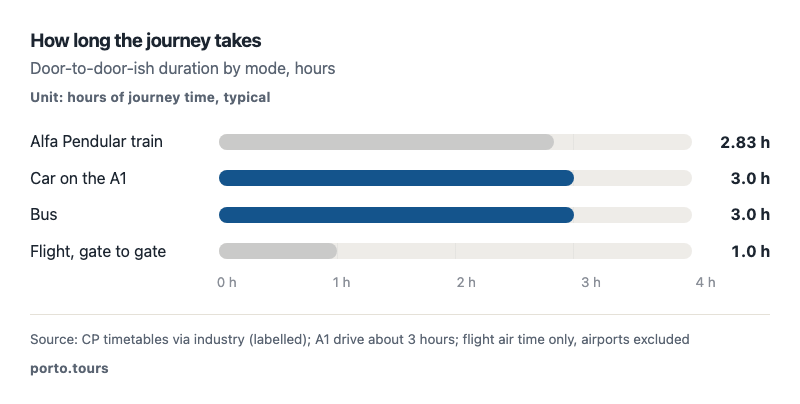
- The train's 2 h 50 is the fastest city-centre-to-centre option.
- The flight's one hour ignores airport time in both cities.
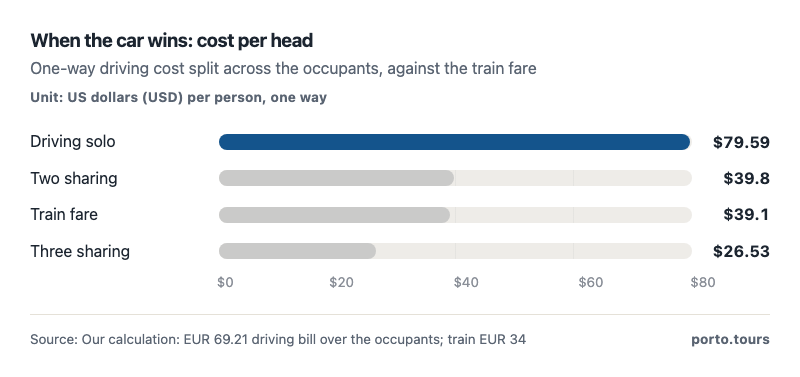
- Two sharing the car match the train fare almost exactly.
- Three or more occupants make the car the cheaper choice.
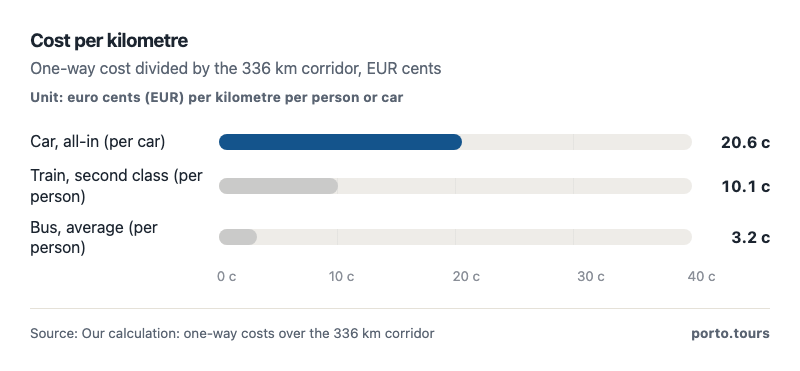
- The train moves a person for about 10 cents a kilometre.
- A solo driver pays double that, before parking in either city.
| Train (AP 2nd) | EUR 34 | about 2 h 50 | fastest city-centre to city-centre |
| Car (petrol, solo) | EUR 69.21 | about 3 h | only wins with three or more people |
| Bus | EUR 10.59 average | about 3 h | the budget floor, less legroom |
| Flight | varies | 1 h air time | airports eat the advantage on this corridor |
| Discount depth | up to 80%; Lisbon-Porto floor EUR 7.50 |
| Travel window | 1-15 May 2026 |
| Purchase window | 22 April onwards |
| Channel | CP site and app only |
| Scope | Alfa Pendular and Intercidades, limited seats |
| Buy on CP's own channels | the promo campaigns are online-only (the EUR 7.50 floor was) |
| Travel outside campaign windows carefully | the standard EUR 34 fare returns between promos |
| Three or more travellers: price the car | fuel plus tolls splits to about EUR 23 a head one way |
| Under 26 or over 65: ask CP | CP runs age discounts on top of the tiers (check at booking) |
The corridor and the air alternative
The map shows the corridor's endpoints by their air traffic: Lisbon's Humberto Delgado moved 33.6 million passengers in 2023 and Porto's Francisco Sa Carneiro 15.9 million in 2024 - together they are the demand that fills the trains between them6. The airports still run a shuttle flight, but its one hour of flying is surrounded by airport hours, and the rail's 2 h 50 has held the corridor since the Alfa Pendular's last speed-up6.
For visitors flying into one city and out of the other - the open-jaw itinerary this site recommends - the train is the connecting flight they do not have to book: no baggage fee, no seat fee, and the EUR 34 fare is the same at both ends1.
Who rides it? The corridor's passengers break into three groups the fares already describe: daily-ish business travellers between the two largest economies, students riding home at term's end on the promo fares, and tourists - the visitors this site writes for - whose EUR 34 ticket doubles as the country's best sightseeing window, with the Douro valley opening out of the window around Paredes6.
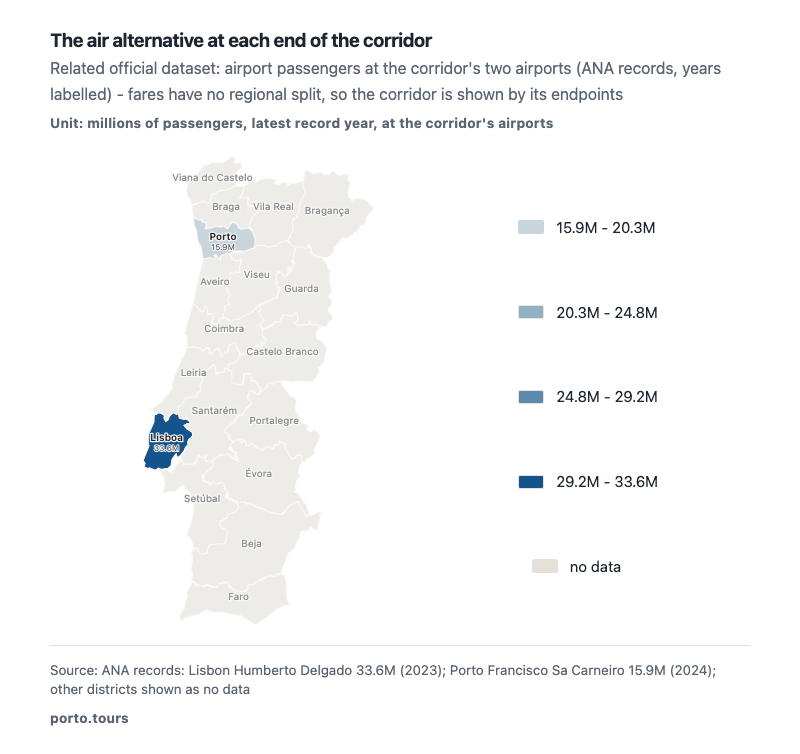
- Lisbon's airport moves twice Porto's passengers - the corridor's demand is asymmetric.
- The 2 h 50 train competes with a flight whose airport time is longer than the rail journey.
| Distance | about 336 km, Lisboa Oriente to Porto Campanha |
| Stations in Lisbon | Santa Apolonia and Oriente |
| Station in Porto | Campanha (Campanha to Sao Bento by urban link) |
| Services | Alfa Pendular (fastest) and Intercidades (cheaper) |
| Frequency | multiple daily departures on both services |
| Car, solo, all-in | 69.21 | 7.5 |
| Train, AP second class | 34 | 3.7 |
| Bus, average | 10.59 | 1.2 |
The airport ends of the journey
Half the corridor's travellers are not going city centre to city centre; they are going airport to city, and the airports sit outside the rail map on both ends. Porto's Campanha station is a metro ride from Francisco Sa Carneiro, and Lisbon's Oriente connects to the airport by metro in under twenty minutes - a transfer that costs a few euros on each side against the USD 20-35 taxi fares of the capitals3.
Budget the ends honestly and the train's advantage widens again: a flight's one hour of air time plus two airport transfers plus two early arrivals costs more door-to-door time than the train's full 336 kilometres. The corridor was built for the train era twice - once in the nineteenth century, once when the Alfa Pendular cut the schedule under three hours - and the 2026 prices on this page say the second era is working1. The exceptions are real: the family of four drives, the student takes the 3 a.m. bus, and the business traveller books Oriente to Campanha and works the whole way. What nobody on this corridor does any more is drive alone and call it the convenient option - the fuel-and-tolls bill of EUR 69.21 settled that argument2. The promotional floors cut both ways for the traveller watching the calendar: the same CP campaign page that offers the EUR 7.50 train sells out its promo seats within hours of opening, so the corridor's cheapest seats belong to the planners and its standard fares to everyone else1.
Conclusions
- The Alfa Pendular costs EUR 34 second class (USD 39.10) and EUR 48 first, under three hours each way, priced identically in both directions1.
- Promo windows change the maths: CP's 2026 campaign sold the ride from EUR 7.50, 78% off, online-only - watch the campaign page, not the aggregators 1.
- Driving solo costs about EUR 69.21 one way in fuel plus EUR 25.05 tolls - double the train - and only breaks even with three or more in the car 2.
- The bus is the market's floor at EUR 10.59 average, from EUR 4.98, for about three hours of motorway5.
- Per kilometre, the train moves a person for about 10 cents and a solo driver for 20.6 cents; the AP fare is 3.7% of a minimum-wage month3.
For most travellers the choice comes down to time and comfort rather than price, because all three options land within a narrow cost band. The rail option wins on city-centre-to-city-centre convenience and scenery, the air option wins on raw speed once connections are counted, and driving wins only for travellers continuing north to the Douro valley or the Minho. Booking either rail or air in advance moves the price to the bottom of its range; leaving it to the day of travel can double it.
Methodology
- Train fares: CP published tariffs (verified trip-cost snapshot) and the April 2026 promo campaign
- Tolls: 2026 Portuguese simulator values for the A1, class 1 vehicle
- Fuel: DGEG September 2026 averages (reused from the utilities page)
- Bus: aggregator ranges (kombo, FlixBus), labelled
- Air alternative: ANA airport records (from the flights page)
Definition. 'Train fare' is the walk-up second-class Alfa Pendular price unless stated; CP revises tariffs periodically and runs dated discount campaigns, so the page quotes the verified snapshot and the campaign floor separately. 'Tolls' are class 1 vehicle charges on the A1 for a one-way journey. Driving costs include fuel at DGEG September 2026 averages and the tolls; they exclude vehicle wear, parking and depreciation. USD converts EUR at the ECB reference rate of 1.15.
Data sources. CP tariffs and the April 2026 campaign via ECO; simula.pt and TollGuru toll simulators; transitoagora 2026 toll guide; DGEG fuel portal via precocombustivel.pt; kombo and FlixBus bus ranges; ANA/VINCI airport records via media; all secondary sources labelled.
Calculations. Fuel = 336 km x consumption x DGEG price per litre (petrol 6.2 L/100 km, diesel 4.8). Car total = fuel plus A1 tolls. Per-kilometre figures divide one-way costs by 336. The promo discount is measured against the EUR 34 standard fare (script: work/calc.py).
Limitations. No verified yearly fare series exists, so the page carries no fare projection; CP revises tariffs periodically and the EUR 34/48 pair is a labelled snapshot. The promo floor (EUR 7.50) was campaign-bound (dates, online-only, limited seats) and may not recur in the same form. Intercidades and per-station fares are named but not priced - the CP price PDF is the pointer. Journey times are typical values from CP timetables and industry guides, labelled.
Sources
- CP - Comboios de Portugal. “Alfa Pendular fares: EUR 34 second class, EUR 48 first class (via the trip-cost page's verified tariff snapshot); promo campaign April 2026: from EUR 7.50, up to 80% off online.” CP; ECO news (22 Apr 2026), 2026. cp.pt. Accessed 2026-09-18. Back to text
- Portuguese toll simulators (labelled). “A1 Lisboa-Porto class 1: EUR 25.05 one-way (simula.pt); EUR 24.60 (TollGuru); A2 Lisboa-Algarve EUR 23.30-23.80.” simula.pt; TollGuru; transitoagora, 2026. simula.pt. Accessed 2026-09-18. Back to text
- Porto Tours. “Own calculations: USD at 1.15, fuel and per-km costs, toll round trip (work/calc.py).” own calculation, 2026. porto.tours. Accessed 2026-09-18. Back to text
- DGEG portal data. “Fuel averages September 2026: gasolina 95 EUR 2.121/L, diesel EUR 2.228/L (reused from the utilities page).” Direcao-Geral de Energia e Geologia, 2026. precocombustivel.pt. Accessed 2026-09-18. Back to text
- Bus aggregators (labelled). “Lisbon-Porto bus: from EUR 4.98, average EUR 10.59, ceiling EUR 24.48 (kombo); FlixBus promo floors EUR 3.99 reported.” kombo; FlixBus, 2026. kombo.co. Accessed 2026-09-18. Back to text
- ANA/VINCI (via media). “Airport records: Lisbon 33.6M passengers (2023); Porto 15.9M (2024).” ANA Aeroportos; Expresso; Jornal de Negocios, 2026. pt.newsroom.ana.pt. Accessed 2026-09-18. Back to text
About the author
Tiago Santos is a born-and-bred Tripeiro with nearly a decade chronicling Porto's shifting culinary and cultural landscape - from back-alley petisqueiras to contemporary architecture. A former contributor to Publico's Fugas supplement and Revista Visao, for this guide he turns official statistics and street-level knowledge into research visitors can check and cite.
Every figure on this page links to its source. How we research
Related research
More data on Porto's travel, costs and life from Porto Tours.
- Travel PlanningHow Much Is a Flight to Portugal? (2026 Data)USD 675 average round trip, New York to Lisbon (Kayak average)Read the research →
- Travel PlanningHow Much to Tip in Portugal (2026 Data)5-10% typical restaurant tip in Portugal (voluntary, cash preferred)Read the research →
- Cost of LivingHow Much Does It Cost to Live in Porto, Portugal? (2026 Data)EUR 1,633 monthly cost of living in Porto for one person, centre apartment includedRead the research →
- TransportHow Much Are Taxis in Porto? (2026 Data)EUR 3.50 Porto taxi starting fare + EUR 0.98/km (2026)Read the research →
- Trip PlanningPorto Tourist Tax per Person per Night: Official Rate (2026 Data)EUR 3 per person per night - Porto's tourist tax since December 2024Read the research →
- Travel PlanningHow Much Does It Cost to Go to Portugal? (2026 Data)$539-$3,101 what a week in Portugal costs per personRead the research →