How Much Is a Dollar in Portugal? (2026 Data)
The euro, the dollar conversion, how much cash to carry and what a day costs in both currencies - the money page, fully labelled.
- Published
- Updated
- 5 sources
- 5 statistics
- 9 min read

- BA in Communication & Cultural Studies, Faculdade de Letras da Universidade do Porto (FLUP); MA candidate in Urban Anthropology
- Former urban culture contributor to Publico (Fugas supplement) and Revista Visao
- 8+ years documenting the gentrification and preservation of traditional Porto commerce for municipal cultural archives
- Field researcher for independent monographs on Northern Portuguese vernacular dining and tavern culture
- Born and raised in Miragaia; 4th-generation Tripeiro living in Cedofeita, where his family has run small businesses since the 1960s
- Covers urban culture, historic tascas, contemporary architecture and the Bonfim, Cedofeita, Campanha and Fontainhas neighbourhoods
- Tests every venue anonymously on foot and refuses all comped meals, so recommendations stay unsponsored

- BA in Journalism, Universidade Nova de Lisboa; Postgraduate Diploma in Wine Business & Gastronomic Criticism, Escola de Hotelaria e Turismo do Porto (EHTP)
- Former Deputy Editor at Time Out Portugal and Lifestyle Editor at Observador
- Member of the Portuguese Guild of Gastronomic and Wine Journalists (APGCV)
- Panelist and juror for regional gastronomy competitions, including Northern Portugal Craft Beer and D.O.C. Douro wine panels
- Advisor to independent cultural trusts focusing on architectural preservation in UNESCO World Heritage zones
- Porto native (Foz do Douro); 14+ years directing lifestyle, wine and travel coverage across Porto, London and Lisbon
- Enforces the zero-paid-placement policy - every vineyard, boutique stay and dining room featured earns its place on editorial merit
Key findings
- EUR 0.87One US dollar buys about EUR 0.87 in Portugal, which has used the euro since 2002.
- USD 77-443A Portugal day costs USD 77-443 per person depending on tier - budget 77, mid-range 189, luxury 443.
- EUR 200About EUR 200 in cash covers a Porto weekend; a bank card handles everything else.
- 0 feesBank-branded Multibanco ATMs charge 0 fees for typical withdrawals - cards work almost everywhere too.
- 23%All Portuguese prices already include the 23% VAT - nothing is added at checkout.
How much is a dollar in Portugal? The first answer is that dollars stop at the border: Portugal uses the euro, which it adopted on 1 January 2002 after three years of "book money" transition1. At the September 2026 ECB reference rate, one dollar buys about EUR 0.87 - so every dollar figure on this site converts at 1 EUR = 1.15 USD, and every price you see in Portugal is already final, VAT included2. The second answer is practical: cards and contactless work nearly everywhere, the national Multibanco ATM network is typically fee-free, and cash matters only for cafes, markets and tips3. The per-day question then? The site's Porto research puts it at USD 77 budget, USD 189 mid-range or USD 443 luxury per person per day - EUR 67, 164 and 385 in the local currency4. This page converts the ladders, prices the cash question (about EUR 200 covers a weekend; EUR 300+ for the rural interior), and explains the Multibanco rails, the VAT-inside-the-price rule and the small-print taxes that the other pages document in full.
The dollar in Portugal, converted
How much is the US dollar worth in Portugal: USD 1 = EUR 0.87 at the snapshot this page uses - and the ladder table prices the amounts travellers actually change2. Five practical anchors: a EUR 2.50 cafe bill is about USD 2.88; a EUR 45 dinner for two is USD 51.75; a EUR 917 one-bedroom rent is USD 1,055; the EUR 920 minimum wage is USD 1,058 a month2. Portugal has no exchange controls and no dual pricing - the euro is the only till currency, so the conversion happens in your card app or at an ATM, at rates far better than any exchange kiosk3.
The conversion ladders below price the amounts people actually change: USD 100 is EUR 87, USD 500 is EUR 434.78, and USD 1,000 is EUR 869.57 - all at the ECB reference snapshot, before any bank spread. The reverse table answers the departing visitor: EUR 100 left over is USD 115. Neither table is an invitation to carry more cash - Portugal's card rails make large cash holdings unnecessary, and the spread story gets worse the moment a human cashier touches the transaction2.
Card-culture details worth knowing before arrival: contactless is universal down to the pastry counter; American Express is accepted at chains and hotels but thinner than Visa/Mastercard; and the MB Way app dominates local peer-to-peer payments so thoroughly that splitting a dinner bill by app is the default. None of it requires a Portuguese bank - a foreign card travels fine - but a travel card that charges no foreign-transaction fee captures the last 1-3% the banks would otherwise take3.
Portugal's euro history explains the card culture too: the country launched Multibanco in 1985 and skipped a generation of cheque culture, going straight to electronic payment - the rails a visitor's contactless card rides today were built while other countries were still printing chequebooks3.
One fee trap deserves naming: "dynamic currency conversion" - the ATM or card terminal offering to charge you in dollars instead of euros. It always costs 3-8% more than the euro price at your bank's rate. The rule is absolute: choose euros, let your own bank do the conversion at its rate2.
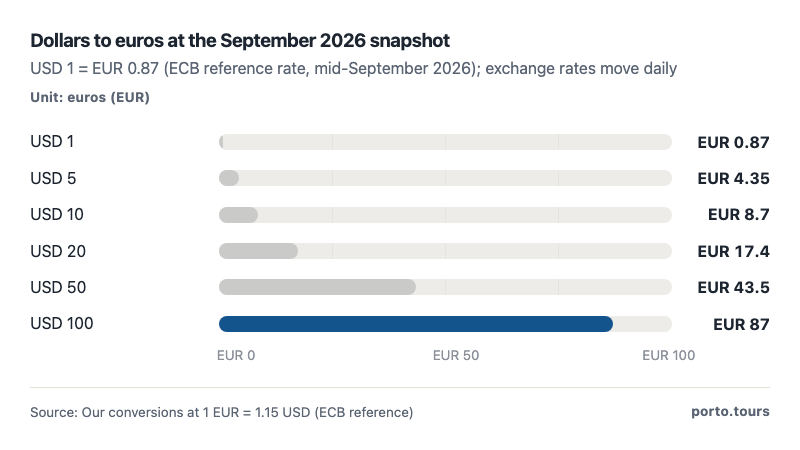
- USD 100 is EUR 87 at the September 2026 snapshot.
- The dollar buys slightly less than one-for-one everywhere in the eurozone.
- Portugal's prices already include VAT - the converted number is the checkout number.
| 1 | 1 | 0.87 |
| 2 | 5 | 4.35 |
| 3 | 10 | 8.7 |
| 4 | 20 | 17.4 |
| 5 | 50 | 43.48 |
| 6 | 100 | 87 |
| 7 | 500 | 434.78 |
| 8 | 1,000 | 869.57 |
| 1 | 1 | 1.15 |
| 2 | 5 | 5.75 |
| 3 | 10 | 11.5 |
| 4 | 20 | 23 |
| 5 | 50 | 57.5 |
| 6 | 100 | 115 |
| 7 | 500 | 575 |
How much money do I need per day in Portugal?
The tiers answer it: EUR 67 for a budget day, EUR 164 mid-range, EUR 385 luxury - or in dollars, 77, 189 and 4434. A week scales to USD 539, 1,323 and 3,101 before intercity transport4. How much money should I bring to Portugal in cash is a different question from how much you need: the answer is a small reserve, not the budget - EUR 200-300 in notes covers a city weekend's cash corners, and EUR 300-plus suits rural stays where small establishments still prefer notes2.
What the daily money buys at mid-range: a 3-star room (USD 69), three restaurant-quality meals, a transport pass (EUR 40 covers unlimited metro and buses) and one paid attraction - the composition the budget donut on the cost page shows in detail4. For residents the same currency answers differently: the EUR 920 minimum wage and EUR 980 net median salary are the local anchors, and EUR 1,591 is the single-person city-centre monthly total the cost-of-living page builds2.
The per-day money question also has a minimum floor worth stating plainly: Portugal's minimum wage of EUR 920 a month is the national income anchor, so a budget traveller spending EUR 67 a day is spending more per day than a minimum-wage worker earns - travel money is relative, and the site's cost-of-living page exists for the resident version of the same arithmetic.
Where the tiers separate is accommodation and restaurants, not transport or sights: a metro pass costs the same to a banker as to a backpacker, Livraria Lello charges both EUR 8, and the pastel de nata is EUR 1.30 for everyone. Portugal's budget spread lives in the bed and the bottle - the two lines a tier choice actually moves2.
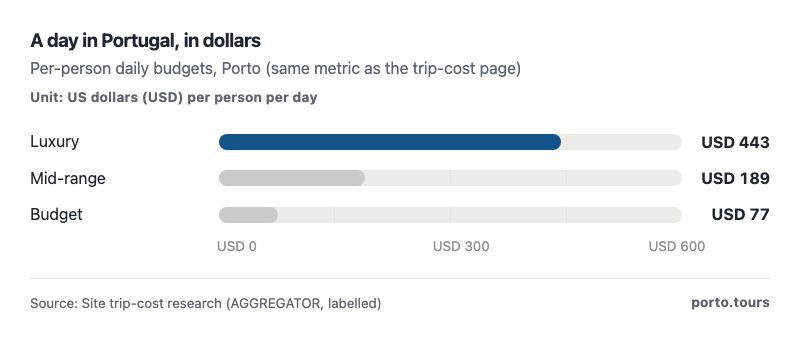
- A budget day costs USD 77 all-in; mid-range USD 189; luxury USD 443.
- The mid-range number is the one most itineraries and this site's planners assume.
- Accommodation is the biggest line at every tier.
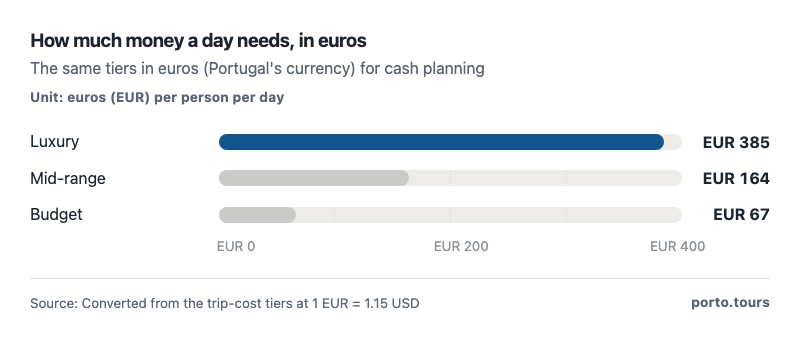
- EUR 67 a day covers a budget traveller's Porto.
- EUR 164 is the mid-range daily euro figure - about EUR 1,150 a week.
- Even the luxury tier sits under EUR 400 a day.
| 1 | Budget | 77 | 67 |
| 2 | Mid-range | 189 | 164 |
| 3 | Luxury | 443 | 385 |
| 1 | Budget | 539 | 1,078 |
| 2 | Mid-range | 1,323 | 2,646 |
| 3 | Luxury | 3,101 | 6,202 |
Cash, cards and the Multibanco rails
How much cash should I take to Portugal: less than instinct suggests. Portugal is a card-first country with a national payment network (Multibanco) that predates the smartphone era - bank-branded ATMs are typically fee-free for withdrawals, contactless works at every cafe counter, and the MB Way app handles peer-to-peer and online payments locally3. Cash still matters in three places: rural tascas, market stalls and the tipping jar - hence the EUR 200 weekend guidance above2.
The ATM strategy for visitors: use bank-branded Multibanco machines (they carry the MB logo), decline the machine's currency conversion (always choose to be charged in euros), and withdraw larger amounts less often to cap any home-bank fixed fees3. Airport exchange kiosks price the worst spreads in the chain - the EUR 100 that costs USD 120 at a kiosk costs USD 115 by card2.
For card-culture visitors from cash countries, the adjustment is trust: Portugal's small merchants take contactless for a EUR 1.20 coffee without blinking. The cash reserve exists for the exception - the market stall, the countryside festival, the tip jar - not for the daily budget2.
How much euro should I bring to Portugal, then: EUR 200-300 in notes answers a weekend, EUR 300-500 covers a rural week where the tascas still prefer paper - and every euro beyond that is exchange-rate exposure you did not need2.
The fee architecture has one more layer: some foreign banks charge their own fixed fee per withdrawal (USD 2-5), which turns many small withdrawals into a tax. The arithmetic favours three larger withdrawals over ten small ones - EUR 200 per ATM visit is the local norm rather than a daily EUR 40 ritual2.
| 1 | City weekend (2-3 nights) | EUR 100-200 |
| 2 | One week city trip | EUR 200-300 |
| 3 | Rural / interior stays | EUR 300+ |
| 4 | Islands | same rules as mainland - euro everywhere |
| 1 | ATMs | bank-branded Multibanco machines are typically fee-free for withdrawals |
| 2 | Cards | Visa/Mastercard contactless accepted nearly everywhere |
| 3 | MB Way | the Portuguese instant-payment app, ubiquitous locally |
| 4 | Currency exchange | skip airport kiosks - card plus ATM beats their spreads |
The tax inside, and the small taxes on top
Every Portuguese price already contains the 23% VAT - no checkout surprises, no state tax added at the register5. The taxes a visitor meets separately are small and few: the EUR 3 per night Porto tourist tax (capped at seven nights, collected at check-in) and the optional tips the site's tipping research prices (EUR 5-10 for a free walking tour guide, EUR 1-2 for housekeeping)5. Both fit inside the cash reserve above2.
For shoppers, the reverse flow exists too: non-EU residents can reclaim most of the VAT on goods exported home - the effective refund about 10-11 points after fees, which the taxes page documents with the thresholds5.
| 1 | Restaurant bill | 23% included |
| 2 | Supermarket goods | 6-23% by category, included |
| 3 | Hotel room | VAT in the rate; tourist tax added separately |
| 1 | Restaurant | 5-10%, cash preferred |
| 2 | Free walking tour guide | EUR 5-10 per person |
| 3 | Housekeeping | EUR 1-2 per night |
| 4 | Taxi | round up |
The euro's history, briefly
Portugal adopted the euro on 1 January 2002, replacing the escudo at the fixed rate of 200.482 escudos to the euro, after three years in which the euro existed as accounting money while escudo notes stayed in pockets1. Monetary policy moved to the European Central Bank - which is why Portuguese mortgage rates track Frankfurt, not Lisbon, and why the currency section of every Portuguese inflation story ends in the same place: the ECB decides, Portugal spends1.
The coins carry Portuguese motifs on their national faces (the royal seals and the armillary sphere), the notes are common eurozone design, and the practical effect twenty-four years on is frictionless: the same cash works in Porto, Paris and - at slightly different price levels - Ponta Delgada2.
The escudo's memory survives in Portuguese slang and price intuitions - older Portuguese still convert mentally at 200 escudos to the euro, which makes a EUR 10 lunch feel like 2,000 escudos and explains the national debate every time prices jump. The euro's critics and defenders agree on the mechanics even where they disagree on the verdict: membership killed the devaluation tool, delivered the lowest interest rates in Portuguese history, and made price comparison with Spain transparent enough to discipline both markets1.
For the traveller this history is invisible except in one place: the coins. Portuguese euro coins carry the country's royal seals and the armillary sphere of the discoveries on their national faces, and a handful of them in your pocket is the cheapest souvenir the country mints2.
| 1 | 1999 | euro becomes Portugal's official currency (book money) |
| 2 | 1 January 2002 | euro notes and coins replace the escudo (200.482 escudos = EUR 1) |
| 3 | Today | ECB sets rates; Portugal has no national monetary policy |
| 1 | Notes | 5, 10, 20, 50, 100, 200 (500 rarely seen) |
| 2 | Coins | 1, 2, 5, 10, 20, 50 cents; 1 and 2 euros |
| 1 | US dollar | about USD 1.15 |
| 2 | British pound | about GBP 0.84-0.85 (varies) |
| 3 | Nigerian naira | converts via EUR/USD and official FX - check a live source |
| 1 | 'Portugal takes dollars' | no - prices and tills are euro-only |
| 2 | 'You need lots of cash' | cards win almost everywhere; small cash reserve is enough |
| 3 | 'Airport exchange is fine' | kiosk spreads are the worst rate in the chain - ATM beats it |
| 1 | Daily budgets in detail | portugal-trip-cost |
| 2 | Living costs (not travel) | cost-of-living-in-portugal |
| 3 | Tourist tax | porto-tourist-tax |
| 4 | Tipping culture | tipping-in-portugal |
Exchanging physical cash, if you must
Some travellers still arrive with dollars or pounds in notes. Portugal's exchange desks cluster at the airport and the downtown bureaus; their spreads run 3-8% against the mid-market rate, which on USD 1,000 means paying EUR 35-90 for the convenience of paper euros immediately2. The bank alternative is slower but fairer: Portuguese banks exchange notes for account holders, and the post office network handles some currency services - both beat the airport kiosk materially3.
The better chain, in order: withdraw euros from a Multibanco ATM with a fee-free card (the spread is the interbank rate), then use cards for everything large. Physical exchange is the last resort - for the inheritance in dollars, the cash-heavy arrival, or the traveller whose bank card failed. Portugal's system assumes electronic money; paper is the exception it still accommodates politely3.
Traveller's cheques are dead technology here - most banks no longer touch them, and the guides have stopped pretending otherwise. Nobody should carry them to Portugal in 20262.
The foreign-transaction fine print
The costs that hide in the card: foreign-transaction fees (typically 0-3% depending on the card), ATM operator surcharges (Multibanco machines are famously free, but non-bank Euronet machines in tourist zones are not), and dynamic currency conversion - the terminal's offer to bill you in dollars at a 4-8% embedded rate. The correct answers, in order: a no-foreign-fee card, bank-branded ATMs, and always choose to be charged in euros3.
For a two-week mid-range trip spending EUR 2,300, the difference between a good card and a bad one is EUR 25-70 - more than the tourist tax, more than all the tips combined, and entirely avoidable with the card chosen before departure2.
The naira and third-currency variants in the search family resolve through the same euro gate: Portugal prices in euros, the euro converts to any currency at the day's rate, and the page's snapshot convention (1 EUR = 1.15 USD) is the reference every other rate derives from. Live cross-rates belong to a converter, not to a page that would be wrong by publication2.
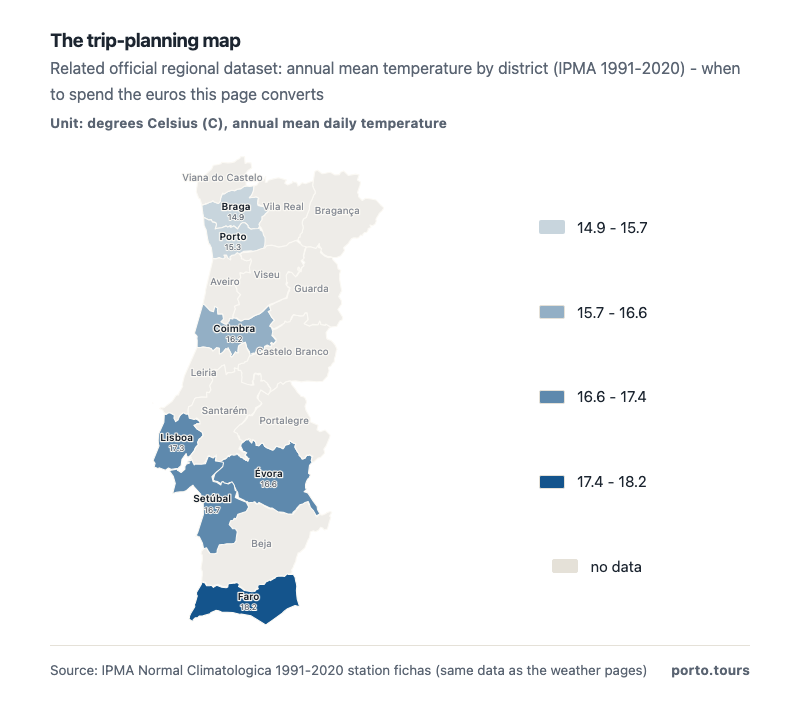
- Porto's 15.3 C annual mean is the mildest-north baseline for the budget plan.
- Faro (18.2 C) is the warmest district - the winter-euros destination.
- The tax-and-euro rules are identical across every district shown.
Conclusions
- The currency is simply the euro - since 2002 - and USD 1 bought about EUR 0.87 at the September 2026 snapshot; every dollar question resolves through that one rate2.
- The daily money answer is tiered and stable: USD 77 budget, USD 189 mid-range, USD 443 luxury per person - EUR 67/164/3854.
- Cash is a small reserve, not the budget: EUR 200 covers a weekend's cafes, markets and tips, while Multibanco ATMs and cards carry the rest fee-cheaply3.
- The prices you see are final: 23% VAT sits inside every shelf price, and the only add-ons a visitor meets are the nightly tourist tax and the optional tip5.
- Portugal's euro membership means no currency risk inside the eurozone and none of the exchange-control friction of its pre-2002 history - the money question is the simplest part of a Portugal trip1.
For visitors, the practical takeaway is that card acceptance is near-universal and contactless is the default in cities, so the amount of physical cash needed on a typical trip is small. ATMs are plentiful and Multibanco is the national network that every bank card participates in. Travellers arriving with dollars or pounds get the best effective rate from card networks and multi-currency accounts rather than airport exchange bureaux, whose spreads add several percent to every conversion.
Methodology
- Exchange snapshot: mid-September 2026
- Payment culture: 2026
- Euro adoption: 1999 (book money) and 2002 (cash)
Definition. Currency: Portugal's legal tender is the euro (EUR), issued under the European Central Bank's monetary authority since 2002. All conversions on this page use the ECB reference rate of 1 EUR = 1.15 USD (mid-September 2026), the site-wide convention.
Data sources. ['European Commission - Portugal and the euro (adoption history) - OFFICIAL', 'Multibanco/payment guides 2026 - GUIDE, labelled', 'Site trip-cost, cost-of-living, taxes, tipping and tourist-tax pages - each labelled on its own page']
Calculations. ['All conversions at the stated snapshot rate', 'Budget tiers converted from the trip-cost research', 'Cash guidance is our synthesis of payment-guide advice, labelled as guidance']
Limitations. ['Exchange rates move daily; the snapshot is stated and dated', 'Individual bank FX spreads and ATM operator fees vary - the guide figures are typical, not guaranteed', 'Naira and third-currency questions are routed through the euro snapshot rather than live cross-rates']
Sources
- European Commission - Economy and Finance. “Portugal and the euro: euro adopted 1 January 2002 after a three-year book-money transition.” European Commission (OFFICIAL), 2026. economy-finance.ec.europa.eu. Accessed 2026-09-16. Back to text
- Porto.tours research. “Conversions at 1 EUR = 1.15 USD (ECB reference, mid-September 2026); cash-guidance framing.” porto.tours, 2026. porto.tours. Accessed 2026-09-16. Back to text
- Multibanco / payment guides (portugalinternet, Wise 2026). “Multibanco fee-free bank ATMs; card and contactless ubiquity; MB Way app.” payment guides (GUIDE, labelled), 2026. portugalinternet.com. Accessed 2026-09-16. Back to text
- Porto.tours trip-cost research. “Daily budgets Porto: USD 77 / 189 / 443 (EUR 67 / 164 / 385); week totals USD 539 / 1,323 / 3,101.” porto.tours/research/porto.tours/portugal-trip-cost/, 2026. porto.tours. Accessed 2026-09-16. Back to text
- Porto.tours research pages. “Tourist tax EUR 3/night; VAT 23% embedded; tipping EUR 5-10 guides; minimum wage EUR 920.” porto.tours pages (labelled), 2026. porto.tours. Accessed 2026-09-16. Back to text
About the author
Tiago Santos is a born-and-bred Tripeiro with nearly a decade chronicling Porto's shifting culinary and cultural landscape - from back-alley petisqueiras to contemporary architecture. A former contributor to Publico's Fugas supplement and Revista Visao, for this guide he turns official statistics and street-level knowledge into research visitors can check and cite.
Every figure on this page links to its source. How we research
Related research
More data on Porto's travel, costs and life from Porto Tours.
- Trip PlanningHow Much Are Hotels in Porto? (2026 Data)USD 69 average 3-star hotel price per night in Porto (2026)Read the research →
- Trip PlanningHow Much Time to Spend in Porto? (2026 Data)2-3 days for Porto - two city days plus a Douro Valley day (2026 consensus)Read the research →
- Trip PlanningHow Much to Ship a Car to Portugal? (2026 Data)USD 2,850-4,850 to ship a container from the USA to Portugal (2026)Read the research →
- Travel PlanningHow Much Does It Cost to Go to Portugal? (2026 Data)$539-$3,101 what a week in Portugal costs per personRead the research →
- Cost of LivingHow Much Does It Cost to Live in Portugal? (2026 Data)EUR 1,591 a month to live in Portugal, single person, city centre (2026)Read the research →
- LanguageHow Much English Is Spoken in Portugal? (2026 Data)612/800 Portugal's EF English Proficiency score - 6th in the world (2025)Read the research →